
School Pressure and What Parents Can Do

Academic pressure from Indian parents in Australia often grows from love, migration sacrifices and community comparison. You can ease it by checking your child's weekly load, praising effort over marks, limiting comparison, keeping rest and play, and talking about many pathways. If stress shows in sleep, mood or health, speak to the school or a GP.
Most Indian parents in Australia who push hard on school do it out of love. Many left careers, families and a familiar life so their children could have more choices. Wanting those children to succeed is natural. The trouble is that pressure meant as support can land on a child as fear.
This page is about reducing academic pressure without giving up on your child's education. It covers where the pressure comes from, how it shows up at different ages, and what helps.
Key takeaways
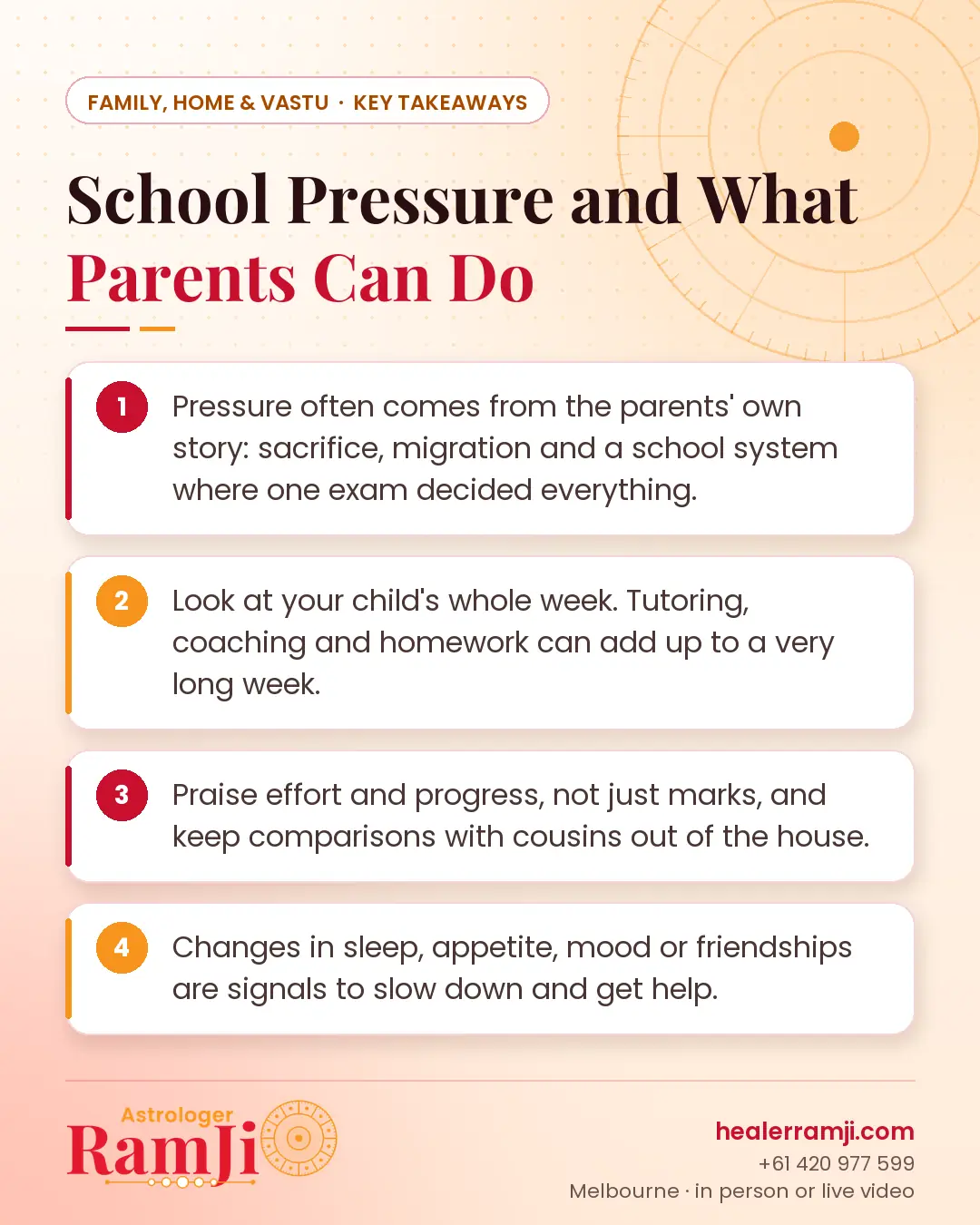
- Pressure often comes from the parents' own story: sacrifice, migration and a school system where one exam decided everything.
- Look at your child's whole week. Tutoring, coaching and homework can add up to a very long week.
- Praise effort and progress, not just marks, and keep comparisons with cousins out of the house.
- Changes in sleep, appetite, mood or friendships are signals to slow down and get help.
Where does the pressure come from?
It rarely starts with the child. Some common sources:
- Your own schooling. Many parents grew up where a single board exam or entrance test shaped a whole life. That fear can travel with you, even though Australian pathways work differently.
- Sacrifice. Children often know what their parents gave up, and they can feel they owe a result in return.
- Community talk. Results get compared at gatherings and in family group chats. A cousin's offer can become a measuring stick.
- Narrow ideas of success. Medicine, engineering, law and IT can be treated as the only safe paths.
- Worry about the future. Housing costs, job security and visa memories can make parents anxious about everything.
Naming your own source of pressure is the first step. It's easier to ease a fear once you know whose fear it is.
How does pressure show up at different ages?
Primary school
The main risk here is overload. Coaching for selective tests, music exams, extra maths and weekend classes can leave little time for unstructured play and rest, which young children need too. Watch for stomach aches before school, tears over homework or a child who has stopped enjoying things they used to love.
Early secondary
Comparison bites harder now. Children notice rankings and start to define themselves as "smart" or "not smart". This is also when they want more independence. The Better Health Channel suggests listening more than you speak, giving teenagers privacy and using "I" statements rather than blame. Those habits keep the door open when marks are disappointing.
Senior years
The stakes feel highest, and so does the risk of burnout. Our article on Year 12 pressure and how parents can help covers this stage in detail. For selective entry worries, see selective school pressure in families.
How do you check whether the load is too much?
Sit down and write out your child's typical week, hour by hour. Include school, travel, homework, tutoring, coaching, music, sport and religious classes. Then look at what's left for sleep, meals, play, friends and doing nothing at all.
If there is almost nothing left, something needs to go. Ask your child which activity they would drop if they could. Their answer is often revealing, and dropping one thing can make them more willing to commit to the rest.
What should you say, and what should you avoid?
Kids Helpline's advice for parents suggests having realistic expectations, not pushing too hard, and listening to concerns after an exam without criticising. In everyday terms:
- Ask "what did you find interesting?" before "what mark did you get?"
- Praise the work that went in, especially when the result was ordinary.
- Avoid "after everything we've done for you". It turns love into a debt.
- Keep cousins, neighbours' children and classmates out of the conversation.
- Tell your child, often, that your love doesn't depend on a score.
If relatives ask about marks, you can answer for your child: "They're working hard, and we're proud of them." Then change the subject.
How can you widen the picture of success?
Children who believe there is only one acceptable career feel every test as a threat to it. Show them the range. myfuture, Australia's national career information service, is a good place to explore occupations and study pathways side by side with your child. Talk about people you know who changed direction, studied later or found work they love in fields you never expected. Our piece on choosing what to study with your family watching looks at this from the young person's side.
When is it more than ordinary school stress?
Kids Helpline lists signs of exam stress that include irritability, trouble sleeping, stomach upsets and losing touch with friends. Take it further if these last, worsen, or come with tears most days, refusal to go to school, or talk of feeling worthless. Speak to the school's wellbeing staff and your GP early. Kids Helpline is free on 1800 55 1800 for young people aged 5 to 25, at all hours, by phone or webchat. Encourage your child to contact them. If your child talks about not wanting to live, stay with them and call 000 if there is immediate danger, or Lifeline on 13 11 14.
Where does astrology fit?
A chart can't predict marks, school offers or a career, and a child under pressure should never be told they are in an unlucky period. If astrology matters in your family, its best use here is for parents, as a way to reflect on how your own temperament meets your child's. Our article on reading a child's chart without labelling them explains the care needed.
A parent and child chart reading stays with temperament and how you relate, with no predictions about your child's future. Vijay Ramji is based in Ascot Vale, appointments are arranged in advance, and sessions can be held by phone, WhatsApp or video. What you share is confidential. If you'd like to talk about your own worries as a parent, get in touch.
Related service
Keep reading
Holding a Namkaran in Melbourne
Planning a namkaran ceremony in Melbourne at home: choosing the day, a running order built around your baby, guests, relatives on video, and registering the name.
Read article →
Setting Up a Small Home Mandir
Home mandir setup for a small apartment: where to place it, what to keep inside, daily care, and how to keep lamps, incense and camphor safe in a tight space.
Read article →
Caring for Ageing Parents From Melbourne
Caring for ageing parents overseas from Melbourne: planning before a crisis, sharing roles with siblings, the visa question, and living with the guilt of distance.
Read article →Quick answers
Should parents get a child's chart read?
A child's chart can be read with care, as a way to reflect on temperament. Here is when it may help, what to avoid, and who to see about real concerns.
Read answer →What is vastu shastra?
Vastu shastra is a traditional Hindu system of home and building design based on direction and layout. Here is what it covers and what it can't claim.
Read answer →Talk to Vijay Ramji
Tell us what you are facing. If a reading is unlikely to help, you will be told that plainly.