
Choosing What to Study With Your Family Watching

When choosing a study field with Indian parents who have strong views, start by understanding their worries, then research the options together using real course and career information. Look for paths that answer both their concerns and your interests. A birth chart can prompt reflection, but it shouldn't settle a family argument about your future.
You like design, psychology or teaching. Your parents talk about medicine, engineering, pharmacy or IT, and every relative at every gathering seems to agree with them. You don't want to disappoint anyone, and you don't want to spend four years and a HECS debt on something you dread.
This page is for students caught in the middle, in Year 11 or 12 or already at uni and wondering about a switch. It is about having the conversation well, not about winning it.
Key takeaways
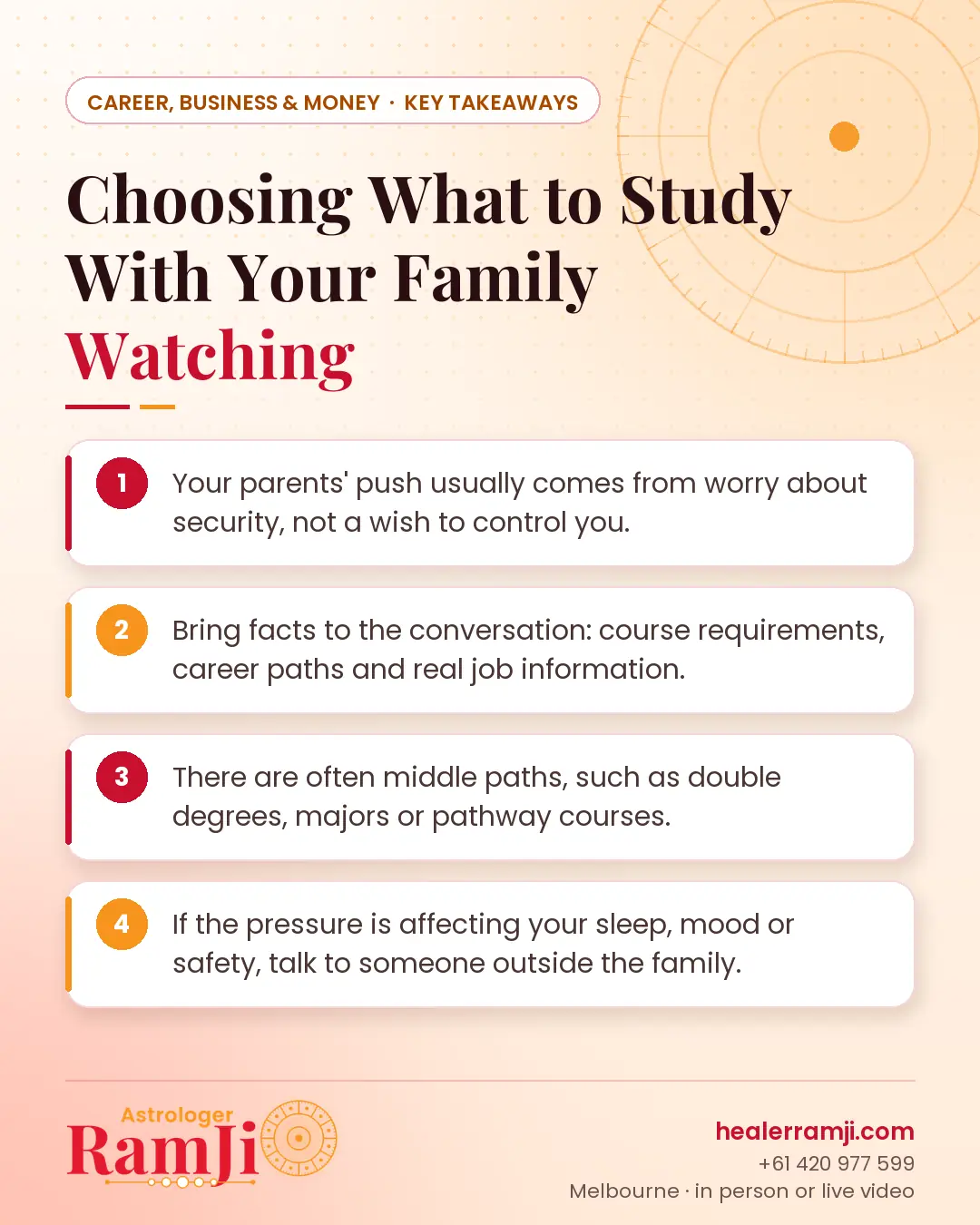
- Your parents' push usually comes from worry about security, not a wish to control you.
- Bring facts to the conversation: course requirements, career paths and real job information.
- There are often middle paths, such as double degrees, majors or pathway courses.
- If the pressure is affecting your sleep, mood or safety, talk to someone outside the family.
Why do Indian parents care so much about the study field?
For many migrant families, a degree was the ticket to a better life. Your parents may have left jobs, family and status behind so that you could study here. A field like medicine or engineering feels safe to them because they have seen it lead to stable work, respect and a visa or a home.
There can be other pressures too. Comparisons with cousins, questions from the community and worry about how you will look after yourself all play a part. None of this makes their view right for you. But it helps to know that "do medicine" often means "please be secure", and you can answer that worry directly.
How do you prepare for the conversation?
Turn up with information rather than just feelings. Before you talk:
- Research the field you want. myfuture, Australia's national career information service, lets you explore occupations, the study that leads to them and the work they involve.
- Find out what jobs it leads to. List three or four actual roles, not just the degree name.
- Know the entry requirements. Prerequisite subjects, ATAR guides and portfolios or interviews if needed.
- Be honest about the risks. If the field is competitive, say what your back-up plan is.
- Learn about their choice too. Show you have looked seriously at the course they prefer and can explain why it doesn't fit.
A calm, prepared student is much harder to dismiss than an upset one.

What could you actually say?
Try to speak to their worry first. For example:
- "I know you want me to have a stable job. Here's what people in this field actually earn and where they work."
- "I've looked at the course you suggested. I'd find it hard to stay motivated for that long, and I think my marks would show it."
- "Can we agree on a plan for the first year and review it together after semester one?"
Choose a quiet time, not the night results come out or during a family function. If one parent is easier to talk to, start there.
Are there middle paths?
Often there are. Families sometimes treat the choice as all or nothing when it isn't:
- Double degrees can pair a "safe" field with one you love, such as commerce and arts, or science and design.
- Majors and electives let you test an interest inside a broader degree.
- Pathway courses, such as diplomas, can lead into a degree later.
- Changing preferences. In Victoria, VTAC opens a change of preference period after results come out, so you can reorder courses. Check VTAC's key dates each year.
- Switching later. Many students change courses after first year. Ask your uni about credit for subjects you have done.
Free advice is also available. Victoria's Skills and Jobs Centres offer career and training guidance, and your school careers adviser knows the local options well. Inviting a parent along to one of these appointments can take the heat out of things.

What if your parents won't budge?
Sometimes the conversation doesn't move. A few things to keep in mind:
- Your relationship with your parents will last longer than this decision. Try not to say things in anger that are hard to take back.
- If you are an adult, the final choice is yours to make. That doesn't make the family side easy, but it is worth remembering.
- A trusted adult, such as an aunt, a teacher or a family friend, may be able to speak to your parents in a way you can't.
- Give it time. Some parents soften once they see you working hard at something you care about.
Parents reading this may find our piece on school pressure and what parents can do useful.
When is it more than a disagreement?
Family tension is normal. But if you can't sleep, can't eat, feel hopeless, or are being threatened or punished, please talk to someone. Kids Helpline offers free counselling for young people aged 5 to 25 on 1800 55 1800, at any hour. You can also talk to your GP, a school wellbeing staff member or your uni's counselling service. Lifeline is on 13 11 14 if you are in crisis.
Can astrology help you choose a course?
In Vedic astrology, the fourth and fifth houses are linked with education and intelligence, and the tenth with career. Readers weigh these differently. A reader may describe broad themes, such as creative work or structured work. That is a tradition of interpretation, not a test of your ability, and it knows nothing about your marks, interests or the job market. Our answer on whether astrology can help you choose a career explains the limits.
Be wary if a chart is being used to end the argument, such as "the chart says engineering". A reading of your chart should happen with your agreement, and its result is something to discuss, not an order. A career timing reading is better suited to questions about when to push and when to prepare, once you have a direction.
Sessions can be held by phone, WhatsApp or video, and what you share stays confidential. If you would like to talk it through, get in touch.
Related service

Keep reading

Choosing a Launch Date for Your Business
How to choose an auspicious date to start a business without missing registration deadlines: two calendars, backup dates, and which moment a muhurat should mark.
Read article →
Which Moment Counts: Registration or Opening Day?
Should a business muhurat mark the registration or the opening? The two views in the tradition, what ASIC rules require, and how to pick the moment you can control.
Read article →
Holding an Opening Puja at Your Melbourne Shop
Planning a shop opening puja in Melbourne? What to ask your landlord, how to avoid a fire alarm call-out, and a checklist of what to prepare for the day.
Read article →Quick answers
Can astrology help me choose a career?
Astrology can prompt useful questions about work, but it can't pick your career. Here is what a chart may suggest, its limits, and who to ask for real advice.
Read answer →Which house shows career in Vedic astrology?
In Vedic astrology, the tenth house is the main house of career. Here is what else a reader looks at, where views differ, and what a chart can't tell you.
Read answer →Talk to Vijay Ramji
Tell us what you are facing. If a reading is unlikely to help, you will be told that plainly.