
Raising Teenagers Between Two Cultures
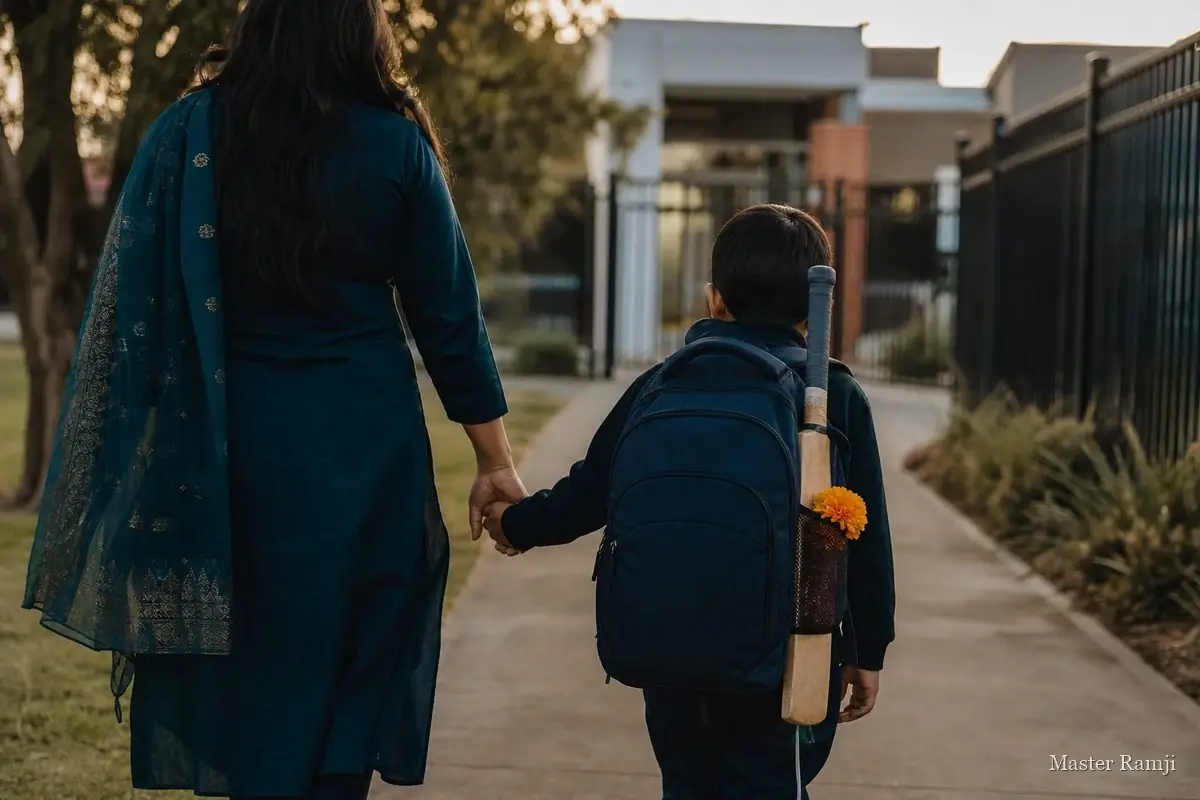
Raising Indian teenagers in Australia works best when parents sort expectations into safety rules, things open to negotiation, and choices that belong to the teen. Expect your child to blend both cultures in their own way. Listen more than you lecture, share why traditions matter to you, and seek help early if mood or behaviour changes.
Many parents who grew up in India remember adolescence as something that happened inside the family. Decisions were made together, or by elders, and the outside world mostly agreed with home. A teenager growing up in Melbourne lives with two sets of expectations at once. At school, independence is praised. At home, closeness and respect may come first. Both are forms of love, but they can pull in opposite directions.
This article looks at the teenage years specifically, when identity, friendships and freedom come to the front, and offers ways to keep the relationship strong through them.
Key takeaways
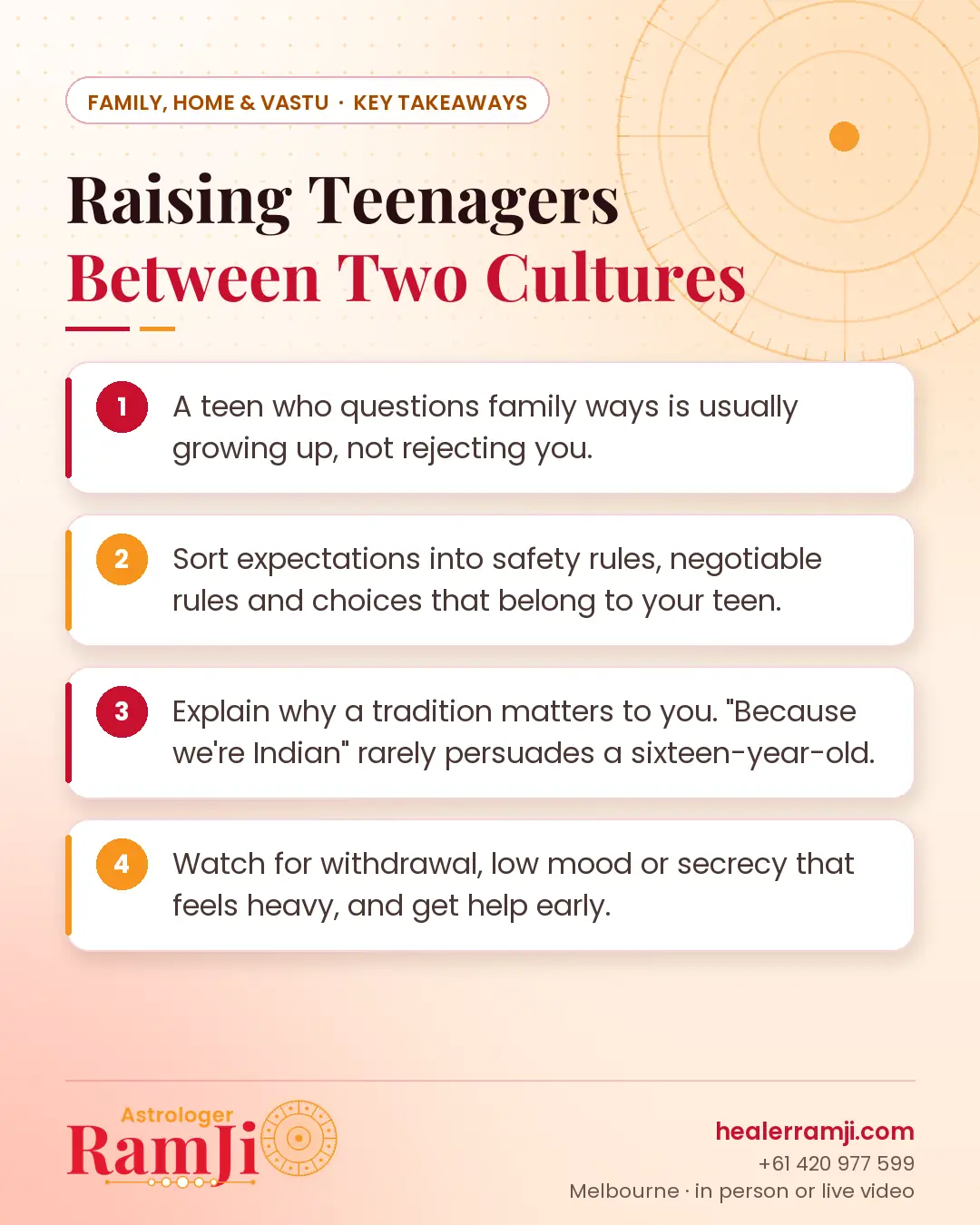
- A teen who questions family ways is usually growing up, not rejecting you.
- Sort expectations into safety rules, negotiable rules and choices that belong to your teen.
- Explain why a tradition matters to you. "Because we're Indian" rarely persuades a sixteen-year-old.
- Watch for withdrawal, low mood or secrecy that feels heavy, and get help early.
Why do the teenage years feel so much harder between two cultures?
All teenagers push for independence. The Better Health Channel notes that young people may develop ideas, values and beliefs different from their parents', and that this is part of the normal move towards adulthood. In a migrant family, that ordinary process can feel like a loss of culture, not just a stage.
Teens feel the squeeze from both sides. Friends may not understand why they can't go to a sleepover, while relatives may say they are "too Australian". Some face racism or teasing at school and keep quiet about it at home. Many end up translating, literally and culturally, for parents and grandparents. It's a lot to carry at fifteen.
For younger children, the challenge is fitting traditions into a school week, as our Point Cook article on balancing school life and family traditions describes. With teenagers, it becomes a question of who they are.
How do you set expectations without constant fights?
It helps to sort your expectations into three groups and to be honest about which is which:
- Safety rules. Knowing where they are at night, no drink driving, no getting into cars with people who have been drinking, and checking in when plans change. These are firm in most families of any background.
- Negotiable rules. Curfews, sleepovers, part-time work, phone use, how often they attend the temple or family events. Agree these together and review them as your teen shows responsibility.
- Their choices. Music, friends, hairstyle, many study and career decisions, and eventually who they love. You can share your view, but these increasingly belong to them.
The Better Health Channel suggests setting reasonable house rules in consultation with your teenager, and seeing different viewpoints as a sign they are learning to be their own person. When a rule really matters to you, say why. "I worry because I don't know these families yet" lands better than "Indian girls don't do that".

What helps a teen hold on to their heritage?
Pressure tends to push teenagers away from tradition. Meaning tends to draw them back. A few approaches that often work:
- Tell your own story. Why did you leave? What did you miss? Which festivals meant the most to you, and why?
- Let them ask hard questions. About caste, gender roles, rituals or God. A tradition that can't be questioned can feel like a cage.
- Let them choose a way in. Some connect through food, others through music, language, dance, sport, volunteering or a grandparent's stories.
- Make room for blending. A Diwali party with school friends, or a bhajan with a modern tune, is still Diwali and still a bhajan.
Your teen's version of being Indian may look different from yours. That isn't failure. It's how culture survives in a new place.
How do you stay connected when they pull away?
The Better Health Channel's advice will sound familiar but is hard to do: listen more than you speak, make time together, give them privacy, keep up with their interests and celebrate what they achieve. Car trips and late-night snacks are often when teenagers talk, because nobody has to make eye contact.
Try to avoid comparison with cousins or other families' children. It is one of the quickest ways to shut a teenager down. Avoid the question "what will people say?" too. Your teen hears that the community's opinion matters more than they do.
Dating is often the hardest topic. Many teens hide relationships because they expect anger. If you would rather know than not know, say so calmly and early, and focus on safety and respect rather than permission. Our article on telling parents about a relationship looks at this from the young person's side.

When should you get help?
Seek help if your teen seems withdrawn or low most days, stops eating or sleeping well, drops friends or activities, talks about hopelessness or self-harm, or seems frightened of someone. Talk to your GP or the school's wellbeing staff. Kids Helpline has a section for parents, and young people aged 5 to 25 can call Kids Helpline themselves on 1800 55 1800, free and at all hours. If anyone is in immediate danger, call 000.
If conflict at home has become frightening or violent, call 1800RESPECT on 1800 737 732.
Where does astrology fit?
Some parents find a child's chart helpful for reflecting on temperament, such as a teen who needs time alone or one who needs to talk things out. It should never be used to label a teenager, choose their career or decide their marriage. Our article on reading a child's chart without labelling them explains why. If your teen is old enough, ask them before you have their chart looked at.
A parent and child reading is a conversation for you, the parent, about patience and understanding, and it makes no predictions about your child's future. Any fee is stated before paid work begins, and sessions can be held by phone, WhatsApp or video. If it would help, get in touch.
Related service
Keep reading

Reading a Child's Chart Without Labelling Them
A parents' guide to a child's horoscope reading: why children should never hear bad predictions, which labels do harm, and what to say if they already have.
Read article →
School Pressure and What Parents Can Do
Academic pressure from Indian parents in Australia often comes from love and sacrifice. How to ease it at each stage of school while still backing your child.
Read article →
Holding a Namkaran in Melbourne
Planning a namkaran ceremony in Melbourne at home: choosing the day, a running order built around your baby, guests, relatives on video, and registering the name.
Read article →Quick answers
Should parents get a child's chart read?
A child's chart can be read with care, as a way to reflect on temperament. Here is when it may help, what to avoid, and who to see about real concerns.
Read answer →What is vastu shastra?
Vastu shastra is a traditional Hindu system of home and building design based on direction and layout. Here is what it covers and what it can't claim.
Read answer →Talk to Vijay Ramji
Tell us what you are facing. If a reading is unlikely to help, you will be told that plainly.