
Griha Pravesh in Point Cook: Planning Around Settlement
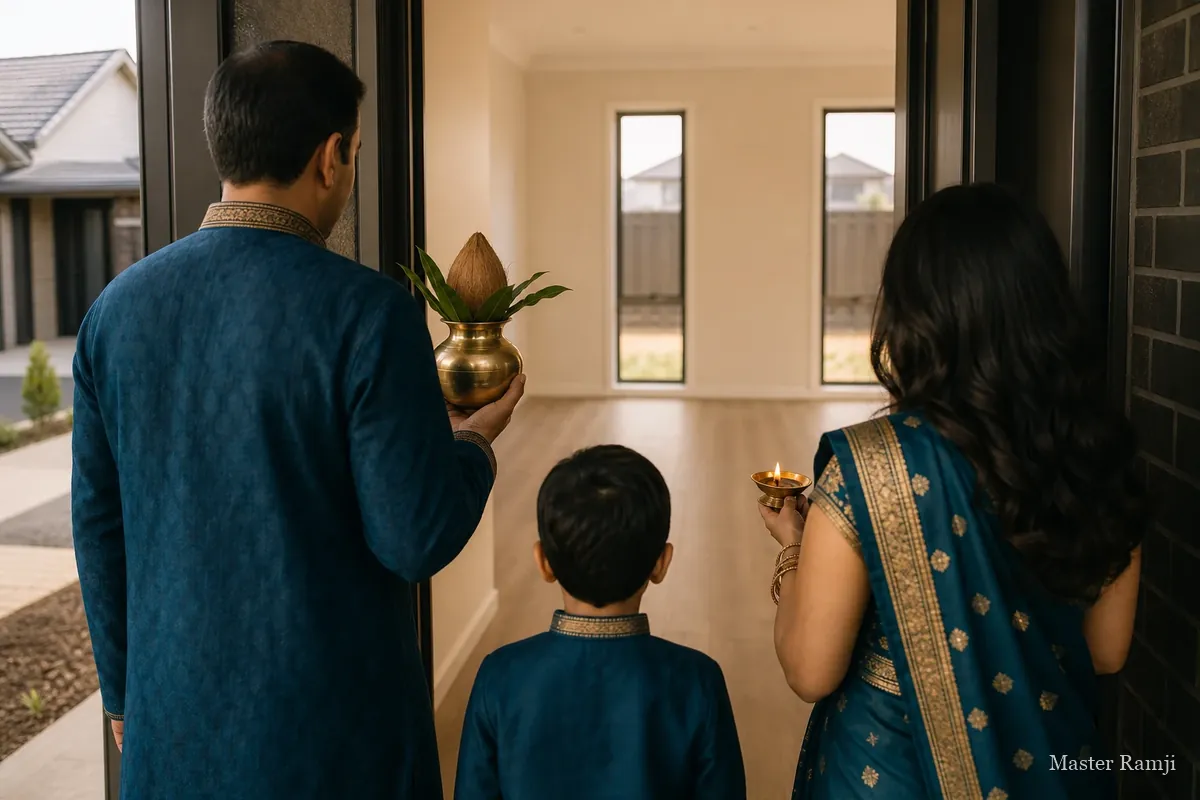
For griha pravesh in Point Cook, fix your settlement date first, because the contract sets it. Then ask for several suitable muhurat options after you expect the keys, and book the removalists around your chosen one. Keep a buffer, since settlement times can slip. The rite is a family tradition, not a legal or financial step.
Point Cook was mostly rural until the mid-1990s. Victorian Places records home building from the late 1990s around Sanctuary Lakes, on former salt-harvesting lagoons, and then rapid growth to the west and south. ABS figures from the 2021 census show close to 10,000 residents born in India, the largest overseas-born group. So plenty of households here want to mark a new home properly.
The trouble is that a griha pravesh in Point Cook has several timetables to fit. Your settlement date comes from a contract, your removalists from their booking sheet, your priest from their diary, and your muhurat from the panchang. This guide is about fitting those four together.
Key takeaways
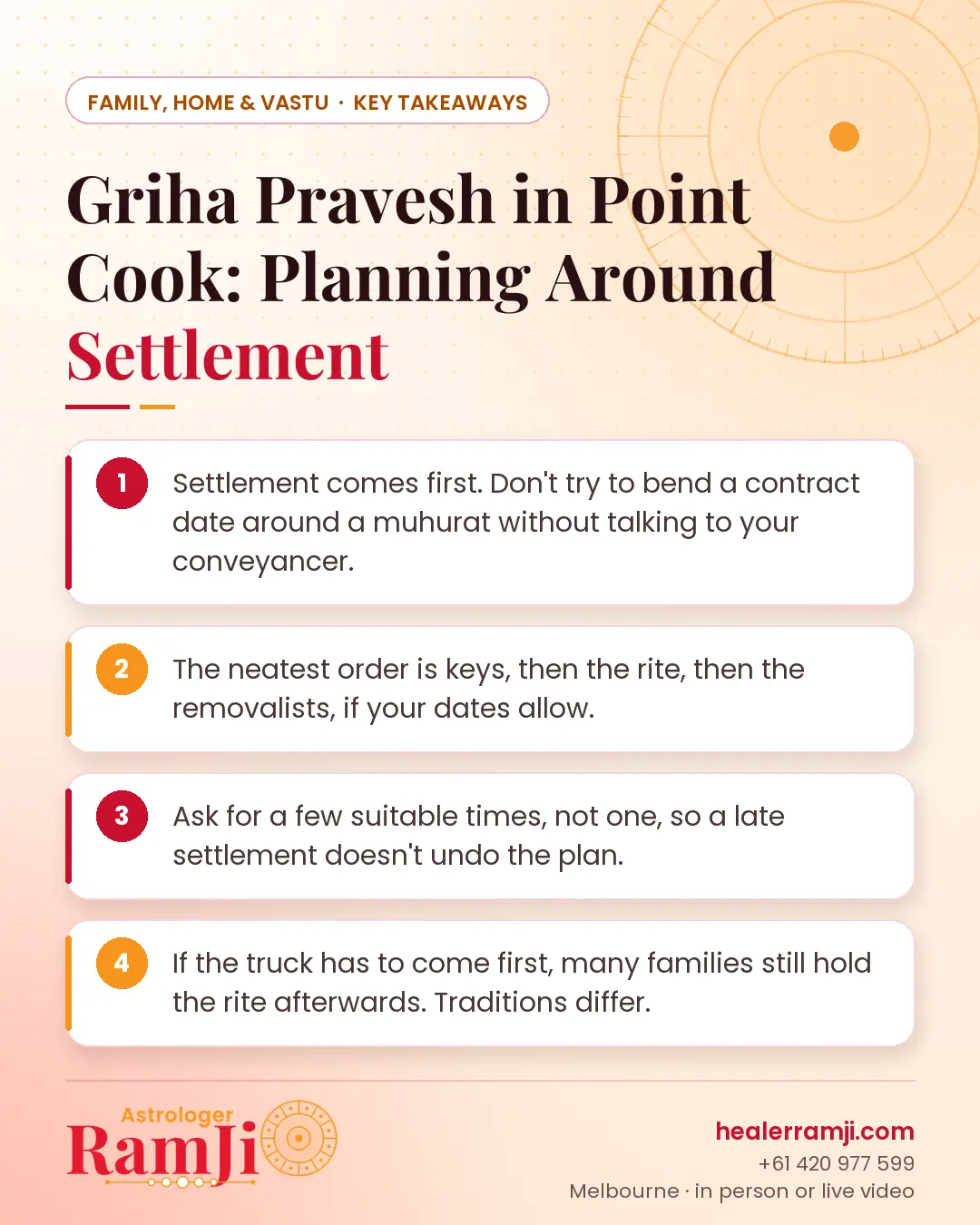
- Settlement comes first. Don't try to bend a contract date around a muhurat without talking to your conveyancer.
- The neatest order is keys, then the rite, then the removalists, if your dates allow.
- Ask for a few suitable times, not one, so a late settlement doesn't undo the plan.
- If the truck has to come first, many families still hold the rite afterwards. Traditions differ.
What actually happens on settlement day?
Consumer Affairs Victoria explains that the seller sets the settlement date in the contract of sale. Settlement is usually handled between the legal practitioners or conveyancers and the lenders, so you probably won't be in the room. Most Victorian settlements now happen online. Once it is complete, you can collect the keys from the agent.
Two things follow. First, the hour isn't really yours. A settlement booked for the afternoon may finish later, and your phone call may come at closing time. Don't book a priest for that same afternoon. Second, the date is not a casual one. Missing it can bring penalty interest and other consequences, so talk to your conveyancer before asking for any change. A muhurat isn't a good enough reason to take that risk, and we can't give you legal advice on it.

Can you do the rite before settlement?
Plan on no. Until settlement is done, the home is not yours to use. Buyers can usually inspect in the week before settlement, but that visit is for checking the property's condition with the agent, not for a ceremony. If it means something to you, say a quiet prayer in your own mind while you're there, and save the rest for later.
How do you fit it between the keys and the removalists?
If your dates give you any room, work through it in this order:
- Confirm the settlement date with your conveyancer.
- Ask for muhurat options. Request several times in the days after settlement, ranked if you like. A griha pravesh timing reading or a broader muhurat selection can give you this.
- Book your priest, or the elder who will lead, as soon as you've chosen. Popular dates can fill up. Finding a priest who knows your family's tradition can take time in the west.
- Book the removalists for after the rite, ideally the next day or two, with a little slack.
- Check power and water are connected in your name in time for the day. Allow time for a clean as well.
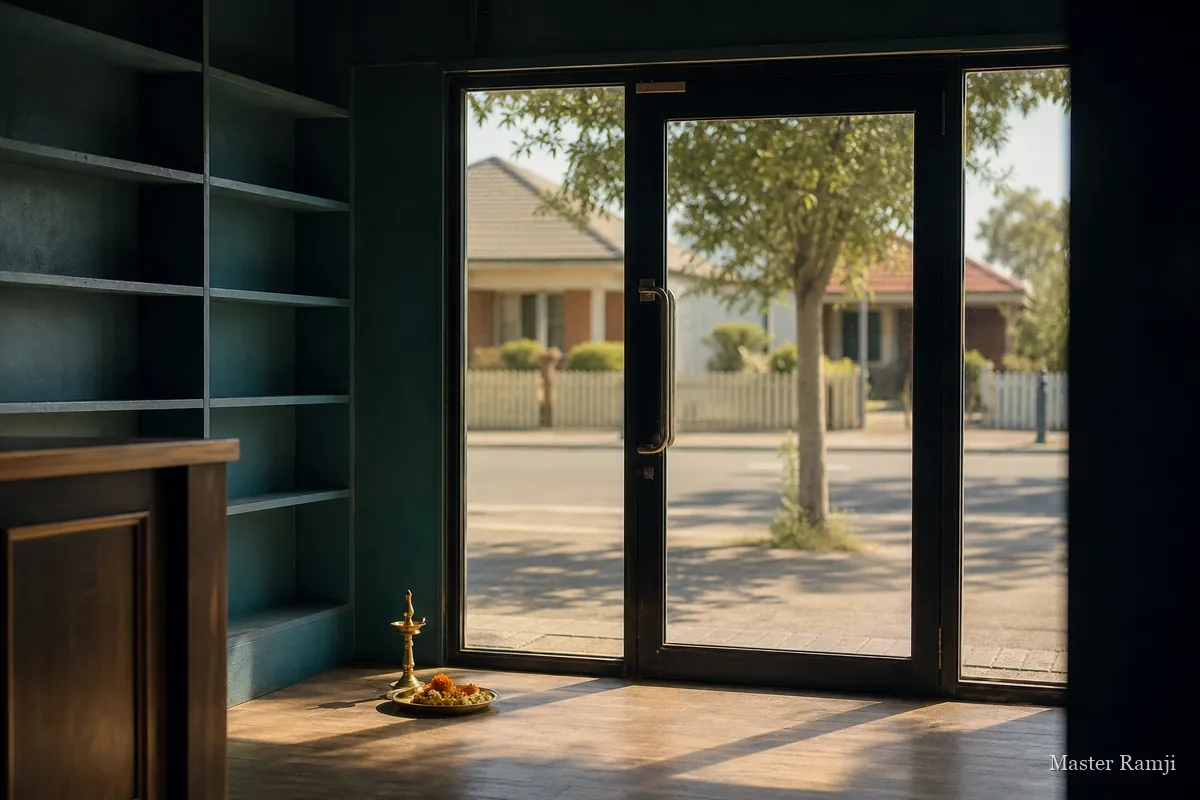
- Hold the rite in a clean, nearly empty home, carrying in just the lamp, the kalash, a pot and whatever your family's practice needs.
- Move in once it's done.
As a purely generic example, a family settling on a Thursday might collect keys that afternoon, clean on Friday, hold the rite on Saturday morning and have the truck on Monday. Your own muhurat may not sit so neatly, but the shape is the point.
What if the truck has to come first?
This is common. A lease may end on settlement day, or the only suitable muhurat may be weeks away. You have a few options:
- Overlap your lease by a week or so, if the cost is manageable.
- Move boxes into the garage and leave the rooms largely empty until the rite.
- Move in fully and hold the rite later. Many families do. Some bring a lamp and an image in first, as a small first step.
Some households won't sleep in the home before the rite. Others aren't troubled by it. Ask your elders what your family has always done, and don't let anyone frighten you over a date you couldn't control. A home isn't cursed by a removalist's schedule. For a wider view of the tradition, see griha pravesh in Australia.

How is the muhurat chosen?
Traditions commonly distinguish between a first entry into a newly built home (often called apurva), a return to a home after a long absence, which some also use for an existing home (sapurva), and re-entry after major repairs (dvandva). Definitions vary. So a first-time entry into a new house in Saltwater Coast may be treated differently from a resale in Sanctuary Lakes, depending on your family's practice.
Many astrologers look for the waxing fortnight (shukla paksha) and particular tithis and nakshatras. Many avoid Chaturmas, Pitru Paksha, adhik maas and eclipses, though regions differ on these. Timing should be worked out for Melbourne, using local sunrise and allowing for daylight saving, not copied from a calendar printed for India. It's a matter of faith and custom. It can't affect your home's value, your loan or your family's health.
Does a new build change the plan?
Yes. In newer estates such as Saltwater Coast, Featherbrook and Alamanda, you may have bought land and contracted a builder separately. In that case, the date that matters is handover, not land settlement, which may have been months earlier. Before planning anything, ask your builder about the occupancy permit or certificate of final inspection, and don't assume you can move in or hold a rite until you have the home legally. Handover dates can slip, so ask for your muhurat options once you have a firm date.

What should you plan for in Point Cook itself?
- Getting the truck in. Some estate streets are narrow and fill with parked cars. Warn your removalists, and give your new neighbours a friendly heads-up.
- Owners corporation rules. Some townhouses and estates have an owners corporation. Ask for the rules before organising a large gathering or anything outdoors.
- Guests. Most people will drive in via the Princes Freeway and Point Cook Road, so allow for traffic on a weekday morning muhurat. Williams Landing is the nearest station for many homes, and older relatives may need a lift from there.
How do you keep the flame and the milk safe?
The CFA advises keeping candles, incense and oil burners at least a metre from anything that can catch fire, and never leaving them unattended. A nearly empty house helps, but new curtains and packing boxes don't. Smoke from a havan or even incense can set off alarms, so open windows and keep the fire small. Don't disable an alarm. Our guide to havan at home goes into detail, and outdoor flames need a check of fire danger ratings first.
If your family boils milk as part of the rite, test your cooktop beforehand. Some newer homes have induction, and a traditional pot may not work on it. Keep a compatible pot ready, and remember boiling milk needs watching with children about.

What can the rite do, and what can't it?
A griha pravesh can give your family a shared moment of gratitude and a sense of beginning. It's a belief and a custom. It doesn't replace building inspections, insurance or legal advice, and nobody should use it to pressure you into extra paid rituals.
Sessions can be held by phone, WhatsApp or video, and fees are stated before paid work. For more about this side of the city, see our page on Melbourne's western suburbs. If you have a settlement date and want a set of times to work with, please get in touch.
Related service

Keep reading

Vastu for New Homes in Armstrong Creek and Geelong
Building in Armstrong Creek or buying on the Bellarine? A vastu guide for Geelong's new estates and coastal homes, covering lot shape, water, wind and overlays.
Read article →
Vastu When Your Southbank Apartment Faces the Wrong Way
Is a south-facing Southbank apartment bad in vastu? Why fixed facing is no catastrophe, what the tradition says, and what you can sensibly change in a tower.
Read article →
Year 12 Pressure in Mill Park Families
Is VCE stress weighing on your teen in Mill Park? Practical ways parents can ease Year 12 pressure, the warning signs to watch, and where to find local support.
Read article →More from Melbourne's Western Suburbs
Finding Your Spiritual Community in Wyndham
Living in Tarneit, Point Cook or Werribee? How to find a Hindu spiritual community in Wyndham, keep up your practice, and get support when you feel alone.
Read article →
Planning Hindu Last Rites From Melbourne's West
A gentle guide for families around Werribee after a death: who to call first, Victorian certificates and cremation paperwork, and questions about Hindu rites.
Read article →
New to Tarneit: Settling In as a Young Indian Family
Moving to Tarneit with young children? Set routines that last, answer family expectations from overseas, and find free local help for parents.
Read article →Local pages
Astrologer for Footscray
Live in Footscray? Vijay Ramji is based in Ascot Vale, with sessions by phone, WhatsApp or video. Questions that fit apartments, study, shops and mixed families.
View area →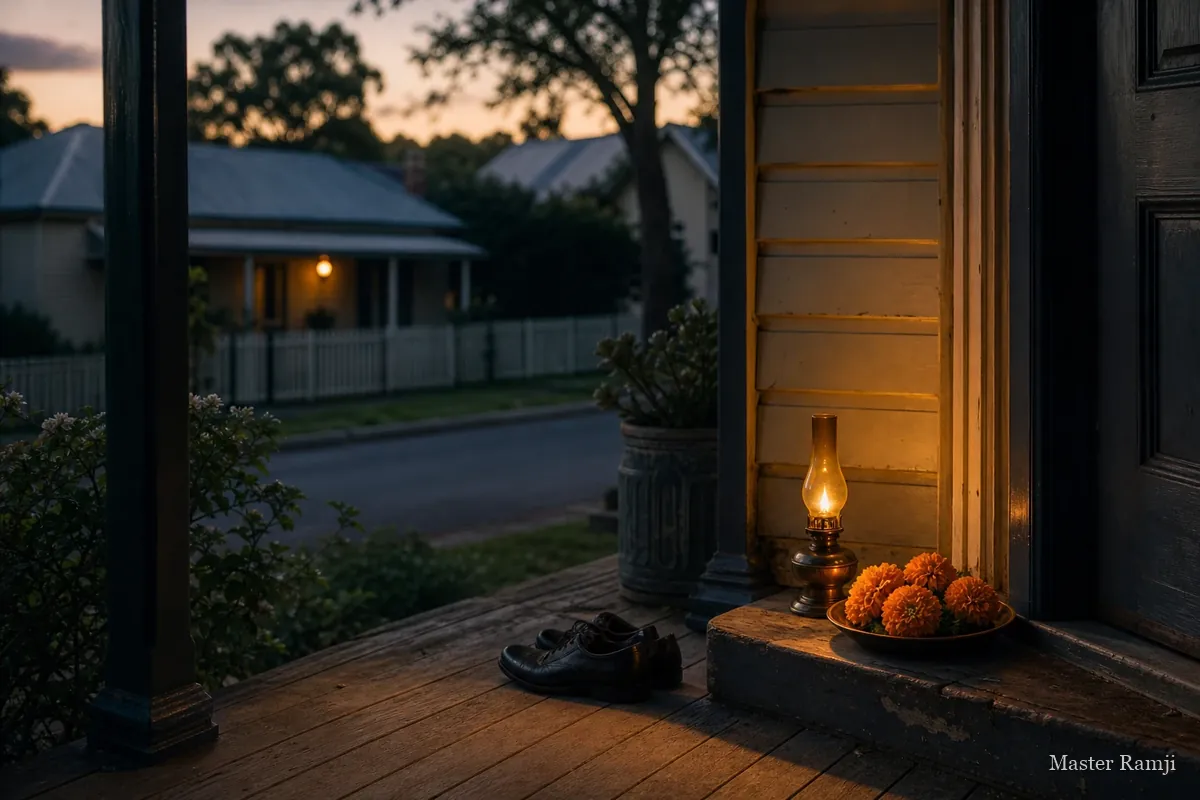
Astrologer for Sunshine
In Sunshine, Victoria? Vijay Ramji is based in Ascot Vale, with sessions by phone, WhatsApp or video. Questions about older homes, changing work and family.
View area →Astrologer for Werribee
Live in Werribee? Vijay Ramji is based in Ascot Vale, with kundli readings by phone, WhatsApp or video. Questions for long-settled families and new arrivals.
View area →Quick answers
What is griha pravesh?
Griha pravesh is a Hindu housewarming ceremony held when moving into a home. Here is what usually happens and how families fit it around a move in Australia.
Read answer →Is griha pravesh needed for a rented home?
A griha pravesh isn't strictly needed for a rented home, though many families choose a simple version. Here is what a short ceremony can look like.
Read answer →Talk to Vijay Ramji
Tell us what you are facing. If a reading is unlikely to help, you will be told that plainly.