
Extended Family Arguments: A Plan for Hoppers Crossing Homes

When relatives stay long term in a Hoppers Crossing home, most arguments come from unspoken expectations about money, chores, space and parenting. Agree a few clear house rules early, review them regularly, and give every adult a fair say. If arguments involve fear, threats or control over money, contact family violence or elder abuse services.
Living with extended family is normal in many Indian households. Parents come from India for long stays, a brother's family moves in while they find their feet, or a grandparent joins the household for good. It can be a great gift: more hands, more love, children who know their elders.
It can also mean more arguments. This page offers a practical plan for agreeing house rules when relatives are staying for months or longer, so that small frictions don't turn into lasting resentment.
Key takeaways
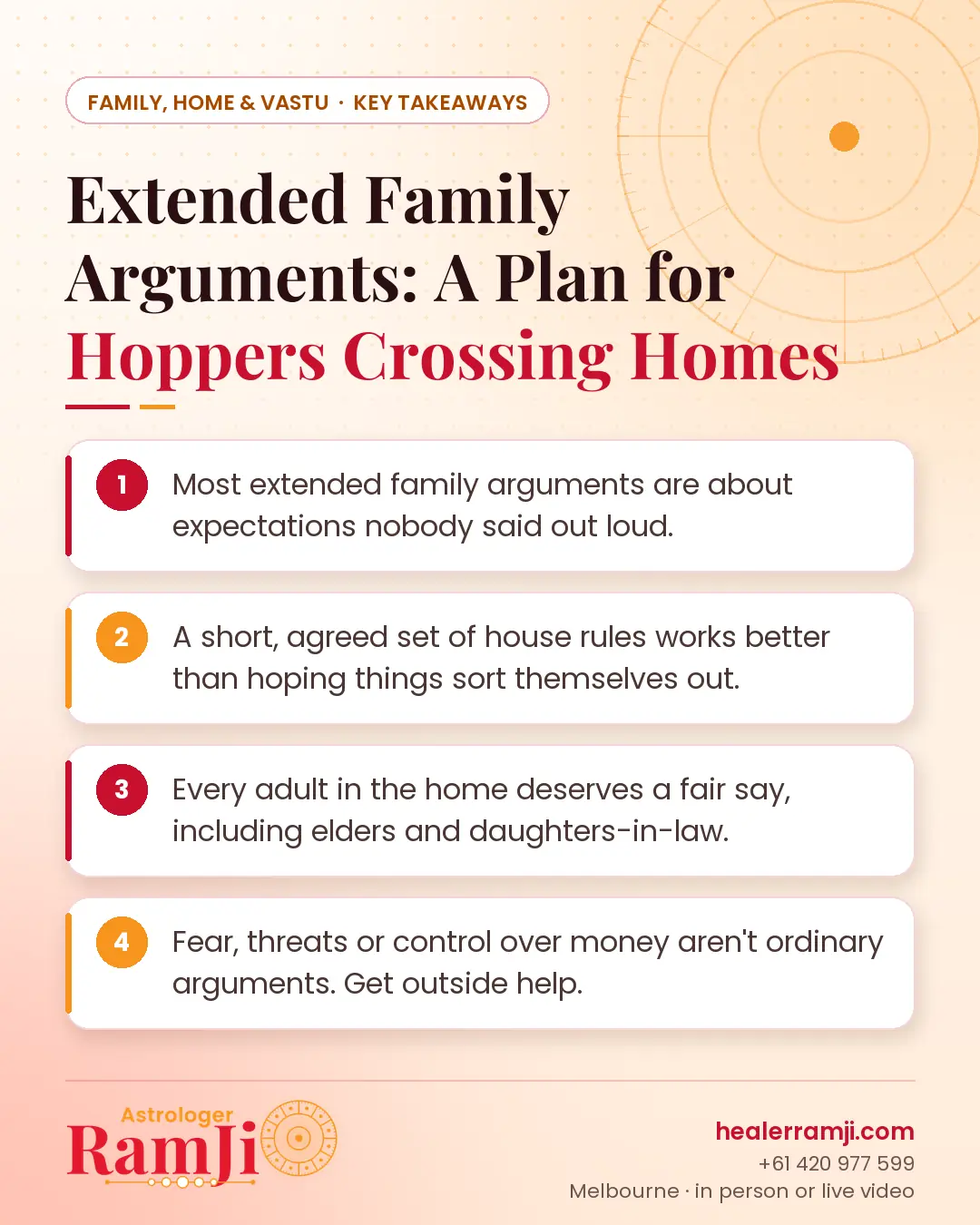
- Most extended family arguments are about expectations nobody said out loud.
- A short, agreed set of house rules works better than hoping things sort themselves out.
- Every adult in the home deserves a fair say, including elders and daughters-in-law.
- Fear, threats or control over money aren't ordinary arguments. Get outside help.
Why do long stays get tense in a suburban house?
Hoppers Crossing is an established family suburb. Victorian Places describes it as a residential suburb immediately east of Werribee, about 25 km south-west of central Melbourne in a straight line, where residential subdivision began in 1963 and growth took off in the 1970s. It also notes that land prices have been relatively modest for first home buyers, which is one reason many young families settled here.
A house bought for a couple and their children can feel very different with three or four more adults. One bathroom in the morning rush, one kitchen with two cooks, one TV, one car. None of that is anyone's fault. But daily friction builds, and it often comes out as arguments about something else entirely.
What do extended family arguments usually come down to?
In many homes, the same themes come up again and again:
- Money. Who pays for groceries, power, petrol and phone plans? Is anyone expected to send money to India?
- Chores. Who cooks, cleans and does the school run? Is the load fair, or does it fall on one person?
- Parenting. Grandparents may have firm views on food, screen time or discipline that differ from the parents'.
- Privacy. Couples may have no private space to talk, and teenagers may have lost their room.
- Decision making. Whose house is it, and who has the final word?
If the main strain is between a spouse and their in-laws, our guide to living with in-law tension looks at that relationship in more depth.
How do you agree house rules without offending anyone?
Rules can sound cold in a family. It helps to frame them as "how we'll make this work for everyone" rather than a list of complaints. A simple process:
- The couple talks first. Agree between yourselves what matters most, so you don't argue in front of relatives.
- Pick a calm time. A weekend meal is better than a heated moment after work.
- Start with thanks. Acknowledge what each person brings to the house.
- Cover the big five: money, chores, children, privacy and visitors. Keep it short.
- Write it down, even informally, and stick it on the fridge if that suits your family.
- Set a review date. Agree to check in after a month, and again whenever circumstances change.
Use plain, specific words. "Everyone helps" leads to arguments. "Mum cooks dinner on weekdays, we cook on weekends, and the kids clear the table" doesn't.
How should elders be included?
Older relatives sometimes feel like guests in a house that isn't theirs, especially if they've given up a home and a social life in India. They may not speak much English, may not drive, and may depend on the family for everything. That loss of independence can make them sharper in arguments.
Give elders real roles and real choices: a say in meals, time with grandchildren on their terms, and their own money if possible. Help them find a local seniors group, temple or language group, so the household isn't their whole world. If you're caring for ageing parents, our piece on looking after elderly parents has more ideas.
When is it more than an argument?
Ordinary family arguments are loud and uncomfortable, but everyone stays safe and free to disagree. It's different when someone is frightened, controlled or harmed. Watch for:
- Someone being kept from money, a phone, documents or friends.
- Threats, hitting, pushing or breaking things.
- Pressure on an older person to sign over money or property, or to hand over their pension.
- An elder being neglected, ignored or treated as a burden.
- A daughter-in-law being blamed, isolated or threatened, including over dowry or visas.
Seniors Rights Victoria explains that elder abuse can be financial, emotional, physical, sexual or neglect, and that it's most often carried out by someone the older person knows, often a family member. Its confidential helpline is 1300 368 821, for Victorians aged 60 and over, or Aboriginal and Torres Strait Islander Victorians aged 45 and over.
For family violence, Safe Steps runs a 24/7 Victorian crisis line on 1800 015 188. You can also call 1800RESPECT on 1800 737 732. If anyone is in immediate danger, call 000.
A spiritual reading is never a substitute for safety. No ritual should be used to keep someone in a harmful situation.
What can you do when the arguments keep coming back?
Some families get stuck in the same fight for months. A few steps help:
- Take a break from the topic and agree to revisit it on a set day.
- Bring in a respected neutral person, such as a family elder outside the house or a community leader.
- Try family counselling. A GP can point you to local services.
- Talk honestly about how long the stay will last. An end date, even a flexible one, can ease pressure on everyone.
If arguments are wearing down your marriage, guidance for marriage difficulties can help you think through what you and your partner each need.
Can family harmony guidance help?
For some families, a calm outside conversation rooted in shared tradition makes it easier to talk. Family harmony guidance focuses on communication, realistic expectations and simple practices the household can share. Astrology is a tradition and a belief, not a science. It can't decide who is right, and it shouldn't be used to blame one person.
Sessions can be held by phone, WhatsApp or video, and what you share is confidential. Read more about our work in Melbourne's western suburbs, or get in touch when you're ready.
Related service

Keep reading
Does Vastu Change in the Southern Hemisphere?
In Melbourne the midday sun sits in the north, not the south. Here is what that means for vastu in Australia and how practitioners differ in their approach.
Read article →
Vastu for a Melbourne Apartment
You can't move the kitchen or front door in a strata apartment. Here is what vastu for apartments can realistically involve within owners corporation rules.
Read article →
Vastu Fixes That Work in a Rental
Vastu tips for a rental home in Victoria: what you can move, what renters may install without permission, what needs consent, and what to leave alone.
Read article →More from Melbourne's Western Suburbs

Vastu for a New Build in Tarneit
Building in Tarneit? When to raise vastu with a volume builder, what to ask for first, and how to get changes in writing before the slab is poured.
Read article →
Choosing a Block in Truganina With Vastu in Mind
Buying land in Truganina? How to weigh vastu on an estate plan you cannot change: road-facing direction, lot shape, easements, covenants and floor plan choices.
Read article →
Griha Pravesh in Point Cook: Planning Around Settlement
Planning griha pravesh in Point Cook? How to fit the rite between settlement day, keys and the removalists, without letting a muhurat run your contract.
Read article →Local pages
Astrologer for Footscray
Live in Footscray? Vijay Ramji is based in Ascot Vale, with sessions by phone, WhatsApp or video. Questions that fit apartments, study, shops and mixed families.
View area →
Astrologer for Sunshine
In Sunshine, Victoria? Vijay Ramji is based in Ascot Vale, with sessions by phone, WhatsApp or video. Questions about older homes, changing work and family.
View area →
Astrologer for Werribee
Live in Werribee? Vijay Ramji is based in Ascot Vale, with kundli readings by phone, WhatsApp or video. Questions for long-settled families and new arrivals.
View area →Quick answers
What is vastu shastra?
Vastu shastra is a traditional Hindu system of home and building design based on direction and layout. Here is what it covers and what it can't claim.
Read answer →Can vastu be applied in a rental?
Yes, vastu can be applied in a rental if you stick to reversible changes. Here is what to try first and what Victorian renters should check.
Read answer →Talk to Vijay Ramji
Tell us what you are facing. If a reading is unlikely to help, you will be told that plainly.