
Living With In-Law Tension

To deal with in-law problems, agree on boundaries as a couple first, then let each partner raise issues with their own parents. Keep boundaries about your own actions, say them kindly and repeat them calmly. Protect private time as a couple. If anyone is threatened, controlled or financially exploited, it is no longer tension and needs outside help.
For many couples, living with or near in-laws is a matter of love and duty, not a choice they resent. Grandparents help with the children, meals appear, and nobody is alone. Yet the same closeness can wear on a marriage, especially when nobody is quite sure whose rules apply in whose house.
This article is about the in-law relationship itself: the partner caught in the middle, the conversations that never quite happen, and how to set boundaries without starting a family war. For the practical side of sharing space, see our guide to sharing a home with three generations.
Key takeaways
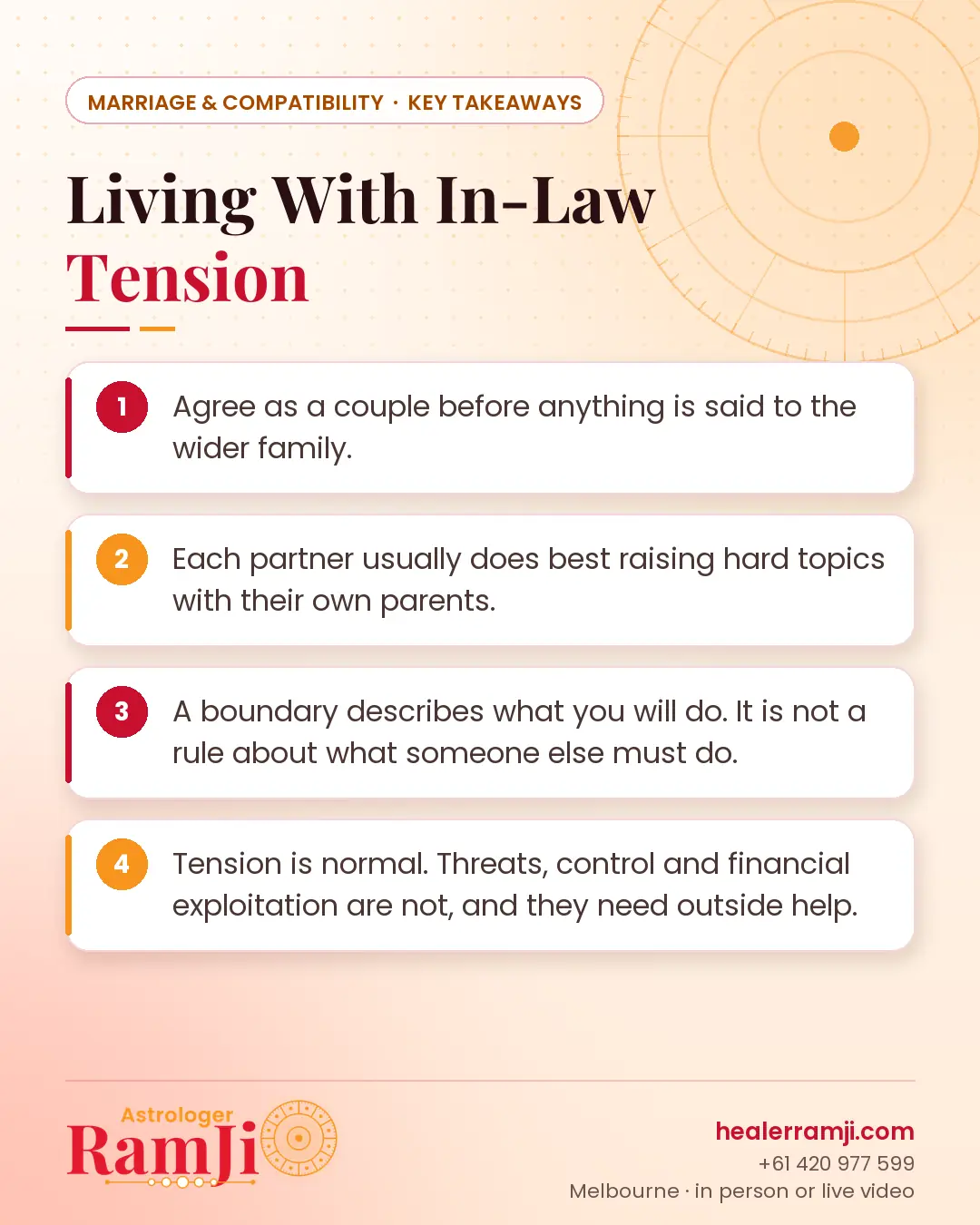
- Agree as a couple before anything is said to the wider family.
- Each partner usually does best raising hard topics with their own parents.
- A boundary describes what you will do. It is not a rule about what someone else must do.
- Tension is normal. Threats, control and financial exploitation are not, and they need outside help.
Why do in-law problems hit a marriage so hard?
Because they rarely stay between two people. A comment about cooking, a grandparent overruling a bedtime, or advice about having another baby lands on one spouse, while the other is torn between their partner and the parents who raised them. When that partner stays quiet to keep the peace, the spouse can feel unprotected. When they speak up, their parents can feel rejected.
Underneath, there are often different ideas about family. In some households, a married son's home is still part of his parents' household. In others, the couple is seen as a new unit. Neither view is wrong, but living with both at once, without saying so, is where most of the friction comes from.
What is a boundary, and what isn't?
A boundary is a limit you set on your own behaviour, time or space. "I'm not going to discuss our finances at dinner" is a boundary. "Your mother must stop asking about money" is a demand, and you can't enforce it.
Good boundaries in a shared home tend to be:
- Specific. "We put the children to bed at 8" works better than "please respect our parenting".
- Few. Choose the two or three that matter most. A long list feels like an attack.
- Agreed by both partners. A boundary that only one of you believes in will collapse the first time it is tested.
- Kind in tone. You can be firm and warm at the same time.

Who should speak to the in-laws?
In most families, it works best when each partner handles their own parents on difficult topics. A parent can hear something from their own child that would sound like an insult from a son- or daughter-in-law. That doesn't mean one spouse never speaks. It means the harder conversations are led by the person with the longest history of love.
Agree on the message together first, in private. Then the partner who speaks should present it as a joint decision: "We've decided", not "She wants".
What can you actually say?
A few phrases that hold a line without picking a fight:
- "You raised us well. We're doing this part a bit differently, and we'd like you to back us up in front of the kids."
- "I need to talk with my husband first. I'll come back to you tomorrow."
- "I'm glad to cook on weekends. On work nights I need that hour to rest."
- "We're not ready to talk about another baby. We'll tell you when there's news."
Expect to repeat yourself. A boundary is usually tested a few times before it settles. Keep your voice calm and your answer the same. You don't need to win the argument, only to hold your ground.

Which areas need boundaries most?
In multi-generational homes, the same flashpoints come up again and again:
- Parenting. Agree that parents make the big calls, while grandparents have freedom in small things when they are in charge.
- Privacy. The couple's bedroom, phones and arguments should stay private. Disagreements belong behind a closed door, not at the dinner table.
- Faith and custom. Different levels of observance can live together. Nobody should be forced to fast, pray or give up a practice.
- Comparison. Being measured against a cousin's wife or another family's son wears people down. One partner can gently ask their parents to stop.
- Time as a couple. A regular walk, a meal out or even an hour with the door shut keeps the marriage from becoming just another household role.
If in-laws are here on a long visit rather than living with you permanently, our article on when parents visit from India for months covers planning around a set stay.
When is it more than tension?
Family violence isn't limited to partners. If an in-law threatens you, controls your money or movements, takes your documents, or makes demands around dowry, call 1800RESPECT on 1800 737 732. 1800RESPECT can talk it through even if you aren't ready to act. In immediate danger, call 000.
Sometimes the older person is the one being harmed. Pressure on an elderly parent to hand over money or property, or neglect of their care, is elder abuse. Seniors Rights Victoria offers information and legal support for older Victorians, and its confidential helpline is 1300 368 821.
For ordinary but stubborn tension, a counsellor can help the whole family talk. Relationships Australia Victoria offers counselling for families as well as couples.
Where does astrology fit, if at all?
Some families blame in-law trouble on a daughter-in-law's chart, a Mangal dosha or an "unlucky" arrival. That isn't fair or useful, and a chart can't make one person responsible for a household's problems. Other people's charts should only be read with their agreement.
What a reading can offer is a calmer way to reflect on your own patterns and timing. Guidance for marriage difficulties looks at strain on the couple, while family harmony guidance looks at the wider household. Both sit alongside counselling, not in place of it. Sessions can be held by phone, WhatsApp or video, and what you share is confidential. If it would help, get in touch.
Related service

Keep reading
Why the First Years of Marriage Feel So Hard
Why the first years of marriage can feel hard, which struggles are normal adjustment, and which signs point to something more serious that needs real help.
Read article →
Remarriage After Divorce in Indian Families
Remarriage after divorce in an Indian family: answering stigma, telling children of different ages, former in-laws, and the legal steps before a new wedding.
Read article →
Finding Partnership Again After Widowhood
Thinking about remarriage after widowhood? A gentle look at grief, guilt, family attitudes and adult children, with real support and honest limits.
Read article →Quick answers
What is Mangal dosha?
Mangal dosha is a traditional marriage concern linked to the placement of Mars in a birth chart. Here is what it means and why it is rarely a reason to panic.
Read answer →What is Guna Milan?
Guna Milan is a traditional 36-point comparison of two people for marriage. See the eight factors it scores, what it leaves out, and how to read the result.
Read answer →Talk to Vijay Ramji
Tell us what you are facing. If a reading is unlikely to help, you will be told that plainly.