
Planning Your Year With a Varshphal: A Berwick Family Guide

A varshphal is a yearly chart cast for the moment the Sun returns to its birth position. A Berwick family can use it as a reflective planner by first entering fixed school terms and work rosters, then reading each consenting adult's chart beside them. It suggests themes, and it can't predict events or replace professional advice.
Berwick was once a small farming town. Victorian Places now describes it as an outer suburb 43 km south-east of Melbourne, with High Street shops, Casey Hospital and a mix of government and independent schools. For a family living here, a year is often less a matter of planets than of drop-offs, rosters and a long trip to the city.
A varshphal won't change that timetable. Used well, it's a prompt for a family conversation about where the year has room and where it doesn't. This article shows one way to set a yearly chart beside a school and work calendar.
Key takeaways
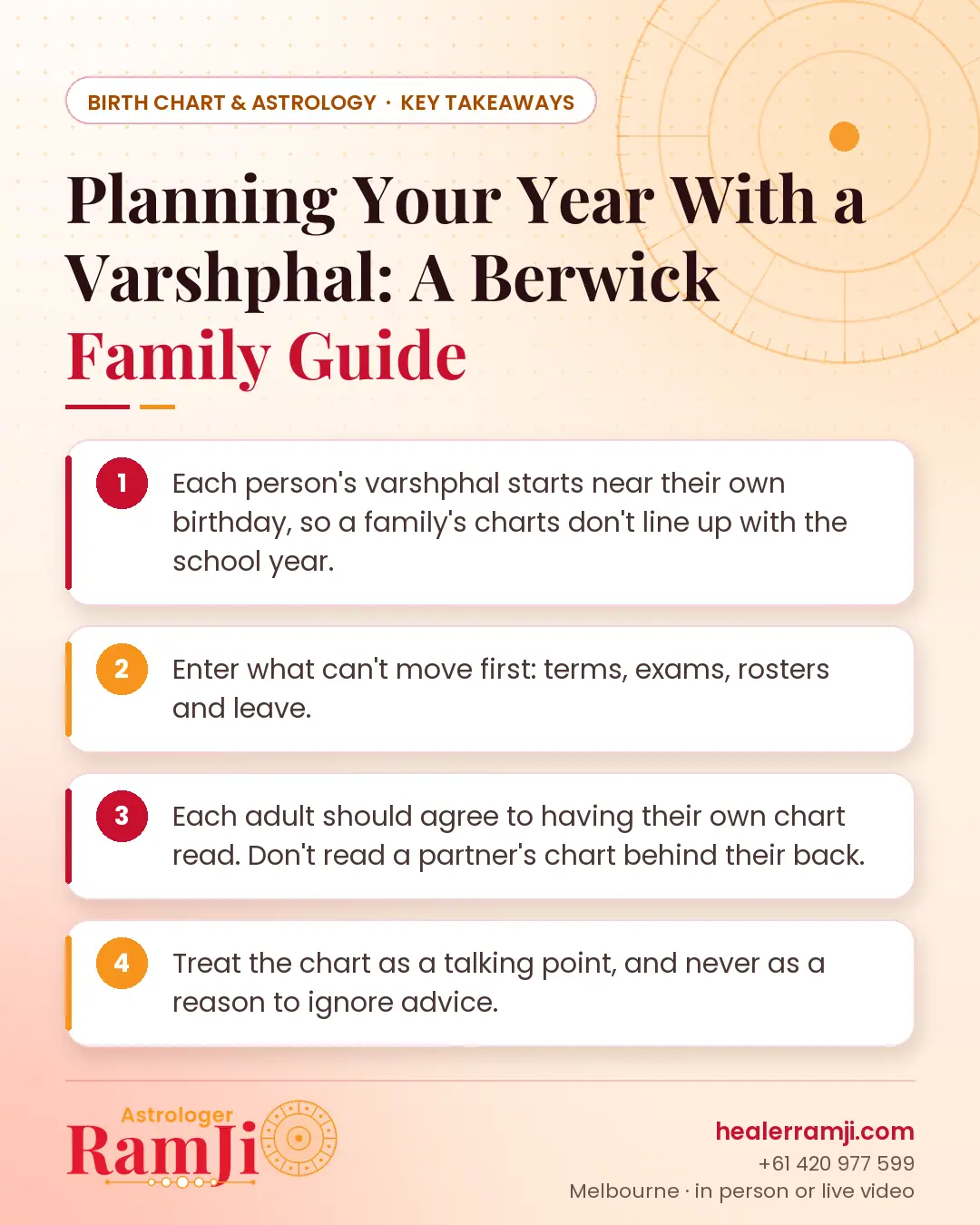
- Each person's varshphal starts near their own birthday, so a family's charts don't line up with the school year.
- Enter what can't move first: terms, exams, rosters and leave.
- Each adult should agree to having their own chart read. Don't read a partner's chart behind their back.
- Treat the chart as a talking point, and never as a reason to ignore advice.
What is a varshphal reading?
Varshaphala, often written varshphal, is a kind of annual horoscope. The word means the result for one year. It's a chart cast for the moment of your solar return, when the Sun reaches the same longitude it held at your birth. It comes from the Tajika tradition, which has Persian links and sits alongside the main Parashari approach in Indian astrology.
Astrologers commonly look at the lord of the year, the muntha (a sensitive point in the annual chart), and the birth chart behind it all. Many also use a compressed period system called mudda dasha. Methods differ between schools, including whether to cast the chart for your birthplace or for where you are living. If you were born overseas and now live in Berwick, ask your reader which they use, and why. Astrology is a tradition and a belief system, not a proven science.

Why doesn't a family's yearly forecast fit the school year?
Victorian schools run from January to December, but your personal year starts around your birthday. In one household, then, a parent's chart might turn over in June, the other parent's in February and an older child's in September. That sounds messy. It's actually helpful, because it reminds you that no single chart speaks for a whole family's year.
So don't build your calendar around the charts. Build it around the fixed dates, then see what each chart may add.
How do you set up the calendar?
Start with what can't move. For 2027, the Victorian Government's term dates are as follows:
- Term 1: 27 January to 25 March (students start on 28 January in government schools)
- Term 2: 12 April to 25 June
- Term 3: 12 July to 17 September
- Term 4: 4 October to 17 December
Those are the dates published for government schools and kindergartens. If your child goes to an independent or Catholic school in the area, check with the school, as its calendar may differ. Then add the rest:
- Exams and transitions. VCE exams, kinder enrolment, starting Year 7 and similar points that you already know about.
- Work. Hospital rosters, trade shutdowns, end of financial year and any leave you've booked. If someone works at Casey Hospital or commutes to the city, mark the weeks that are hardest on the household.
- Family commitments. Trips to India or elsewhere, visiting parents, weddings and festivals.
- Money and paperwork dates. Insurance renewals, tax and lease dates. Get advice on these from a registered professional, not a chart.
Only now do you bring in the chart.

How can a yearly forecast sit beside those dates?
It's easy to get this part backwards and expect the chart to tell you what to do. Instead, try asking the questions below, with the calendar open:
- Which stretch of this person's year looks busier in the reading, and does it clash with something already on the calendar?
- Is there a quieter patch that might suit a family trip or a home project, if the practical side also works?
- If one parent's reading points to a work-heavy few months, can the other one carry more of the school run then?
Here's a generic example, not a real family. A parent with a mid-year birthday has a reading that highlights work and responsibility in the months ahead. The couple notice that this overlaps with Term 3 and a child's first year at a new school. They decide not to start a renovation that term. It's a sensible choice either way, as the calendar alone would have supported it. The chart simply started the conversation.

What about children's charts and consent?
A reading should have the agreement of the person whose chart it is. A partner or adult relative who hasn't agreed is off limits, however well meant the request. Older children and teenagers deserve a say too.
If you do look at a younger child's chart as a parent, keep it gentle and general. Never tell a child that a year is bad for them, or that their exam results are written in the stars. If you are interested in this side of things, a parent and child reading focuses on understanding and communication, and understanding your child's nakshatra explains that part of the chart.

What can a varshphal not do?
- It can't predict a job offer, a pregnancy, a visa or an exam mark.
- It can't tell you that a date on the school calendar is dangerous. Please don't pull a child out of school, or skip an exam or treatment, because of a chart.
- It can't replace a teacher, a GP, a registered financial adviser or a migration agent.
- It can't be precise if your birth time is a guess. If you are unsure of it, tell your reader, and ask about estimating your birth time from life events.
Be cautious of anyone who uses an annual chart to frighten you into paying for a remedy. A difficult-looking year is a reason to plan with care. It isn't a sentence.
When should you book a reading?
Close to your birthday makes the most sense, as you get the full year's use out of it. But you can start partway through, and focus on the months left. Bring your filled-in calendar, your birth details and how sure you are of them, and the two or three questions that matter most.
A varshphal annual reading looks at one person's year against their birth chart. For a single event, such as a housewarming, muhurat date selection may suit you better. Sessions can be held by phone, WhatsApp or video, which helps when school pick-ups fill the afternoon. You can read about our work in Melbourne's south-east or get in touch.
Related service
Keep reading
Picking a Date for a Family Event in Keilor
Planning a naming ceremony, engagement or puja in Keilor? How to pick an auspicious time when hall dates are limited, and what to check before you book.
Read article →
A Saturn Period With a Mortgage: Advice for South Morang
Feeling squeezed during a Saturn period with a mortgage in South Morang? What the tradition says, practical steps for a slow stretch, and where to get real help.
Read article →
Common Sade Sati Questions Near Moonee Ponds
Common sade sati questions answered plainly for people in Moonee Ponds: how to check if it applies, what it can't predict, remedies and when to get support.
Read article →More from Melbourne's South-East

Your Child's Temperament: A Guide for Berwick Parents
A gentle guide for Berwick parents: what a child's birth star can't tell you about temperament, why labels hurt, and why teachers' observations count for more.
Read article →
Separated and Still Sharing Kids in Narre Warren
Separated and sharing children in Narre Warren? Put the kids' safety first, find local mediation and legal help, and keep yourself steady while things settle.
Read article →
Planning a Griha Pravesh for Your New Clyde Home
Moving into a new Clyde home? How to set a griha pravesh date when handover keeps shifting, book a priest early, and share the work out on the day.
Read article →Local pages

Astrologer for Dandenong
For Dandenong traders and new arrivals: shop timing, vastu for premises, and how to check any spiritual adviser. Sessions by phone, WhatsApp or video.
View area →
Astrologer for Clayton
For Clayton students and graduates dealing with family pressure, relationships and first jobs. Vedic astrology by phone, WhatsApp or video, from Ascot Vale.
View area →Quick answers
What is a kundli?
A kundli is a Vedic birth chart that maps the planets at your exact time and place of birth. Here is what it shows, in plain words.
Read answer →What details do I need for a kundli reading?
A kundli reading needs your date, time and place of birth, plus a clear question. Here is how exact each detail should be, and what to do if one is missing.
Read answer →Talk to Vijay Ramji
Tell us what you are facing. If a reading is unlikely to help, you will be told that plainly.