
Annual Varshphal Forecast
A birthday-to-birthday chart, used as a yearly planner.

A varshphal is an annual horoscope from Indian astrology, cast for the moment the Sun returns to its birth position each year. The reading treats that birthday-to-birthday chart as a planner, highlighting themes and busier stretches to consider. It offers reflection and timing ideas, not predictions of fixed events or a replacement for advice.
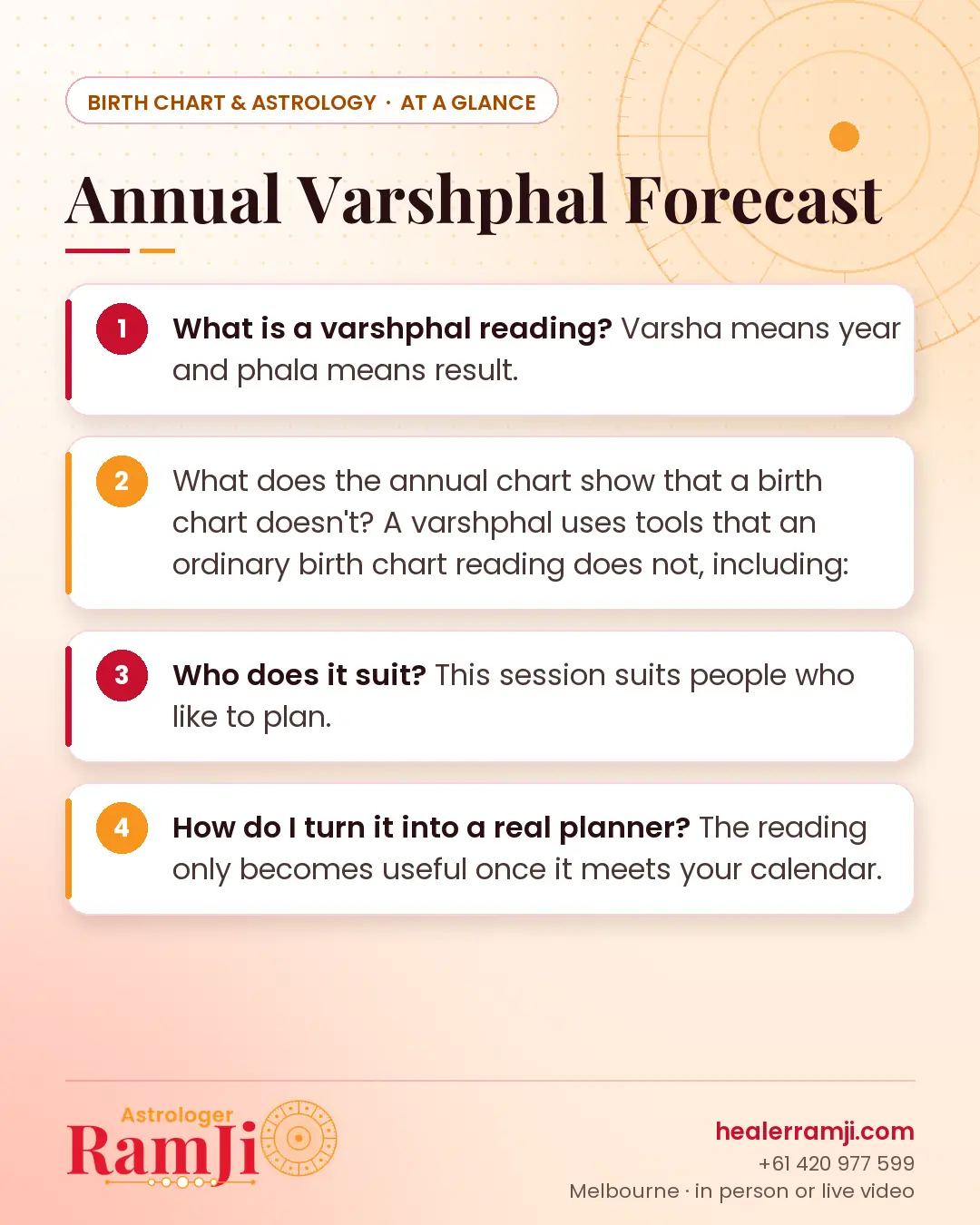
What is a varshphal reading?
Varsha means year and phala means result. A varshphal is a new chart cast each year for the moment the Sun returns to the exact position it held when you were born. It belongs to the Tajika tradition, which reached India through Persian and Arabic astrology and has been part of Indian practice for centuries.
The chart runs from one solar return to the next, so your personal year starts around your birthday and not in January. It often falls close to your birthday without landing right on it, as the return may come a day early or late. Because it is one exact instant, it also has to be converted correctly into clock time. In Melbourne, that means allowing for Victoria's summer time law if your birthday falls in the warmer months. Traditions differ on place, too. Many astrologers cast the chart for where you live or where you will be on the day, while others use your birthplace.
What does the annual chart show that a birth chart doesn't?
A varshphal uses tools that an ordinary birth chart reading does not, including:
- The year lord. One planet is chosen by set rules and read as the main influence on the year.
- The muntha. This sensitive point moves one sign each year from your birth rising sign. The house it reaches is read as an area of focus.
- Sahams. These calculated points relate to particular topics, such as marriage or work.
- Mudda dasha. Planetary periods are compressed into a single year, giving the months a rough order.
Many astrologers apply one important rule here. The annual chart is read together with the birth chart, and it does not stand alone. A single dramatic-looking year chart should not be treated as news on its own. If you want the longer view, a dasha analysis covers the years around this one.

Who does it suit?
This session suits people who like to plan. It tends to work well if a birthday is coming up, if the year ahead already holds big fixed events, or if you have had a birth chart reading and would like something more practical for the next twelve months.
It can also suit busy households, where one person's year affects everyone else's. Our Berwick family guide on setting school and work calendars beside a yearly chart shows how that can look.
If your question is about one single event, it may be better to ask for a date directly. Muhurat date selection is designed for that.
What happens in a session?
- The details are confirmed. You will be asked for your birth date, time and place, and where you expect to be around your birthday.
- The annual chart is calculated. The return moment is worked out and checked against your time zone.
- The main themes are read. This usually includes the year lord, the muntha and the houses that stand out, read against your birth chart.
- The year is sequenced. The mudda dasha may be used to talk through which months look busier and which quieter.
- Your plans are discussed. You bring the real events of your year, and these are looked at alongside the chart, with a plain word about how confident the reading is.

How do I turn it into a real planner?
The reading only becomes useful once it meets your calendar. A simple method works well:
- Write in what cannot move. School terms, leave, lease renewals, exams, visa dates and family events go in first. A chart never moves a court date.
- Mark the stretches that were discussed. Note them in pencil, because they are only prompts.
- Choose one or two actions. For example, leave some slack around a busy month, or hold a big conversation in a calmer one.
- Review around the middle of the year. Compare what happened with what was discussed, and adjust. If the chart has not been useful, give it less weight.
For a fuller walkthrough, read using your varshphal as a yearly planner.
What should I bring?
- Your birth details, along with how reliable your time is
- The place you expect to be on your birthday
- A calendar or list of the year's fixed dates
- Notes on last year, if you kept any, including what went well and what dragged
What can't a varshphal do?
Astrology is a traditional practice with no scientific evidence behind its predictions. An annual chart cannot promise a good year or warn of a specific event. A hard-looking chart is not a sentence, and it is no reason to give up on a plan or to pay for a remedy out of fear.
It also does not replace professional advice. If a reading touches on health, do not wait for a better month to see your GP. Money decisions need a licensed adviser, and legal matters need a lawyer.
What does it cost?
Ask when you get in touch. Any fee is stated before paid work begins, whether you have a reading once or come back year after year.
How do I get in touch?
You can reach Vijay Ramji by call or WhatsApp on +61420977599, or through the contact form. Mention your birthday so the timing can be planned. The practice is based in Ascot Vale, with appointments arranged in advance, and sessions can be held by phone, WhatsApp or video.
Common questions
When is the best time to book?
Close to your birthday gives you the most of the year to use, although the chart still applies once the year is under way. If you are partway through, the reading can simply focus on the months left.
Do I need an exact birth time?
It helps a lot. The Sun moves about one degree a day, so an error in your birth time moves the return moment by a similar amount, and that can change the annual rising sign. If your time is uncertain, birth time rectification may be worth asking about first.
How is this different from a yearly horoscope in a magazine?
A magazine column is written for everyone who shares one sign and usually runs from January. A varshphal is calculated from your own birth details and starts near your own birthday.
Does a varshphal replace a dasha reading?
No. Many astrologers read the year inside the longer picture set by your dasha periods. The annual chart adds detail, while the birth chart and dasha give it context.
Can it tell me whether I will get a visa, a job or a pregnancy this year?
No. Those outcomes depend on people, rules and health that a chart cannot see. Speak to a registered migration agent, an employment professional or your GP, as the case may be.
Related services

Birth Time Rectification
Birth time rectification with a Melbourne astrologer: estimate an unknown birth time from dated life events, and learn how much confidence the result deserves.
View service →
Saturn and Jupiter Transit Reading
A Saturn and Jupiter transit reading times the slow planets against your own birth chart, not your sun sign. What it shows, what it can't, and how to book.
View service →Read more

Using Your Varshphal as a Yearly Planner
Turn a varshphal reading into a working calendar: find your return date, map the year's periods to real dates, and review honestly as the months pass.
Read article →Planning Your Year With a Varshphal: A Berwick Family Guide
A Berwick family guide to using a varshphal yearly forecast beside school terms and work rosters, with consent, sensible limits and a simple planning method.
Read article →
Why Accurate Birth Details Matter More Than You Think
A few minutes can change a Vedic birth chart. Learn which birth details matter most, how much error is acceptable, and where to find your birth time.
Read article →Quick answers
What is a kundli?
A kundli is a Vedic birth chart that maps the planets at your exact time and place of birth. Here is what it shows, in plain words.
Read answer →What details do I need for a kundli reading?
A kundli reading needs your date, time and place of birth, plus a clear question. Here is how exact each detail should be, and what to do if one is missing.
Read answer →Talk to Vijay Ramji
Tell us what you are facing. If a reading is unlikely to help, you will be told that plainly.