
Why Festival Dates Differ in Australia
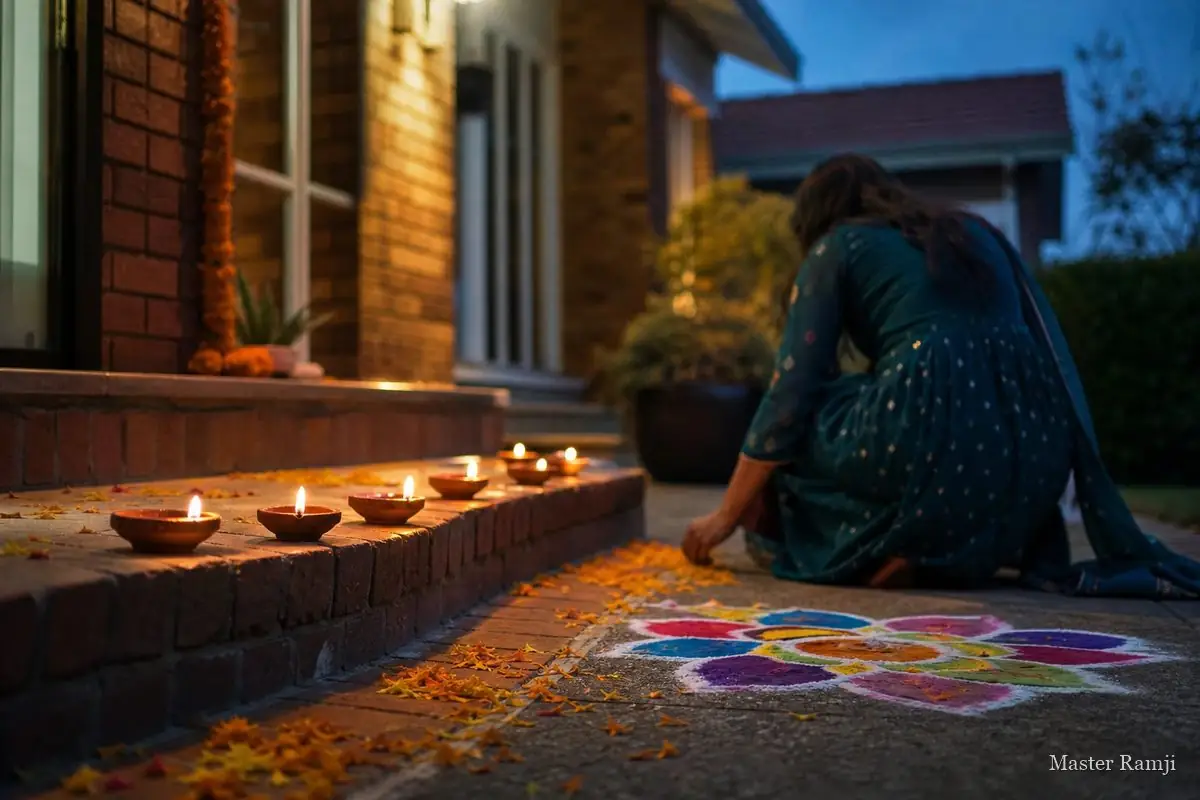
Hindu festival dates in Australia can differ from India because most festivals follow a lunar day, or tithi, and the day is usually judged by local sunrise. Australian sunrise comes hours earlier in absolute time, so the same tithi can fall on a different calendar day. Regional calendars and local time zones add further differences.
It happens most years. Your temple in Melbourne announces a festival for Wednesday. Your mother in India messages to say it's on Tuesday. A cousin in Perth isn't sure either way. Everyone is using a real calendar, and nobody has made a mistake.
This page doesn't list festival dates, because they change every year and differ between traditions. Instead it explains why dates move, why Australia and India can disagree, and why even two Melbourne families may keep the same festival on different days.
Key takeaways
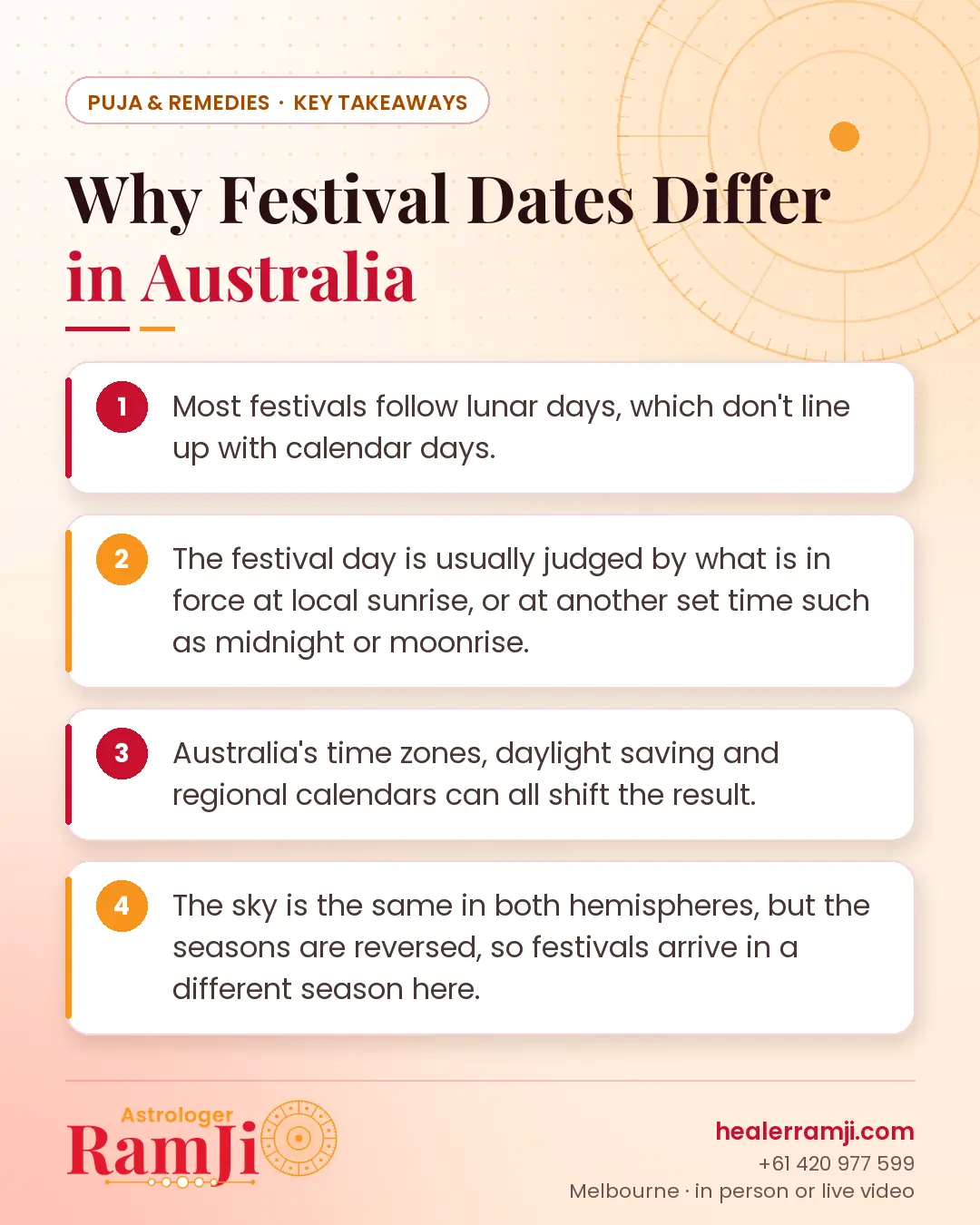
- Most festivals follow lunar days, which don't line up with calendar days.
- The festival day is usually judged by what is in force at local sunrise, or at another set time such as midnight or moonrise.
- Australia's time zones, daylight saving and regional calendars can all shift the result.
- The sky is the same in both hemispheres, but the seasons are reversed, so festivals arrive in a different season here.
Why do festival dates move every year?
Most Hindu festivals are tied to a tithi, or lunar day, in a particular lunar month. The Hindu calendar uses lunar months that fall short of the solar year, and it inserts an extra month about every 32 to 33 months to keep festivals in step with the seasons. So a festival drifts earlier for a couple of years, then jumps later.
A tithi also doesn't match a 24-hour day. Its length varies, roughly between 21.5 and 26 hours, so it can begin in the middle of one day and end partway through the next.
Why can Australia and India disagree?
In everyday practice, a day is treated as running from one sunrise to the next, and the tithi in force at sunrise usually names that day. Sunrise in Melbourne happens hours before sunrise in India. Melbourne is four and a half hours ahead of Indian time for part of the year, and five and a half once Victoria's summer time begins.
Here is a made-up illustration. Suppose a festival tithi begins at 3 am Indian time on a Tuesday. At sunrise in India that morning, it is already in force, so India keeps Tuesday. In Melbourne during daylight saving, 3 am Indian time is 8.30 am Tuesday. Melbourne's summer sunrise came earlier, at around 6 am, before the tithi began. If the tithi is still running at Wednesday's sunrise, as it usually would be, Melbourne's first sunrise inside it is Wednesday's, and the festival falls a day later here.
With other start times, Melbourne and India agree. That's why the difference appears in some years and not others.

Is sunrise always the deciding moment?
No. Some observances look at a different part of the day:
- Midnight. Janmashtami marks Krishna's birth at midnight, and Maha Shivaratri centres on worship through the night, so many calendars check which tithi is in force around local midnight.
- Evening. Diwali's Lakshmi puja is usually done in the evening window after sunset, so the evening matters more than the morning.
- Moonrise. Fasts such as Karva Chauth end when the moon is seen, which depends on local moonrise.
Every one of these is a local calculation. A time copied from an Indian calendar and converted on your phone won't give the right Melbourne answer. Our guide to Diwali puja timing in Melbourne works through one example, and why a muhurat from India may not work here explains the same problem for family events.
Why might two Melbourne families keep different days?
Melbourne's Hindu community comes from many regions, and their calendars differ:
- Lunar or solar. Some regional calendars, including Tamil, Malayalam and Bengali ones, use solar months for some purposes. Festivals tied to the sun entering a new sign, such as Pongal and other Sankranti festivals, barely move on the Gregorian calendar.
- How months are counted. In the amanta system a month ends at the new moon. In the purnimanta system, common north of the Vindhya range, it ends at the full moon. The festival day is the same, but month names may not match.
- Nakshatra festivals. Some festivals follow the Moon's star in a given month, not a tithi.
- Community rules. Some Vaishnava communities apply stricter rules for Ekadashi, so their fast can fall a day after the one in a general calendar.
- Method of calculation. Some panchangs use modern astronomical calculation, while others keep older traditional methods, and the two can differ slightly.
Family custom adds another layer. Some households keep the date their relatives in India keep, so everyone prays on the same day. Others follow the local temple. Neither is wrong.
Does it matter where in Australia you live?
It can. Australia has several time zones, and not every state uses daylight saving. Perth is two hours behind Melbourne in winter and three in summer. Adelaide is half an hour behind. Brisbane doesn't change its clocks, so it sits an hour behind Melbourne in summer. Sunrise also varies with longitude. Most of the time, festivals land on the same day across the country, but now and then a tithi boundary falls between two cities' sunrises. A panchang set for Melbourne may not suit a relative in Perth.
What about the seasons?
This is the part most specific to the southern hemisphere. The calendar follows the sun and moon, which the whole world shares, so the dates aren't flipped for Australia. The seasons are.
Holi, a spring festival in India, usually falls in March, which is autumn here. Makar Sankranti and Pongal, tied to harvest and the end of the cool season in India, arrive in mid-January, in the middle of an Australian summer. Diwali, in October or November, comes in our spring.
Many families simply adapt. Seasonal foods change, outdoor events move indoors or the reverse, and summer festivals may need a check of fire restrictions before any outdoor flame. The meaning of the festival stays the same, even if the weather doesn't match the stories.
How do you check the right date for your family?
- Ask your temple and use the calendar that follows your own tradition.
- Use a panchang set for your city. Check that it says Melbourne, not Delhi or Chennai.
- Look at the time window, not just the day, for observances tied to evening, midnight or moonrise.
- Agree as a family whether you'll follow the local date or your relatives' date.
If you live outside Melbourne, our festival planner for regional Victoria covers travel and home observance.
Can a festival date be wrong for you?
In most traditions, sincere observance matters far more than a few hours either way. Calendars and ritual timing are traditions of faith, not proven science, and no date can promise a particular outcome. Be wary of anyone who says you've ruined a festival by keeping the "wrong" day.
If you need a precise window for a family puja or event, muhurat date selection works it out from local sunrise and your tradition. Sessions can be held by phone, WhatsApp or video, and fees are stated before any paid work. For help with your family's calendar, get in touch.
Related service
Keep reading
Teaching Puja to Children Raised in Australia
Teaching Hindu rituals to children raised in Australia: explaining what each step of a puja means, ideas by age, handling questions, and keeping lamps safe.
Read article →
Where to Pray in Geelong
Looking for a Hindu temple in Geelong? Local groups to contact, what to confirm before you go, and options for prayer when you can't travel.
Read article →
Shopping for Puja Items in Dandenong's Little India
Shopping for puja items in Dandenong's Little India? What a simple home puja needs, how to check labels on kumkum, and what to do when a shop pushes 'energised' goods.
Read article →Quick answers
What is a muhurat?
A muhurat is an auspicious date and time chosen for an important start, such as a wedding. Learn how it is chosen, and why local time in Melbourne matters.
Read answer →What is a puja?
A puja is a Hindu act of devotional worship, at home or in a temple, with offerings such as flowers, light and food. Here is what it usually involves.
Read answer →Talk to Vijay Ramji
Tell us what you are facing. If a reading is unlikely to help, you will be told that plainly.