
Why a Muhurat from India May Not Work in Melbourne

A muhurat calculated for India can't simply be converted to Australian clock time. Many parts of the calculation depend on local sunrise, the length of the day and the sign rising at your location. A tithi may even fall on a different calendar day. The muhurat needs to be worked out again for where the event happens.
A family priest in India sends a date and a time for a wedding or a housewarming. The obvious next step is to add a few hours and book the hall. That step is where many families go wrong. A muhurat is not a clock reading that travels well. It is worked out from the sky as seen from one particular place.
This article explains which parts of a muhurat carry over from India and which parts don't. It doesn't give any Melbourne time, because a real muhurat depends on the event, the date and your family's tradition.
Key takeaways
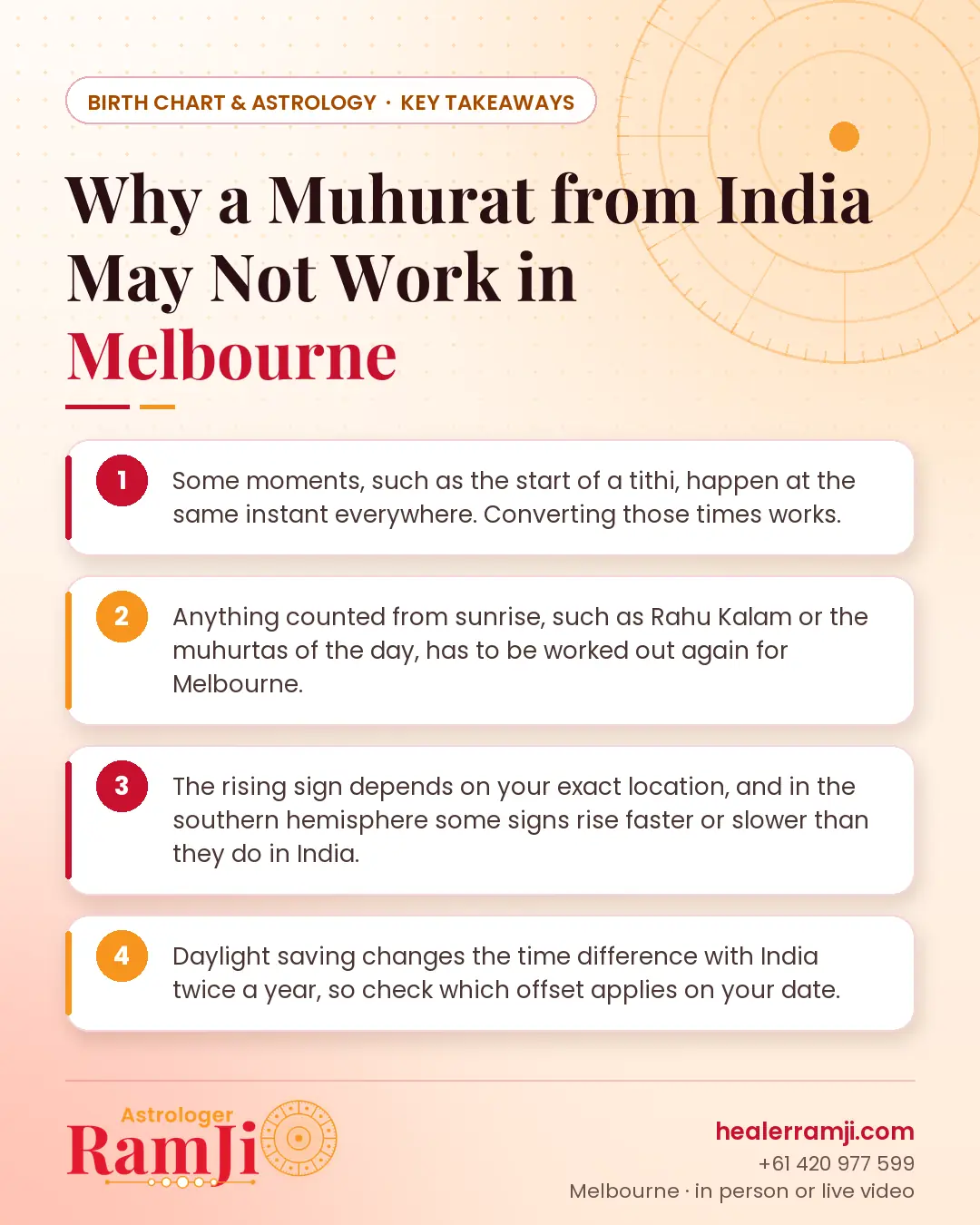
- Some moments, such as the start of a tithi, happen at the same instant everywhere. Converting those times works.
- Anything counted from sunrise, such as Rahu Kalam or the muhurtas of the day, has to be worked out again for Melbourne.
- The rising sign depends on your exact location, and in the southern hemisphere some signs rise faster or slower than they do in India.
- Daylight saving changes the time difference with India twice a year, so check which offset applies on your date.
What is the time difference between India and Melbourne?
India keeps one time zone all year. Victoria does not. For part of the year Melbourne is four and a half hours ahead of India, and for the rest it is five and a half hours ahead, once Victoria's summer time begins. A family that converts a time using the wrong offset will be an hour out before anything else is considered.
Even with the right offset, though, a converted time is still a time chosen for an Indian sky.
Which parts of a muhurat can simply be converted?
Some elements of the panchang depend only on where the Sun and Moon sit relative to each other and to the stars. A tithi, the lunar day, changes when the angle between the Sun and Moon reaches a set point. The Moon's nakshatra changes when the Moon crosses into the next section of the zodiac. Those changes happen at one instant for the whole planet.
So if an Indian panchang says a tithi ends at a certain time, that same moment converted to Melbourne time is correct. In that narrow sense, converting is fine.

Why can the day itself change?
Many traditions name a day by the tithi that is running at local sunrise. Melbourne's sunrise happens several hours before India's in absolute time. If a tithi changes in that gap, Melbourne and India can give the same calendar date a different tithi.
The result is that an auspicious date in India may not be the auspicious date in Melbourne. It can shift by a day either way. This is also why some festivals are observed on a different day here than by relatives in India, and why families in Australia often use a panchang calculated for their own city.
Which parts depend on local sunrise?
A large share of muhurat work is counted from sunrise and sunset where you are:
- The muhurtas of the day. A muhurta is a traditional unit of about 48 minutes, with 30 in a day and night. Many panchang makers divide the actual hours of daylight, not a fixed clock, so the length of each muhurta moves with the seasons.
- Rahu Kalam. This period is one of eight equal parts of the daylight hours, with its place in the day set by the weekday. Melbourne gets about nine and a half hours of daylight around the June solstice and close to fifteen hours in late December. So Rahu Kalam can be well over an hour long in summer and noticeably shorter in winter.
- Abhijit muhurat. Often described as the period around local midday, it follows the Sun, not the clock. Solar midday in Melbourne rarely lines up with 12 o'clock, and daylight saving moves it later again.
- Choghadiya and hora. Both divide the day and night into parts that start at local sunrise and sunset. A choghadiya worked out for Delhi or Chennai won't match one for Melbourne.
None of these can be converted from an Indian time. They have to be recalculated from Melbourne's own sunrise and sunset on that date.

Why does the rising sign need to be worked out for Melbourne?
Many muhurats, especially for weddings, also look at the lagna, the sign rising on the eastern horizon. The ascendant is specific to a time and a place. A sign rising over Delhi at a given moment is not rising over Melbourne at the converted time. Usually a completely different sign is rising here.
There is a further twist. Signs don't all take the same time to rise, and the gap grows the further you are from the equator. In the southern hemisphere, the signs that rise quickly and those that rise slowly are reversed compared with the northern hemisphere. A lagna window that lasts a generous stretch in India may be shorter in Melbourne, or the other way round.
What about times given for a fixed Indian city?
Printed panchangs and many apps default to one location, often a city in India. If you use one, check the place setting before you read anything from it. Also check whether the app has handled Victorian daylight saving correctly. Our article on daylight saving and birth charts shows how often clock rules trip up software, and the same problems affect muhurat tools.
Can you keep the date your priest in India gave you?
Often, yes. The broad reasoning behind a date, such as an avoided month or a favoured nakshatra, may still hold. What usually needs checking is:
- Whether the tithi and nakshatra still fall on that calendar day in Melbourne.
- Where Rahu Kalam and similar periods sit on that day here.
- Which lagna windows are available at your location.
- Which time offset applies, given daylight saving.
It helps to ask your priest how the date was chosen. They may already have allowed for Melbourne. Families and priests differ on which factors matter most, and your own tradition counts.
What if the recalculated time doesn't suit your plans?
This is common. A window may land on a workday or late at night, or clash with when a hall is free. Many families hold the key rite in the chosen window and the celebration at a more convenient time. Our guide to choosing a wedding muhurat in Australia looks at balancing dates with venues and travel.
Keep the limits in mind too. A muhurat is a religious and cultural practice, and there is no scientific evidence that it changes how an event turns out. Missing a window doesn't doom a marriage or a home. Be cautious of anyone who says only one exact minute will do, or that harm will follow if you choose otherwise.
How can you get a time worked out for Melbourne?
A local panchang from your temple is a good start for festival days. For a specific event, muhurat date selection works from Melbourne's sunrise and local time, then fits the options around the dates you can really book. For the short definition first, see what a muhurat is. Sessions can be held by phone, WhatsApp or video, and any fee is stated before paid work begins. If you have a date from India you would like checked, get in touch.
Related service
Keep reading

What to Expect at a First Reading in Ascot Vale
Booking a first reading with an astrologer based in Ascot Vale? How it works by phone, WhatsApp or video, what to prepare, and what a reading cannot do.
Read article →
A Reading on Your Lunch Break: How It Works in the CBD
How to fit an astrology reading into a lunch break in the Melbourne CBD: one question, a phone or video session, a private spot, and what to leave for later.
Read article →
Seeing a Melbourne Astrologer From Geelong
Thinking of seeing a Melbourne astrologer from Geelong? Why a phone, WhatsApp or video session usually makes more sense than a trip up the Princes Freeway.
Read article →Quick answers
What is a muhurat?
A muhurat is an auspicious date and time chosen for an important start, such as a wedding. Learn how it is chosen, and why local time in Melbourne matters.
Read answer →What is a kundli?
A kundli is a Vedic birth chart that maps the planets at your exact time and place of birth. Here is what it shows, in plain words.
Read answer →Talk to Vijay Ramji
Tell us what you are facing. If a reading is unlikely to help, you will be told that plainly.