
Questions Every Engaged Couple Should Discuss
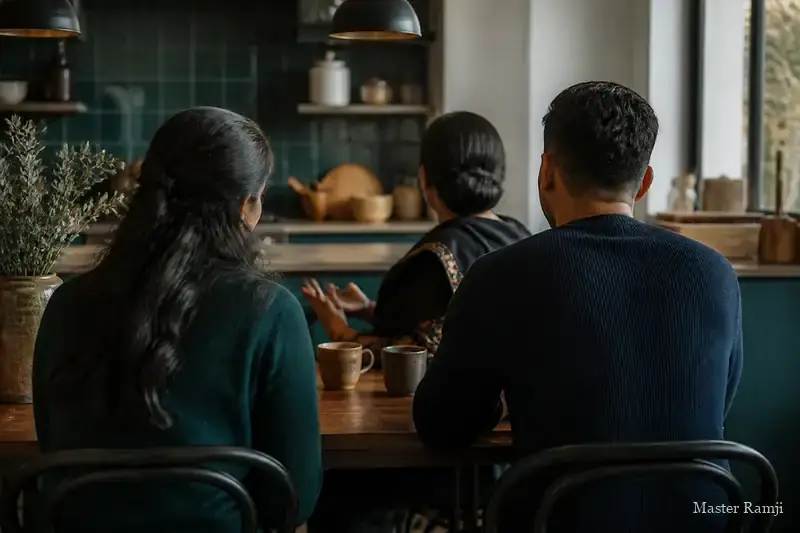
The most useful questions to discuss before marriage cover money, children, family, faith, where you will live and how you handle conflict. A horoscope match says little about these. Talk them through together, write down what you agree, and treat disagreement as useful information. A counsellor can help with harder topics.
Many Indian families spend weeks on a horoscope match and very little time on the conversations that shape a marriage day to day. A strong guna score can't tell you whether you both want children, who will look after ageing parents, or what happens to a pay rise.
This is a list of questions for engaged couples to work through together. It isn't a test, and there are no right answers. The aim is to find out where you agree, where you differ, and how you talk when you differ.
Key takeaways
- A horoscope match is a tradition. The questions below are where most later arguments actually start.
- Money, children and family obligations deserve the most time, especially across two countries.
- Disagreeing now is useful. It is far easier to plan around a difference before the wedding.
- For harder topics, a relationship counsellor or educator does a different job from an astrologer.
How should you have these conversations?
Pick a few questions at a time, not the whole list in one sitting. Choose a calm moment, away from wedding planning and away from parents. Each person answers in their own words before the other responds. Write down what you agree, and mark the questions you want to come back to.
If a subject turns into a fight every time, that tells you something too. Our guide on how couples can disagree without damage may help before you go further.
What should you ask about money?
- What do we each earn, owe and have saved? Include student loans, credit cards and any money owed to relatives.
- Will we combine accounts, keep them separate, or do both?
- Who pays for the wedding, and is anyone borrowing for it?
- Do either of us send money to family overseas? How much, how often, and who decides if that changes?
- What would we each do with an unexpected $10,000?
- Are we hoping to buy a home, and when?
Money sent home is often the most sensitive point, because it can feel like a question about loyalty. Talk about it as a plan, not a judgement. The money talk for engaged couples goes into more detail, and Moneysmart has free government tools for budgets and shared goals.
What should you ask about children?
- Do we both want children? How many, and roughly when?
- What would we do if having children took longer than expected, or didn't happen?
- Which languages, faith practices and festivals do we want our children to grow up with?
- Who would take leave or reduce work hours, and for how long?
- How much help do we expect from grandparents, and where would they be living?
Health can be part of this conversation if you are both comfortable. Pregnancy, Birth and Baby says the best time for genetic carrier screening is before pregnancy, and suggests telling your healthcare provider about any family history of a genetic condition. That is a question for your GP, not for a chart.
What should you ask about family?
- How often will we see each family, and how will we split festivals and holidays?
- Will either set of parents live with us, now or later? For how long when they visit?
- If a parent overseas becomes unwell, what would we each want to do?
- How involved should our families be in our decisions? Where is the line?
- If a relative criticises one of us, what will the other person do?
Long visits from overseas are common in migrant families, and they change a household. When your parents visit from India for months looks at how to plan for them.

What should you ask about faith and tradition?
- How much does religion matter to each of us day to day?
- Which rituals do we want at the wedding, and which do our families expect?
- Will we keep a home shrine, fast, or observe particular days?
- How much weight do we give astrology in later decisions, such as a home purchase or a baby's name?
That last question matters more than people expect. One partner may see a chart as guidance while the other sees it as entertainment. Agreeing on its place now avoids friction later.
What about work, home and everyday life?
- Whose career moves first if a job means moving city or country?
- Who does what at home, and is that fair to both of us?
- How much time alone, with friends and together do we each need?
- What does each of us do when angry, and what helps afterwards?
Where does the horoscope fit?
If your families follow astrology, a match is part of the process, and that is fine. Guna Milan matching gives a traditional score from two Moon positions. It is a cultural practice, not evidence about how a marriage will go, and a low or high score should never replace the conversations above.
A pre-marriage consultation takes a different approach. It reads both full charts together and uses them as prompts for exactly these subjects, which some couples find makes a hard topic easier to raise. Both people should want to be there.
When should you get other help?
Some questions are bigger than a list. If you keep reaching the same impasse, Relationships Australia Victoria offers counselling for couples and relationship education. A financial counsellor or adviser can help with debt, and a lawyer can explain how marriage affects property.
And if your partner frightens you, controls your money or phone, or you are being pressured to marry when you don't want to, please talk to 1800RESPECT on 1800 737 732 before going any further. A booked hall is never a reason to stay silent.
If you'd like a reading as part of your preparation, sessions can be held by phone, WhatsApp or video, and any fee is stated before paid work begins. To arrange one together, get in touch.
Related service
Keep reading
Arranged Introductions for NRIs in Australia
Arranged marriage for NRIs in Australia: how family introductions across two countries can work with informed consent, honest checks and no pressure.
Read article →
A Guide for Parents of an Intercaste Couple
Your child wants to marry outside your caste or community. Gentle advice for parents on handling your own worries while keeping your relationship with your child.
Read article →
Blending Rituals in an Interfaith Wedding
Planning an interfaith wedding with Hindu rituals? Ways to combine two traditions with respect, what to ask each officiant, and the legal steps in Victoria.
Read article →Quick answers
What is Mangal dosha?
Mangal dosha is a traditional marriage concern linked to the placement of Mars in a birth chart. Here is what it means and why it is rarely a reason to panic.
Read answer →What is Guna Milan?
Guna Milan is a traditional 36-point comparison of two people for marriage. See the eight factors it scores, what it leaves out, and how to read the result.
Read answer →Talk to Vijay Ramji
Tell us what you are facing. If a reading is unlikely to help, you will be told that plainly.