
Blending Rituals in an Interfaith Wedding
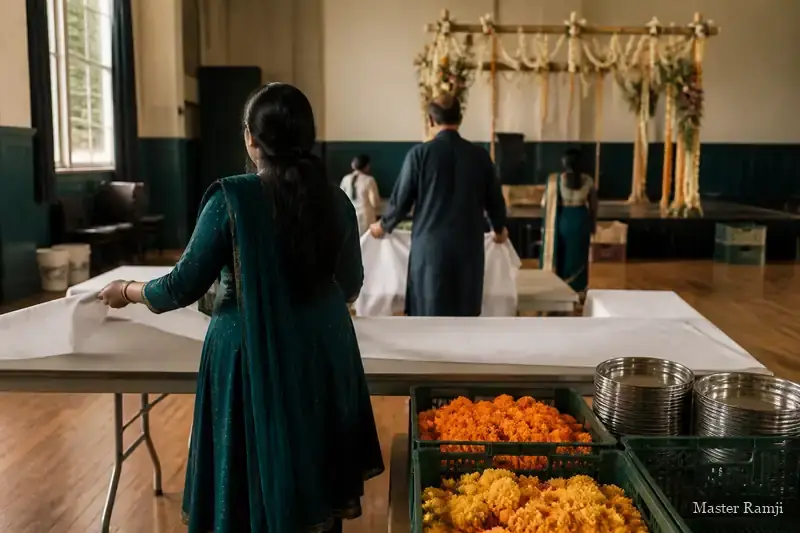
Interfaith Hindu wedding rituals can be combined by holding two ceremonies, or one shared ceremony with elements from both faiths. Ask each officiant what is essential and what is flexible, explain each ritual to guests, and never make conversion a condition. In Victoria, the legal part needs an authorised celebrant and a Notice of Intended Marriage.
When two faiths meet in one marriage, the wedding is often the first big test of how the families will share things. One side may picture a mandap, a sacred fire and seven steps. The other may picture a church aisle, a nikah, an Anand Karaj or a simple garden ceremony. Both pictures carry real meaning.
This guide is about combining rituals with respect, so that neither family feels its tradition was used as decoration. It is written mainly from the Hindu side, but the same questions apply whichever faiths are involved.
Key takeaways
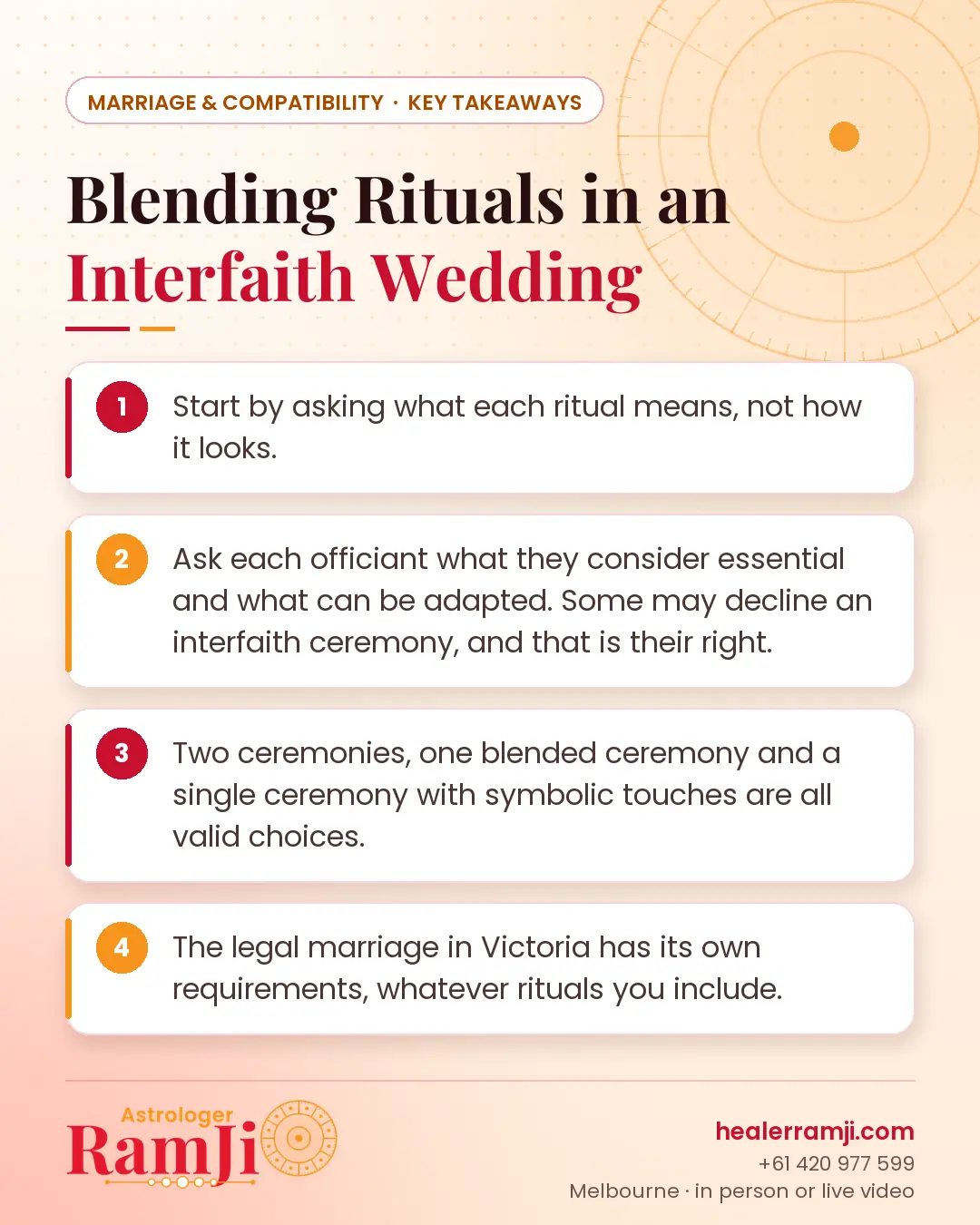
- Start by asking what each ritual means, not how it looks.
- Ask each officiant what they consider essential and what can be adapted. Some may decline an interfaith ceremony, and that is their right.
- Two ceremonies, one blended ceremony and a single ceremony with symbolic touches are all valid choices.
- The legal marriage in Victoria has its own requirements, whatever rituals you include.
Which Hindu wedding rituals do families most often want to keep?
Hindu weddings differ widely by region, language and family, so treat this as a rough map rather than a rulebook. Common elements include:
- Haldi and mehndi. Pre-wedding gatherings with turmeric paste and henna. These are joyful and usually easy for guests of any background to join.
- Jaimala or varmala. The exchange of flower garlands, often a public and light-hearted moment.
- Kanyadaan. The bride's parents giving their daughter's hand. Some modern families reshape or skip it, as its meaning is debated.
- The sacred fire. Agni is treated as the witness to the marriage, and offerings are made into it.
- Pheras and saptapadi. The couple circle the fire, and take seven steps together, each tied to a vow. For many families this is the heart of the ceremony.
- Sindoor and mangalsutra. Marks of a married woman in many North and South Indian traditions, though not all.
Ask your own elders which of these matter most to them. You may find there is one ritual a grandparent truly cares about and several they would happily let go.
What are the main ways to combine two traditions?
- Two separate ceremonies. A Hindu ceremony and a church, mosque, gurdwara or civil ceremony, on the same day or on different days. Each tradition stays whole. It costs more and takes more energy, but many families find it the simplest way to avoid compromise on sacred elements.
- One blended ceremony. A single event led by two officiants, or by one celebrant who weaves in elements from both sides. For example, a garland exchange, readings from both scriptures, and the seven steps, followed by vows and a ring exchange.
- One main ceremony with symbolic touches. The wedding follows one tradition, and the other is honoured through clothing, music, a blessing from an elder, or a ritual held at the reception.
None of these is the "right" answer. The best choice is the one both families can attend with dignity.
What should you ask each officiant?
Go to the priest, pandit, minister, imam, granthi or rabbi early, before you book a venue. Useful questions are:
- Will you lead or take part in an interfaith ceremony?
- Which parts are essential for you, and which can be shortened or adapted?
- Is there anything you would not be comfortable including, such as a sacred fire indoors or a reading from another scripture?
- Do either of us need to belong to your faith, or take any step first?
- Are you authorised to perform the legal part of the marriage?
Religious rules on interfaith marriage vary within each faith, not only between them. If one officiant says no, another from the same tradition may see it differently. A no is still worth respecting, and it is better to hear it early.
How do you make sure both faiths are treated with respect?
- Explain, don't perform. A short printed or spoken guide to each ritual helps guests follow along and shows that the meaning matters.
- Avoid borrowing sacred items for looks. Using another faith's holy objects as props can hurt more than leaving them out.
- Keep conversion out of the bargaining. A change of faith should be the free choice of the person making it. It should never be a condition for either family's blessing.
- Think about food and drink. Vegetarian, halal, kosher or alcohol-free needs can matter as much to guests as the ceremony itself.
How do you choose a date that suits both sides?
Many Hindu families want a muhurat, an auspicious time chosen from the panchang. Other faiths may have their own calendar limits, such as seasons when weddings are avoided. Start by listing any dates each side cannot accept, then look for overlap. A muhurat calculated for India won't suit a Melbourne ceremony as is, because it needs to be worked out for local time. Our guide to choosing a wedding muhurat in Australia explains this.
If the ideal muhurat clashes with the venue, some families use it for one key moment, such as the pheras, and plan the rest around it.
What practical details are easy to miss?
- The sacred fire. Many venues have rules about open flames and smoke alarms. Ask before you book, and plan a small, contained fire if allowed.
- Sindoor and kumkum. The Victorian Department of Health warns that very high levels of lead have been found in some sindoor and kumkum products. It advises buying products with clearly listed ingredients, using them on the skin only, and keeping them away from children.
- Language. Ask whether key vows can also be said in English, so that both families understand what is promised.
What does the law require in Victoria?
Religious rituals and the legal marriage are not always the same thing. Births, Deaths and Marriages Victoria says you must lodge a Notice of Intended Marriage at least one month before the wedding, and that the marriage must be performed by an authorised celebrant, in the physical presence of the celebrant and two witnesses aged 18 or over. Authorised celebrants include Commonwealth-registered celebrants and ministers of religion of recognised denominations.
If neither of your religious officiants is authorised, couples often add a short legal ceremony with a civil celebrant, either on the day or separately. Your celebrant will tell you the words the ceremony must include. For questions about your own situation, ask the registry or a lawyer.
What if a family member objects to the blended plan?
Objections often hide a fear: that a grandchild will lose the faith, or that relatives will gossip. Ask what the worry really is before arguing about rituals. Sometimes adding one meaningful element, or giving an elder a role, changes the mood. Sometimes it doesn't, and the couple has to decide calmly and accept that not everyone will be happy. If you haven't yet told both families, read our guide to telling both families as an interfaith couple. Our guide for parents of an intercaste couple may help a worried parent too.
Disagreement is normal. Threats, pressure to marry someone else, or having your documents or phone taken are not, and they are safety issues. Call 000 in an emergency, or 1800RESPECT on 1800 737 732 for confidential support.
Can astrology play a part?
Only if both of you want it. One family may expect a chart comparison, and the other may not believe in astrology at all. A chart can't approve or forbid a marriage, and no faith or caste should be judged by one. Intercaste and interfaith marriage guidance offers a calm space to talk through ritual, family and timing, with charts only if you ask. Sessions can be held by phone, WhatsApp or video. To start the conversation, get in touch.
Related service
Keep reading
Marriage Counselling and Astrology Together
Marriage counselling and astrology do different jobs. When counselling should come first, what a reading can add, and how to use both without mixing them up.
Read article →
Living With In-Law Tension
In-law tension in a shared home often comes down to unclear boundaries. Practical ways to set them as a couple, words to use, and when it becomes abuse.
Read article →
Why the First Years of Marriage Feel So Hard
Why the first years of marriage can feel hard, which struggles are normal adjustment, and which signs point to something more serious that needs real help.
Read article →Quick answers
What is Mangal dosha?
Mangal dosha is a traditional marriage concern linked to the placement of Mars in a birth chart. Here is what it means and why it is rarely a reason to panic.
Read answer →What is Guna Milan?
Guna Milan is a traditional 36-point comparison of two people for marriage. See the eight factors it scores, what it leaves out, and how to read the result.
Read answer →Talk to Vijay Ramji
Tell us what you are facing. If a reading is unlikely to help, you will be told that plainly.