
How Couples Can Disagree Without Damage

Couples resolve conflict best when both feel safe to disagree. Raise one issue at a time, take a cooling-off break if either of you is too angry, listen before answering, own your part, and come back to repair. If one partner is afraid, controlled or hurt, that is abuse, not conflict, and needs different help.
Every couple argues. About money, about whose parents to visit at Diwali, about the dishes, about the tone of a text. The arguing itself is rarely the problem. What does the damage is how it is done, and whether anything gets repaired afterwards.
This article sets out everyday skills that help couples disagree without wounding each other. It also explains, plainly, when an argument stops being ordinary conflict and becomes something that calls for a different kind of help.
Key takeaways
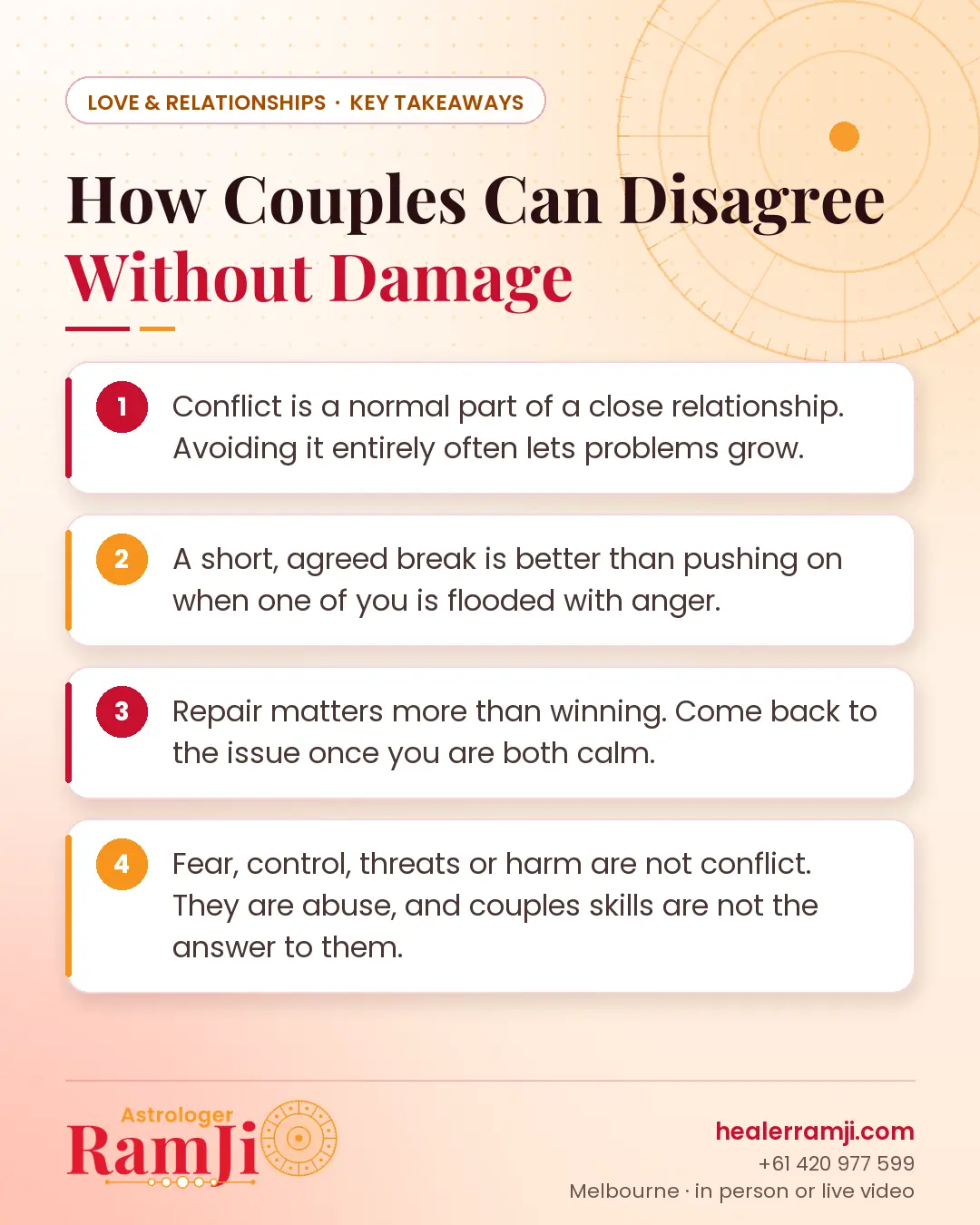
- Conflict is a normal part of a close relationship. Avoiding it entirely often lets problems grow.
- A short, agreed break is better than pushing on when one of you is flooded with anger.
- Repair matters more than winning. Come back to the issue once you are both calm.
- Fear, control, threats or harm are not conflict. They are abuse, and couples skills are not the answer to them.
Is it normal for couples to argue?
Yes. The Better Health Channel calls conflict an inevitable part of any relationship, and notes that it is usually the end result of a build-up of underlying feelings and unresolved issues. A fight about the bins is often really about feeling unappreciated, or carrying more of the load.
So the aim isn't to stop disagreeing. It is to disagree in a way that leaves both of you intact, and ideally understanding each other a little better.
How can you start a hard conversation well?
The first minute often sets the tone for the rest. A few habits help:
- Pick your moment. Not as someone walks in from a night shift, not in front of the children, and not by message when a face-to-face talk is possible.
- Start with the issue, not the person. "I felt left out when the plans changed without me" lands very differently from "You never think about me".
- Keep it to one topic. Bringing up last year's wedding, your mother's comment and the credit card bill all at once turns a conversation into a trial.
- Say what you would like. A complaint with no request leaves your partner guessing.

What should you do when it starts to boil over?
Most people know the signs in themselves: a hot face, a racing heart, words coming out faster than thoughts. Once you reach that point, nobody is listening any more. Better Health suggests giving yourself or your partner cooling-off time if either of you is too angry to talk, and remembering to come back to the issue later.
A break works best when you agree on it beforehand, while things are calm. You might decide that either of you can say "I need twenty minutes" and that the other will respect it. The person who asks for the break also takes responsibility for coming back. Storming out, or going silent for days, is not the same thing.
During the break, do something that settles you, such as a walk or a short prayer. Rehearsing your best comeback doesn't count.
How do you listen when you disagree?
Listening in an argument is hard because you are waiting for your turn. Try this instead: before you answer, sum up what you heard in a sentence. "So you're saying you felt I chose my friends over you on Saturday?" Your partner can correct you, and you haven't agreed with anything yet. You have only shown that you heard.
Better Health also suggests acknowledging and taking responsibility for your part in the problem. That doesn't mean taking all the blame. It means naming the piece that is yours, even if it is small.

Why does repair matter so much?
Couples who do well are not the ones who never hurt each other. They are the ones who come back afterwards. Repair can be small:
- "I'm sorry I raised my voice. That wasn't fair."
- "Can we start again? I handled that badly."
- A cup of tea made without being asked, followed by a proper conversation.
Once things are settled, talk briefly about what you learnt. Was it the timing? A word that always sets one of you off? Next time can then go a little better.
What about family and cultural pressures?
Many couples carry arguments that began elsewhere. One partner may have grown up in a home where nobody raised their voice, and the other in a home where loud debate meant love. Naming that can lower the heat. Then agree on how you want to argue in your own home, which may differ from how either family did it.
When is it not ordinary conflict?
This is the most important part of the page. Ordinary conflict happens between two people who can both speak up, both say no, and both feel safe afterwards. It may be loud and painful, but neither person is afraid of the other.
Abuse is different. Better Health is clear that physical or emotional outbursts are abusive behaviour and not acceptable, and that its conflict suggestions are not meant for people living with family violence. 1800RESPECT describes coercive control as a pattern of behaviour used to dominate, control and isolate someone, which may involve no physical violence at all.
Please treat these as signs that you need safety support, not conflict skills:
- You feel afraid of your partner, or you watch what you say to avoid their reaction.
- They check your phone, track your movements or decide who you can see.
- They control your money, your visa documents or your access to a car.
- They threaten you, the children, a pet or themselves to get their way.
- They push, hit, block doorways, break things or force sex.
- Arguments end with one person always giving in because of fear.
In that situation, a cooling-off rule or a joint session can make things more dangerous, because the person using control may punish what was said. Contact 1800RESPECT on 1800 737 732 at any hour, using a device your partner can't check if that is a worry. If you are in immediate danger, call 000. 1800RESPECT can also point you to services if you are worried about your own behaviour. Our guide to red flags of a controlling relationship goes further.
Be wary too of anyone who offers a ritual to make a partner obey, stay or stop arguing. Trying to control another person is not a remedy for conflict. Our short answer on why vashikaran is not ethical explains why.
When should a couple get outside help?
If you keep having the same fight, or repair never seems to happen, counselling can help long before things reach crisis point. Relationships Australia Victoria offers counselling for couples and families. A counsellor teaches skills and helps both people be heard, which is a different job from anything a reading does.
Some couples also like a cultural or spiritual angle. Astrology has no scientific standing here, but a chart comparison can give a neutral language for differences in temperament, such as one partner who needs to settle things at once and another who needs a night to think. Our page on using counselling and astrology together explains how the two can sit side by side.
Can a reading help with recurring arguments?
Only when both of you feel safe and both want to take part. Trust and conflict guidance uses birth charts, with each person's consent, to reflect on how arguments recur. It can't say who is right, detect cheating, or replace counselling. Sessions can be held by phone, WhatsApp or video, and what you share is confidential. If you'd like to talk about whether it suits you, get in touch.
Related service

Keep reading

Rebuilding Trust After It Is Broken
Rebuilding trust after a lie, hidden money or an affair asks different things of each partner. What repair needs, how long it may take, and when to stop.
Read article →
Control Is Not Love: Red Flags to Take Seriously
Coercive control can look like care at first. Learn the signs of a controlling relationship, how faith can be misused, and where to get real help in Victoria.
Read article →
Why Vijay Ramji Does Not Offer Vashikaran
Vashikaran aims to control another person's will, so it is refused on principle. Why consent matters, why good intentions don't change it, and what helps instead.
Read article →Quick answers
Can astrology bring my ex back?
No, astrology can't make your ex come back, and nobody can honestly promise it. Here is what a reading can help with, and how to avoid costly promises.
Read answer →Is vashikaran ethical?
No. Vashikaran aims to control another person, which is unethical and is refused here. Why consent matters, and where to turn if you feel pressured or controlled.
Read answer →Talk to Vijay Ramji
Tell us what you are facing. If a reading is unlikely to help, you will be told that plainly.