
Arranged Introductions for NRIs in Australia
An arranged marriage for NRIs in Australia works best when families introduce and the two adults decide. That means each person agrees to be introduced, to share details, to meet and to marry, and can say no at any stage. Forced marriage is a crime in Australia, including taking someone overseas to be married against their will.
For many Indian-Australian families, a match still begins with a phone call from home. An aunt in Pune knows a family, a cousin in Hyderabad shares a biodata, and suddenly two people in two countries are being spoken about as a possible couple. Introductions like this have a long history, and many lead to happy marriages.
Distance adds its own pressures, though. This article looks at how families can arrange introductions across India and Australia while keeping one thing at the centre: the free, informed consent of the two people who would actually be married.
Key takeaways
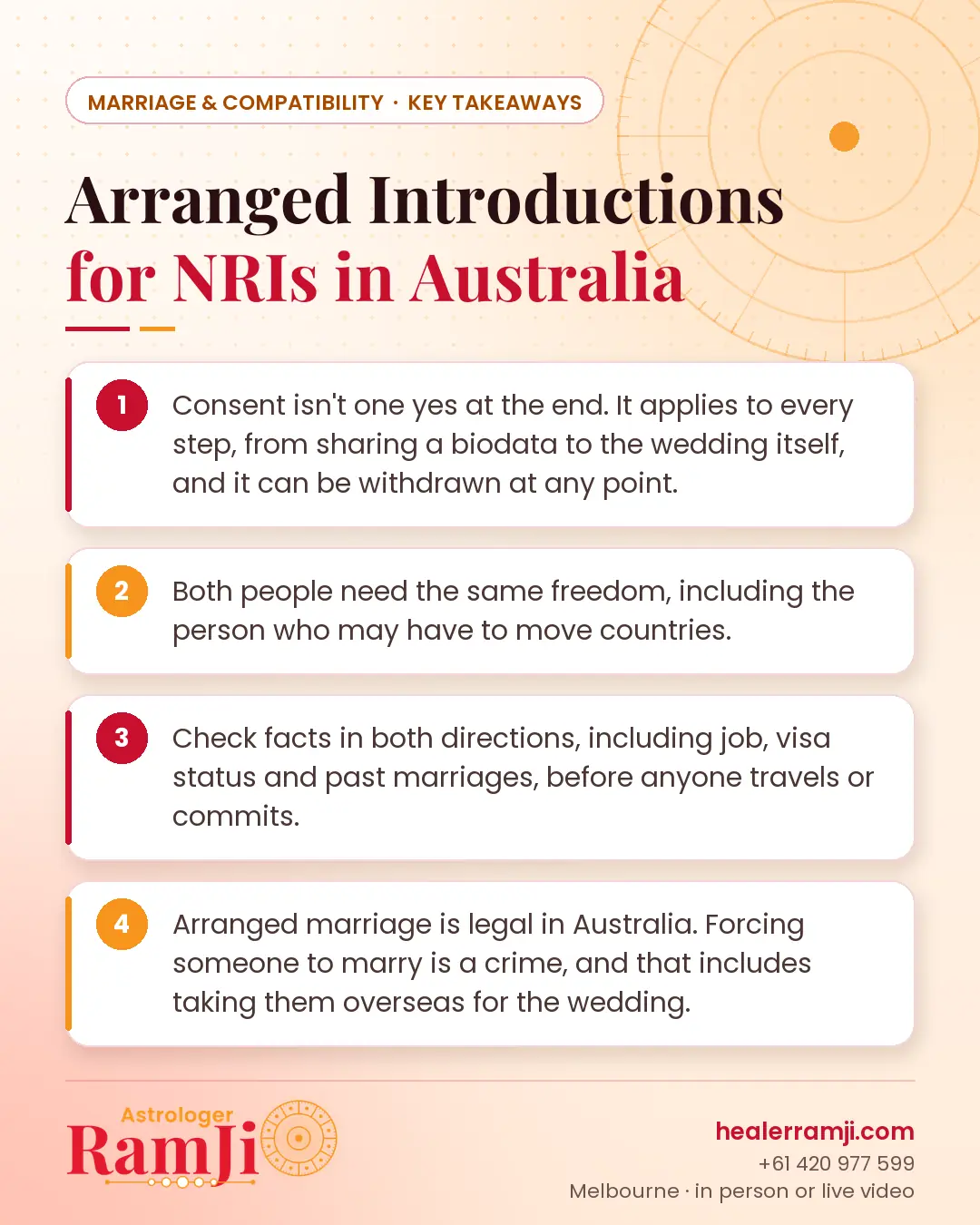
- Consent isn't one yes at the end. It applies to every step, from sharing a biodata to the wedding itself, and it can be withdrawn at any point.
- Both people need the same freedom, including the person who may have to move countries.
- Check facts in both directions, including job, visa status and past marriages, before anyone travels or commits.
- Arranged marriage is legal in Australia. Forcing someone to marry is a crime, and that includes taking them overseas for the wedding.
Who counts as an NRI in this conversation?
Strictly, NRI is an Indian government term. In family talk, it covers almost anyone of Indian origin living abroad, whether they hold an Indian passport, Australian citizenship or something else. The label matters less than the situation it describes: two people raised in different places, with families who may have very different expectations about how fast things should move.
What does consent look like at each step?
It helps to break an introduction into stages and ask whether each person has genuinely agreed to each one:
- Being looked for at all. An adult child should know, and agree, before their name goes around. Some people are happy for parents to search. Others want to wait, or to find someone themselves.
- Sharing details. A biodata, photos and a birth chart are personal information. Ask before sending them on, and agree who may see them.
- Talking directly. Most couples want time to speak alone, by phone or video, without parents listening in. That is a reasonable request, not a sign of disrespect.
- Meeting in person. A visit should be planned with both people's agreement, at a pace that suits them.
- Agreeing to marry. This yes has to be free and full. It shouldn't be given to avoid shame, to repay a family debt, or because tickets are booked.
At any of these points, either person can stop. A roka, a ring ceremony or a printed invitation doesn't remove that right.
Why does distance make pressure harder to see?
When families live in two countries, decisions often happen in phone calls the couple never hear. Parents may agree on dates between themselves. A visit home "for a holiday" can turn into an engagement. The person in India may feel pressure too, perhaps to accept a match because an overseas life is seen as a prize.
My Blue Sky, a national forced marriage service, explains the difference simply. In an arranged marriage, each person can freely choose whether to go ahead. When someone is coerced, threatened or deceived, they are no longer giving free and full consent. It also notes that a person can be taken out of Australia, or brought here, for a forced marriage. My Blue Sky offers free and confidential legal advice, and you don't have to wait until a wedding is planned to ask.
What should each side check?
Trust between families is valuable, but second-hand information can be out of date or polished for the occasion. Gently confirm:
- Current work and study, and where the person actually lives
- Any previous marriage or engagement, and how it ended
- Health matters each person chooses to share, and expectations about children
- Who would move, where the couple would live, and with whom
Visa status deserves particular care. Don't rely on anyone's guess about how quickly a spouse could join someone in Australia. Visa questions belong with the Department of Home Affairs or a registered migration agent, and the Office of the Migration Agents Registration Authority explains how to check that an agent is registered. A visa timeline should never be the reason to rush a wedding.
What are the red flags?
- Requests for money, gifts or "help with fees" early on, especially from a profile met online. Scamwatch explains how to report a suspected scam.
- Demands for dowry or costly gifts, or threats if they aren't met. Government guidance treats dowry-related abuse as a form of family violence, and 1800RESPECT on 1800 737 732 can talk it through.
- One person never being allowed to speak alone
- Unexplained urgency, or pressure to keep things secret from others in the family
Where does horoscope matching fit?
For many families, comparing charts is part of the process, and guna milan horoscope matching is the usual starting point. It works best as one input among many. A high score can't replace getting to know someone, and our article on why online horoscope matching is not enough explains why automatic scores miss so much.
A chart should never be used to push someone into a match they don't want, or to break up a match they do. And each person's chart should be shared and read only with that person's agreement.
How can families keep the peace?
Agree on ground rules early. Who will be told about the introduction? How long will the couple have to talk before families meet? What happens if either person says no? Deciding this before anyone is emotionally invested makes it easier to step back politely. In close communities, privacy matters too, and our piece on keeping arranged introductions private has ideas for sharing details with care.
Could a consultation help?
Once two people have met and both want to go further, a pre-marriage consultation can look at both charts together and open conversations about money, family and where you will live. It suits couples who both want to be there, and it can be held by phone, WhatsApp or video, which works when one person is overseas. What you share is confidential, and fees are stated before any paid work. If you'd like to talk it through, get in touch.
If anyone is being pushed to marry against their wishes, please contact My Blue Sky or, in an emergency, call 000.
Related service
Keep reading
A Guide for Parents of an Intercaste Couple
Your child wants to marry outside your caste or community. Gentle advice for parents on handling your own worries while keeping your relationship with your child.
Read article →
Blending Rituals in an Interfaith Wedding
Planning an interfaith wedding with Hindu rituals? Ways to combine two traditions with respect, what to ask each officiant, and the legal steps in Victoria.
Read article →
Marriage Counselling and Astrology Together
Marriage counselling and astrology do different jobs. When counselling should come first, what a reading can add, and how to use both without mixing them up.
Read article →Quick answers
What is Mangal dosha?
Mangal dosha is a traditional marriage concern linked to the placement of Mars in a birth chart. Here is what it means and why it is rarely a reason to panic.
Read answer →What is Guna Milan?
Guna Milan is a traditional 36-point comparison of two people for marriage. See the eight factors it scores, what it leaves out, and how to read the result.
Read answer →Talk to Vijay Ramji
Tell us what you are facing. If a reading is unlikely to help, you will be told that plainly.