
Guna Milan Horoscope Matching
The 36-point score, and everything it leaves out.
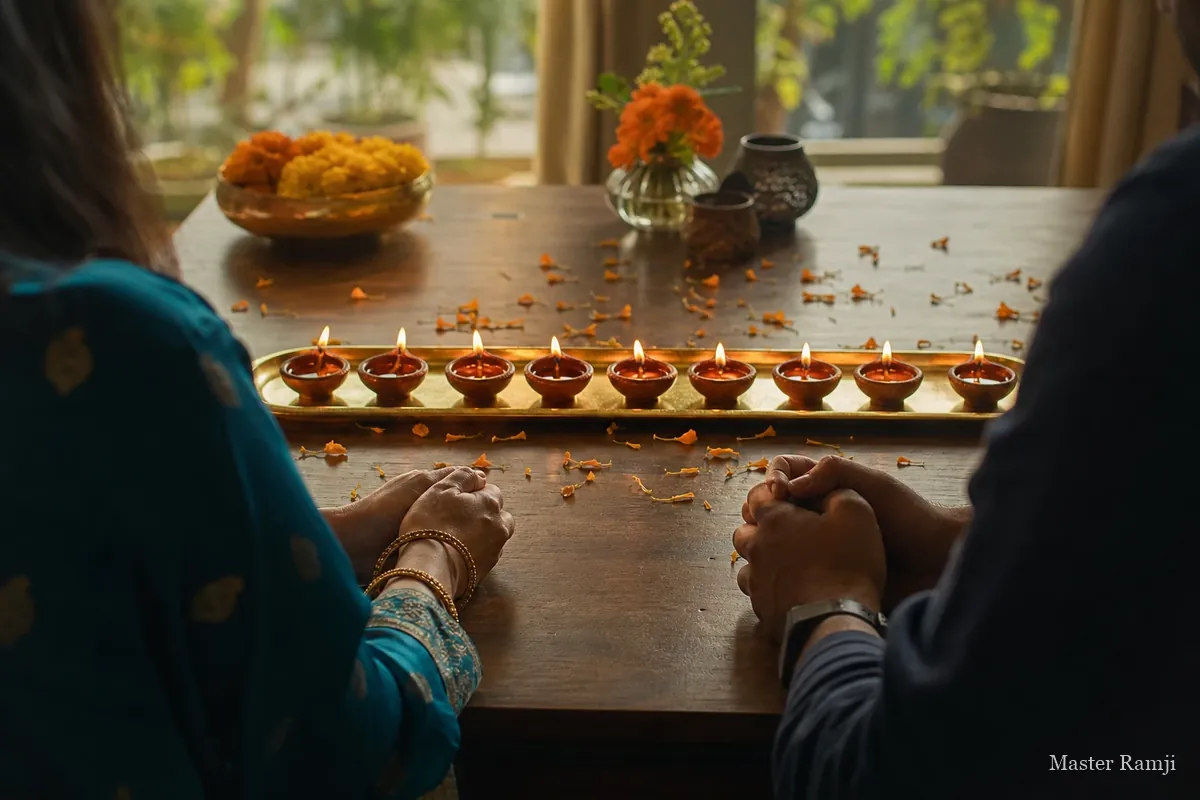
Guna Milan is the traditional 36-point comparison of two people, based on each person's Moon sign and birth star. Vijay Ramji calculates the score, explains which points were lost, and reads it alongside both full charts. It is a tradition, not a test, and it cannot decide whether you should marry.
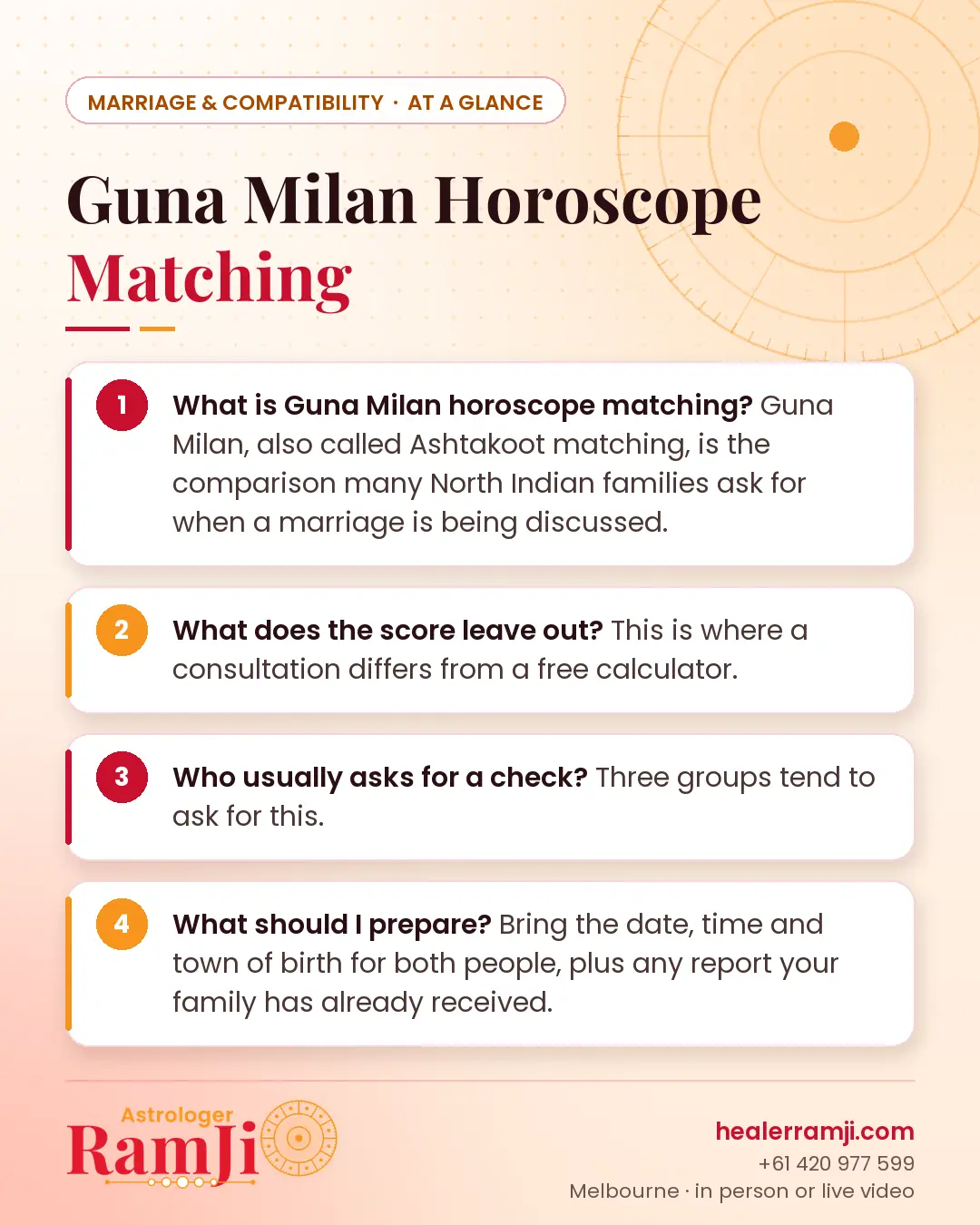
What is Guna Milan horoscope matching?
Guna Milan, also called Ashtakoot matching, is the comparison many North Indian families ask for when a marriage is being discussed. For a quick definition, start with what Guna Milan is. It takes the Moon's sign and birth star for each person and scores them across eight factors, called kootas:
- Varna (1 point), Vashya (2) and Tara (3)
- Yoni (4), Graha Maitri (5) and Gana (6)
- Bhakoot (7) and Nadi (8)
Our guide to what each of the eight kootas measures goes through them one at a time. Many South Indian families use Porutham instead, a related system that reads ten factors as pass or fail rather than adding up to a total. The two can give different verdicts for the same couple, so tell us which tradition your family follows.
What does the score leave out?
This is where a consultation differs from a free calculator. A calculator compares two Moon positions and stops. The number says nothing about:
- The rest of each chart. The rising sign, the 7th house and its ruler, Venus and the navamsa are all outside the 36 points.
- Mars. Mangal dosha is a separate question, and it needs its own Mangal dosha check.
- Which points were lost. Two couples on 24 may have lost entirely different kootas, and they would be read differently.
- Traditional exceptions. Many astrologers recognise cancellation rules for some kootas, though they don't all agree on the list.
- Your real life. Values, money, children, and how you treat each other when you disagree are not in the table at all.
You can read more about why online horoscope matching is not enough.
Who usually asks for a check?
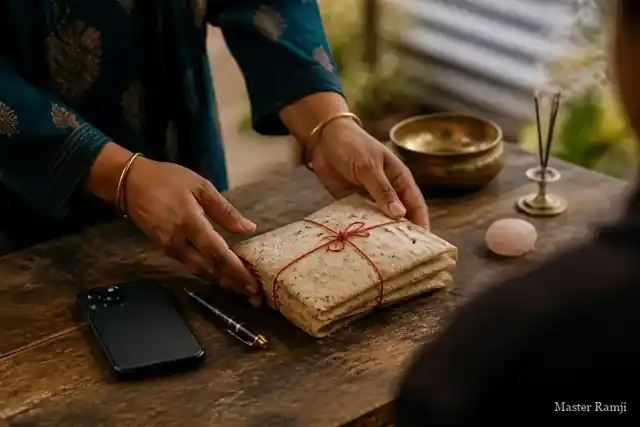
Three groups tend to ask for this. Couples who have already chosen each other may want to understand a result before relatives raise it. People meeting through family introductions may want some context for a report they have been handed. Parents may want to help, and that is welcome, as long as the adult child is leading. Our guides for parents looking for a match and families finding a match from regional Victoria cover that side of things.
Both people should know their charts are being compared. Please use only details that were freely shared with you.
What happens in a session?
- Details are checked. You will be asked for both sets of birth details, and whether each time is recorded or remembered. The Moon changes birth star about once a day, so a birth near a boundary needs care.
- The kootas are scored. You see where each point came from, not just the total.
- The lost points are weighed. Any exception that may apply is explained, including how widely that rule is accepted.
- Both charts are read. This usually covers the 7th house, Venus, Mars and the current planetary periods.
- Your questions are discussed. That may include how to explain the result to family in plain terms.

What should I prepare?
Bring the date, time and town of birth for both people, plus any report your family has already received. It also helps to say who is worried and why, because the real question is often not about the score. If you live in the inner north-west, our piece on arranging a Guna Milan check near Moonee Ponds lists the details to gather.
What if our score is low or shows Nadi dosha?
Take a breath. Our article on what a low Guna Milan score means explains why it is not an automatic no. Nadi dosha causes the most alarm because it swings the total by 8 points and tradition links it with children, so see how Nadi dosha exceptions are assessed or the short answer to what Nadi dosha is.
Nadi is not a medical finding. If you have real concerns about inherited conditions, talk to a GP about genetic carrier screening. That is a medical test. A horoscope is not.
What can't Guna Milan do?
Astrology is a traditional practice, and it is not a scientifically established way to predict how a marriage will go. A score can't tell you whether someone is kind, honest or safe to be with, and a high one should never talk you out of a concern about how you are being treated. It can't forbid a marriage either. That decision belongs to the two adults involved. For the practical side of building a relationship, Relationships Australia offers professional support.
What does it cost?
Ask when you get in touch. Any fee is stated before paid work begins, and you are free to decide without pressure.
How do I arrange a Guna Milan session?
Call or send a WhatsApp message to +61420977599, or use the contact form. Vijay Ramji is based in Ascot Vale, with appointments arranged in advance, and sessions can be held by phone, WhatsApp or video. That suits families spread across Melbourne, or with relatives overseas who want to listen in.
Common questions
Is 18 out of 36 the pass mark?
It is a widely quoted traditional guideline, not a rule of fate. Read what counts as a good Guna Milan score for the context around that number.
Why do two websites give us different scores?
Point tables for some kootas vary slightly between almanacs and software, and settings can differ too. A difference of a point or two is ordinary and tells you very little about the couple.
Can a remedy raise our score?
No. The score is arithmetic from two Moon positions, and no ritual changes when you were born. Be cautious of anyone who says a paid rite will fix a number.
We are already engaged and the score is low. What now?
A low score is a reason to look closer, not a reason to cancel. If you are both committed, a joint pre-marriage consultation can give the time to the questions that matter more than the number.
We are not planning a traditional marriage. Is this still useful?
It can be, if the question interests you both. Couples who want a broader look at how they relate may prefer a love compatibility reading, which isn't built around the 36-point table.
Related services
Mangal Dosha Check
A careful Mangal dosha check: where Mars sits, whether traditional cancellation rules apply, and how both charts compare. Calm, plain and with no fear tactics.
View service →
Marriage Timing Reading
When will I get married? Astrology can suggest favourable windows, not a date. See how a marriage timing reading uses dashas and transits, and where it stops.
View service →Read more

Low Guna Milan Score: Should You Worry?
A low Guna Milan score isn't an automatic no. Learn what the 36-point score measures, what it leaves out, and how families can respond without panic.
Read article →The Eight Kootas Behind Your Guna Milan Score
Varna, Vashya, Tara, Yoni, Graha Maitri, Gana, Bhakoot and Nadi: what each koota looks at, how its points are scored, and what it can't tell you.
Read article →
Nadi Dosha Explained
What Nadi dosha means, why it carries 8 of the 36 Guna Milan points, how astrologers assess exceptions, and why it isn't a genetic test.
Read article →
Why Online Horoscope Matching Is Not Enough
Free matching sites are quick, but how accurate are they? See what automatic calculators leave out, why two sites can disagree, and what to check next.
Read article →
Getting a Guna Milan Check Done Near Moonee Ponds
Your options for a guna milan check near Moonee Ponds, including family priests, nearby readers and video sessions, plus the details both partners should bring.
Read article →Quick answers
What is Guna Milan?
Guna Milan is a traditional 36-point comparison of two people for marriage. See the eight factors it scores, what it leaves out, and how to read the result.
Read answer →What is a good Guna Milan score?
A good Guna Milan score is traditionally 18 or more out of 36. Here is what that threshold means, how bands vary, and why the total can mislead.
Read answer →What is Nadi dosha?
Nadi dosha means two partners' birth stars share one of three Nadi groups, scoring 0 of 8 in Guna Milan. Here is what it means, and what it can't tell you.
Read answer →Where can I get kundli matching done in Melbourne?
Kundli matching is available in Ascot Vale, Melbourne, in person or by video. Here is what you need, how families in Australia and India can join, and what the score means.
Read answer →Talk to Vijay Ramji
Tell us what you are facing. If a reading is unlikely to help, you will be told that plainly.