
How to Use a Mala
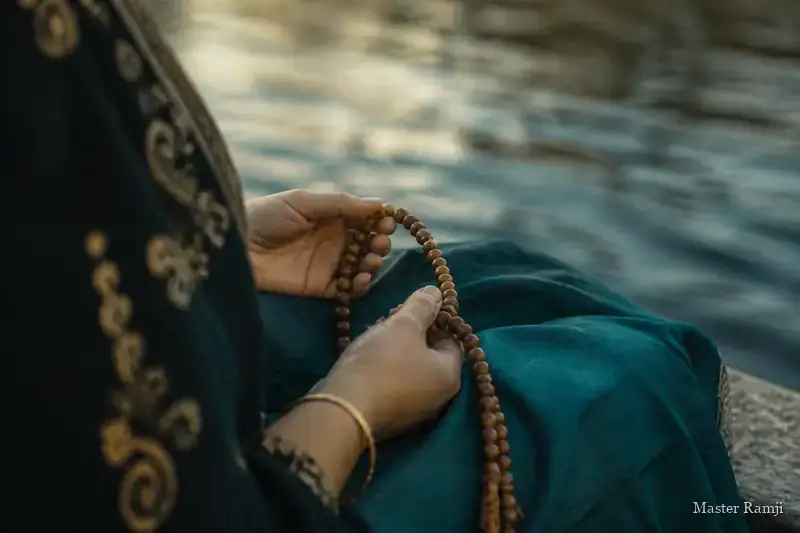
To use a mala, hold it in one hand and start at the bead beside the larger guru bead. Say your mantra once for each bead, moving them with your thumb. When you reach the guru bead, turn the mala around rather than crossing it. Hand and finger rules vary by tradition, so follow your family or teacher.
A mala looks simple: a loop of beads with one larger bead and often a tassel. Yet people who are given one by a grandparent or buy one at a temple shop often aren't sure how to use it. Which hand? Which finger? What happens at the end of a round?
This guide covers the counting technique step by step, explains where traditions differ, and offers some plain advice on choosing a mala that suits you.
Key takeaways
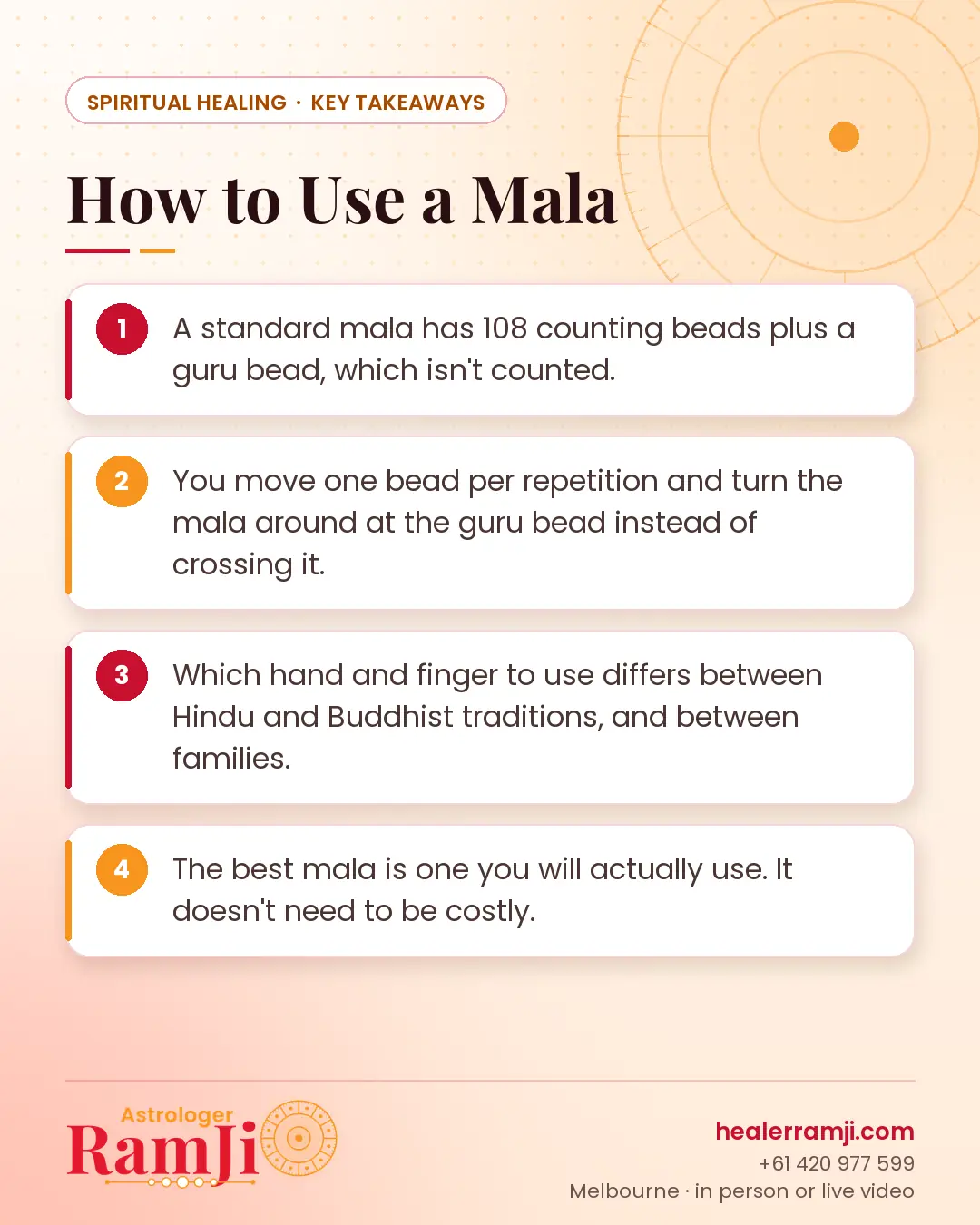
- A standard mala has 108 counting beads plus a guru bead, which isn't counted.
- You move one bead per repetition and turn the mala around at the guru bead instead of crossing it.
- Which hand and finger to use differs between Hindu and Buddhist traditions, and between families.
- The best mala is one you will actually use. It doesn't need to be costly.
What is a mala?
A japa mala is a string of prayer beads used to count repetitions of a mantra. The main loop usually has 108 beads. A larger bead, called the guru, meru or sumeru bead, sits where the ends meet. It marks the start and finish of a round and is not counted. Shorter malas often use a factor of 108, such as 54 or 27, and small wrist malas are handy for a pocket.
Prayer beads aren't unique to Hinduism. Buddhists, Sikhs, Catholics and Muslims all have their own versions, which shows how widely people have found that the hands help the mind keep its place. If you're curious about the number itself, see why mantras are chanted 108 times.
How do you hold a mala?
This is where advice varies most. A common Hindu teaching runs like this:
- Hold the mala in your right hand.
- Let it hang over your middle finger, or your ring finger in some families.
- Use your thumb to draw each bead towards you.
- Keep your index finger away from the beads. Many teachers explain that this finger stands for the ego.
Other Hindu descriptions place the loop over the index finger instead. In many Buddhist traditions the mala is held in the left hand, and Tibetan practice has its own finger rules for different kinds of practice. None of these is the single correct way. If your family or teacher has a method, use theirs. If not, pick one that feels comfortable and stick with it.
How do you count one round?
- Sit comfortably and take a few slow breaths.
- Find the guru bead, then take hold of the first bead beside it.
- Say your mantra once, aloud, in a whisper or silently, then move to the next bead with your thumb.
- Carry on until you reach the bead on the other side of the guru bead. That's 108 repetitions.
- If you want another round, don't pass over the guru bead. Turn the mala around and go back the way you came.
Not crossing the guru bead is a widely shared custom in Hindu and some Buddhist practice. It's usually explained as a sign of respect for the teacher. To keep track of several rounds, some malas have small counter beads, or you can simply make a tally mark on paper after each round.
Should you chant aloud, whisper or stay silent?
Traditions describe all three. Speaking aloud helps beginners learn the sounds. Whispering, with lips barely moving, suits a shared home or a quiet office. Silent repetition is often regarded as the deepest form, though it's also the easiest to drift from. A mala helps most with the silent kind, because the beads keep moving even when your attention slips. If you live with others or have thin walls, a whisper and a mala make a good pair.
How fast should you go?
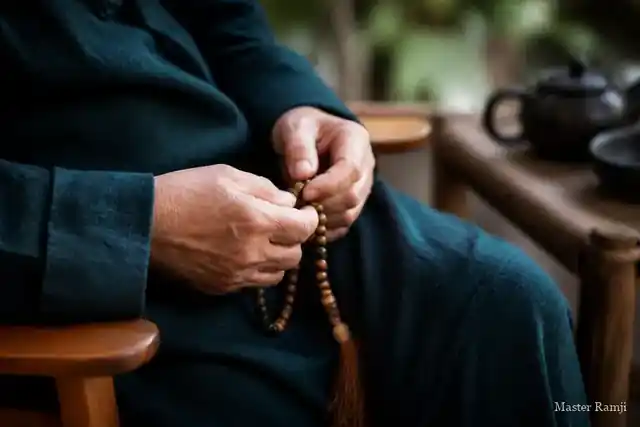
Slowly enough that each repetition is complete. Racing to finish a round defeats the point. A short mantra may take a few minutes for 108 beads, and a longer one much more. If a full round is too long for now, use a 27-bead mala or stop at a marker bead. Our guide to starting a mantra practice that lasts explains why a small daily count usually beats an ambitious one.
How do you choose a mala?
Material often follows tradition. Rudraksha seeds are especially valued by devotees of Shiva, and tulsi wood by devotees of Vishnu and Krishna. Sandalwood, plain wood and glass or crystal beads are also common. Practical points matter just as much:
- Bead size. Beads that are too small are hard to feel. Try a few if you can.
- Knots between beads. These stop beads slipping and make counting easier.
- A strong string. Malas wear with use and may need restringing.
- Price. A simple wooden mala works perfectly well.
Be wary of claims that a particular mala is "energised" or will bring money, love or health, especially when that claim comes with a high price. A mala is a counting aid and a devotional object. Its value comes from the practice.
How should you look after it?
Many people keep their mala in a small cloth bag, sometimes called a gomukhi, and store it in their prayer space. Some families treat a japa mala as personal and don't lend it. Customs differ on whether to wear it, so ask an elder if it matters in your family. When the string frays, restring it before it breaks.
What can a mala practice do?
Many people find counting on beads calming and steadying. Healthdirect notes that meditation may help with symptoms such as anxiety and sleep problems, and that it takes time and practice. A mala doesn't replace medical care, and it can't bring about a particular outcome in your life. If sitting quietly stirs up distress, stop and speak to your GP.
Would some guidance help?
If you'd like help choosing a mantra, learning to say it and setting a count you can keep up, one-to-one mantra and meditation guidance covers all of that, mala technique included. Sessions can be held by phone, WhatsApp or video, and fees are stated before any paid work. If that sounds useful, get in touch.
Related service

Keep reading
Hindu Rites After a Death in Melbourne
What antim sanskar, the mourning days and shraddha mean, and how Hindu families in Melbourne adapt funeral rites to Australian crematoria and customs.
Read article →
Grieving a Parent From the Other Side of the World
Grieving a parent overseas from Australia: why distance makes loss feel unreal, how to mark it here in the months after, and where to find real support.
Read article →
Small Rituals That Help With Grief
Simple rituals for grief at home: a lamp, a daily prayer with their name, a remembrance shelf and the dates worth keeping, done safely and at your own pace.
Read article →Quick answers
What is a mantra?
A mantra is a sacred sound, word or phrase repeated in prayer or meditation. Here is what the word means, how it is used, and how to begin simply.
Read answer →What is energy healing?
Energy healing rests on the belief in a life force that can be guided. Here is what a session involves, and what the evidence does and doesn't show.
Read answer →Talk to Vijay Ramji
Tell us what you are facing. If a reading is unlikely to help, you will be told that plainly.