
How to Start a Mantra Practice That Lasts

To start a mantra practice that lasts, choose one short mantra and repeat it a small, fixed number of times each day, such as one round of 11 or 27. Link it to something you already do, like making morning tea. Increase the count slowly over weeks, and simply carry on after a missed day.
Most people who give up on a mantra practice don't give up because the mantra was wrong. They give up because they started too big. A full mala of 108 on day one feels wonderful. By day nine, with a cold, a late shift and a child who won't sleep, it feels impossible, and the practice quietly stops.
This guide is about the opposite approach: starting so small that it is hard to fail, then letting the practice grow at its own pace.
Key takeaways
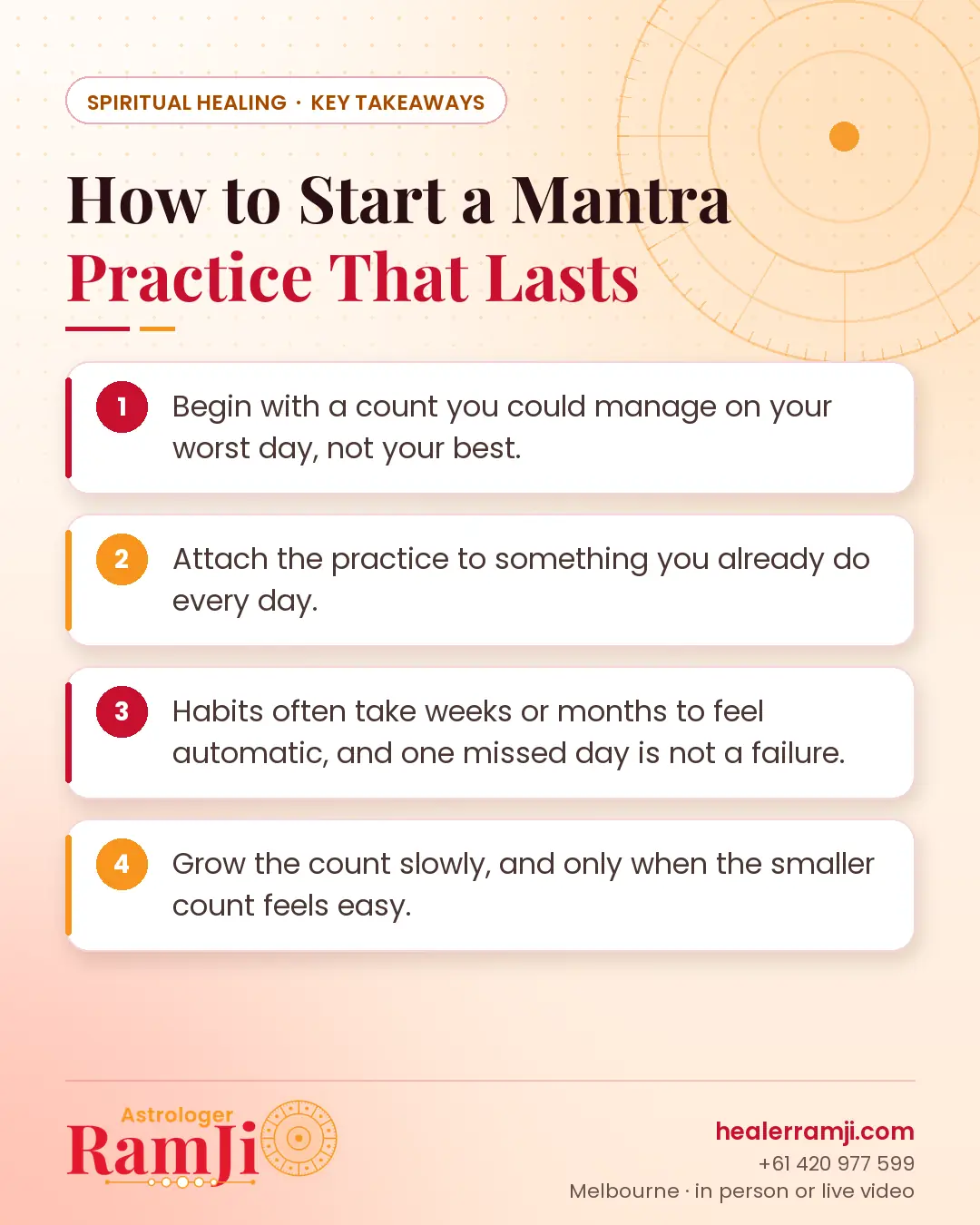
- Begin with a count you could manage on your worst day, not your best.
- Attach the practice to something you already do every day.
- Habits often take weeks or months to feel automatic, and one missed day is not a failure.
- Grow the count slowly, and only when the smaller count feels easy.
Why does starting small work better?
A small count removes the daily negotiation. If your practice takes two minutes, there is rarely a good reason to skip it. healthdirect suggests that beginners start meditating for 1 to 2 minutes a day and slowly increase the time over weeks or months. A short mantra session fits that advice well.
Research on habits points the same way. In a study summarised by the British Psychological Society's Research Digest, people repeated a chosen daily health behaviour linked to a cue, such as eating a piece of fruit with lunch or doing sit-ups after morning coffee. The average time for it to feel automatic was 66 days, but it ranged widely, from 18 days to a predicted 254 days. For most participants, the early repetitions brought the biggest gains. That study was about health habits, not prayer, but the lesson carries over: steady repetition matters more than heroic effort.
How do you choose your first mantra?
Keep it simple. One short mantra is enough for months. Good starting points are often:
- a mantra your family already uses, such as Om Namah Shivaya or a Ganesha mantra
- a name of a deity you feel close to, repeated with devotion
- for those who prefer something non-devotional, the sound Om alone
Some longer mantras are traditionally received from a teacher, and families differ on this, so ask an elder or priest if you are unsure. For the basics, see what a mantra is and how it is used.
Resist the urge to collect several mantras at once. Switching every week keeps the practice new but stops it from deepening.
What daily count should a beginner use?
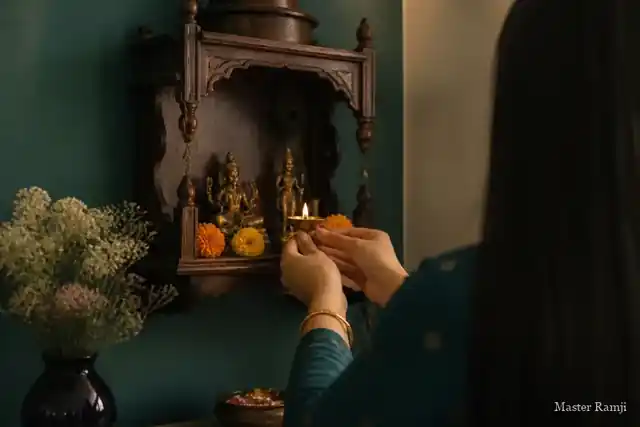
Pick a number you could do on a tired evening. Common starting counts are:
- 11 repetitions. Under a minute for most short mantras.
- 27 repetitions. A quarter of a mala, and a common count on smaller wrist malas.
- A timer. Two minutes, without counting at all.
The full count of 108 has symbolic roots, which our answer on why mantras are chanted 108 times explains. It is a good destination, but it doesn't have to be the starting line.
How do you make it a habit?
The most reliable trick is to tie the new practice to an old one. Instead of "I will chant in the morning", decide "After I put the kettle on, I will do 11 repetitions at the window". The existing habit becomes the reminder.
Other things that help:
- Use the same place. A corner, a chair or the edge of your bed. The place itself starts to cue the practice.
- Keep your mala where you will see it. Our guide on how to use a mala covers holding and counting.
- Choose your style. Japa can be spoken, whispered or silent. Silent repetition means you can practise in a shared home without disturbing anyone.
- Track it lightly. A tick on a calendar is enough. Don't turn it into another source of guilt.
Choose a time and place where you can give it your attention. Never practise while driving, and save it for a parked car or a train seat instead.
What if you miss a day?
Carry on the next day. The same habit study found that a single missed day had little effect on how automatic the behaviour later became. A gap is a normal part of building any routine.
Be careful with advice that says a broken count must be restarted from zero, or that a missed day brings bad luck. Some traditions set strict rules for formal vows, called sankalpa, and that is a personal choice. For an everyday practice, fear of breaking a streak is more likely to end the practice than to protect it.
When should you increase the count?
When the small count feels easy and you notice you want a little more. A gentle path might look like this:
- Weeks 1 to 4: 11 repetitions daily
- Weeks 5 to 8: 27 repetitions
- Later: 54, then a full mala of 108, if and when it suits you
These numbers are only an example. If life gets busy, dropping back to your starting count is a sensible way to keep the thread, not a step backwards. Our ideas on meditation for people with no spare time help on those weeks.
What can a mantra practice offer, and what can't it?
Many people find a daily mantra steadying. It can give the day a quiet anchor and a few minutes of focused attention. Believers also value it as prayer, which is a matter of faith.
A mantra can't change a diagnosis, fix money problems or make another person feel differently about you. If you are struggling with low mood, anxiety or sleep, talk to your GP alongside any spiritual practice. Be wary of anyone selling a "secret" mantra for a high price, or claiming a practice will work only if you keep paying.
Would guidance help?
If you would like help with pronunciation, meaning or choosing a count that fits your week, mantra and meditation guidance works through one practice you can keep up on your own. Sessions can be held by phone, WhatsApp or video, and fees are stated first. To arrange a time, get in touch.
Related service
Keep reading
The Gayatri Mantra: Meaning and Practice
The Gayatri mantra meaning, word by word: where the verse comes from, how translators render it, and how to chant it respectfully as a beginner.
Read article →
Meditation for People With No Spare Time
Meditation for busy people, shift workers and commuters: one to ten minute practices tied to your roster or trip, plus why you should never meditate while driving.
Read article →
How to Use a Mala
How to use a mala for mantra practice: holding it, counting a round, what to do at the guru bead, how traditions differ, and how to choose one without overspending.
Read article →Quick answers
What is a mantra?
A mantra is a sacred sound, word or phrase repeated in prayer or meditation. Here is what the word means, how it is used, and how to begin simply.
Read answer →What is energy healing?
Energy healing rests on the belief in a life force that can be guided. Here is what a session involves, and what the evidence does and doesn't show.
Read answer →Talk to Vijay Ramji
Tell us what you are facing. If a reading is unlikely to help, you will be told that plainly.