
Saturn and Work: The Slow Years

Saturn's career effects in Vedic astrology are usually described as slow, heavy and demanding: more duty, delayed recognition and lessons in discipline. The tradition sees this as a time of building, not punishment. It is a belief, not a forecast, and slow years still need a real review of your pay, skills and workplace.
You turn up. You do the work. Others seem to get promoted faster, and your own title hasn't changed in years. If you have mentioned this to an astrologer, you may have heard one word in reply: Saturn.
The word often comes with dread. It doesn't have to. This page explains why Saturn is linked with slow years at work, how slow progress can still be real progress, and how to tell patience from being stuck in a job that isn't treating you fairly.
Key takeaways
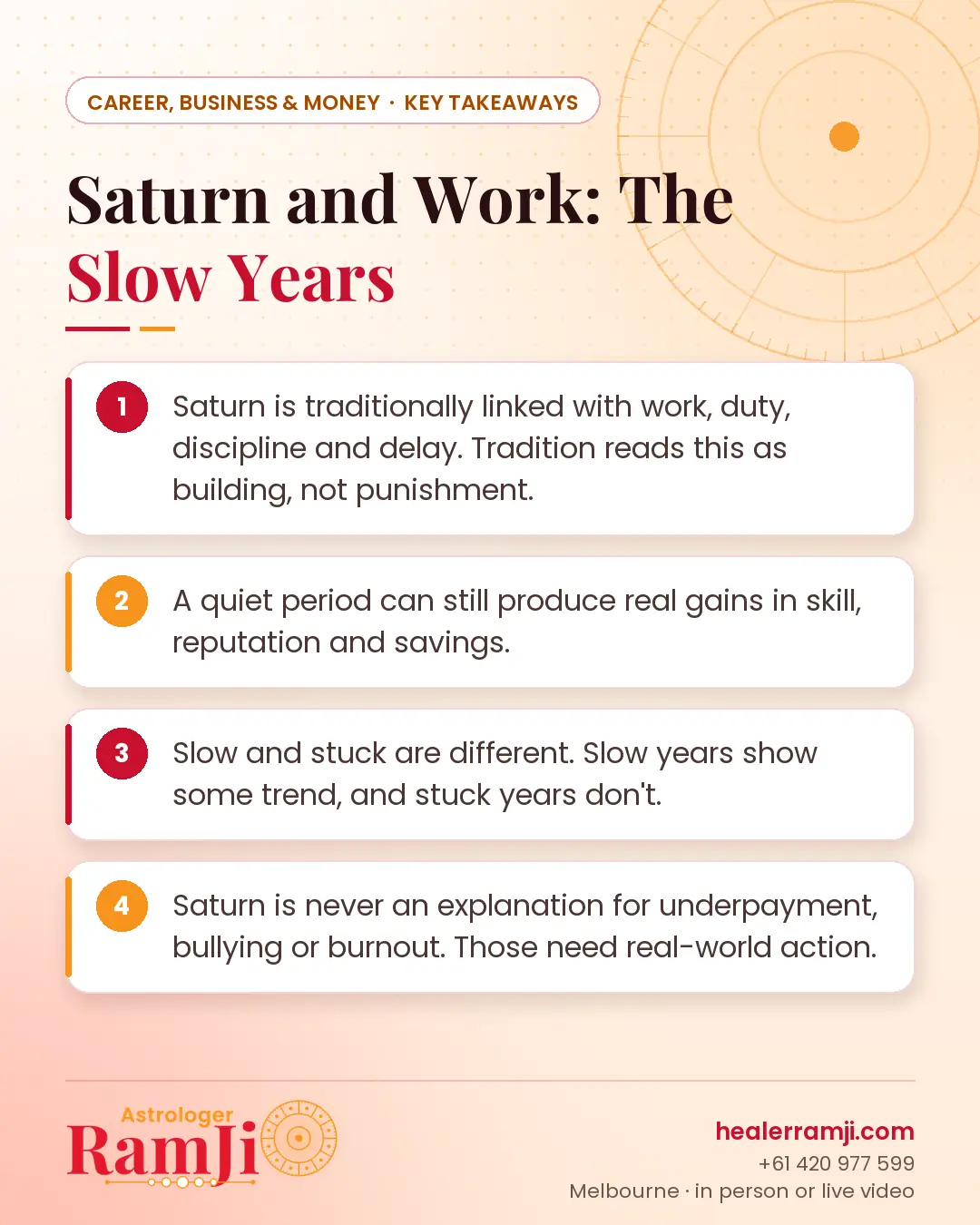
- Saturn is traditionally linked with work, duty, discipline and delay. Tradition reads this as building, not punishment.
- A quiet period can still produce real gains in skill, reputation and savings.
- Slow and stuck are different. Slow years show some trend, and stuck years don't.
- Saturn is never an explanation for underpayment, bullying or burnout. Those need real-world action.
Why is Saturn linked with slow work?
It starts with the sky. Among the nine grahas, Saturn is the slowest of the visible planets. One of its Sanskrit names, Shanaishchara, is commonly explained as "the slow mover". It takes about 29.4 years to go around the zodiac, and spends roughly two and a half years in each sign.
From that slowness, the tradition builds its picture. Saturn, or Shani, is associated with karma, labour, service, endurance and discipline. It is also one of the natural significators of the tenth house of career. So its themes are less about sudden wins and more about what lasts when you keep showing up.

When do Saturn's career effects come up?
Astrologers usually point to a few periods, each read differently:
- Saturn's mahadasha. In the Vimshottari system, it runs for 19 years. Saturn sub-periods also occur within other dashas.
- Saturn's transit through your tenth house. This is often read as a time of heavier responsibility and closer scrutiny. Many readers check it from both the lagna and the Moon.
- Sade Sati. This roughly seven-and-a-half-year transit around your Moon sign attracts a lot of fear, much of it needless. See Sade Sati myths.
- The Saturn return. Around the age of 29 or 30, Saturn comes back to its birth position. Read more in Saturn's return in Vedic astrology.
How any of this plays out, according to the tradition, depends on the chart. A well-placed Saturn may be read very differently from a weak one. And none of these periods tells you a fixed outcome. These are interpretations from a tradition, not established predictions.
How can slow progress be real progress?
Modern work culture counts titles and pay rises. But plenty of what makes a working life solid doesn't appear on a business card. During slow years you may be gaining:
- Depth. You can now handle the hard cases, not just the easy ones.
- Reliability. People know you finish what you start, and that kind of reputation travels with you.
- Judgement. You make fewer mistakes, and you recover faster when you do.
- Financial footing. Slowly paying down a debt or saving a little is real change.
- Qualifications. A course done at night over several years may seem like nothing, until it isn't.
- Steadiness. You can stay calm when others panic.
Try this once a year: write down what you can do now that you couldn't do twelve months ago. Then look at the last three lists together. On a bad week, slow progress feels like nothing. On paper, it often looks different.

How do you tell slow from stuck?
This is the most useful question on this page, because a Saturn story can make you stay too long in the wrong place. Ask yourself:
- Have I learned anything new in the past year?
- Is my pay at least keeping up with my award or the market?
- Have I actually asked for feedback or a promotion, and what was the answer?
- Has anyone in my position ever moved up here?
- Would I advise a younger relative to stay in this job?
If most answers are positive, you may be in a slow patch that is still paying off. If most are negative, calling it Saturn could be a way of avoiding a hard decision. It might be time to look around. You can weigh that with our job offer framework.

What doesn't count as a Saturn lesson?
Please don't file these under fate:
- Being underpaid. Check your pay with the Fair Work Ombudsman, which offers free information.
- Bullying, harassment or unsafe work. Raise it through your employer, your union or the relevant workplace regulator.
- Exhaustion that doesn't lift. That is a health matter for your GP.
- Discrimination. You don't have to accept it as your karma, and there are real avenues for complaint.
A reader who tells you to quietly endure any of these isn't giving you spiritual wisdom.
What does the tradition suggest doing?
Traditional advice for Saturn tends to be plain, and it is mostly about conduct:
- Keep your commitments, and be on time.
- Treat cleaners, junior staff and contractors with respect. Saturn is said to look after working people.
- Give something on Saturdays, if that is part of your practice, even if it is modest.
- Keep up a short routine, such as a Saturday prayer or a short mantra.
You don't need a costly ritual. If someone says terrible things will happen unless you pay for a Shani remedy, that is a sales tactic. These practices can steady your mind, but they don't move a promotion closer or change your workplace.
When is a slow year too heavy?
Patience is one thing, but a long stretch of feeling low, hopeless or worn out is another. If you have lost interest in things you used to enjoy, can't sleep, or dread each day, please see your GP. Beyond Blue offers support on 1300 22 4636, and Lifeline is there at any hour on 13 11 14. Getting help doesn't mean you have failed a test from Saturn.
Would a timing reading help?
Some people find it helpful to see where they stand in a longer cycle, so a hard stretch has a shape and not just a weight. A career timing reading looks at which years are traditionally read as growth and which as consolidation, without promising dates or job titles. To start a conversation, please get in touch.
Related service

Keep reading

Restarting Your Career After Migrating
Restarting a career after migrating to Australia: getting overseas qualifications recognised, coping with the loss of professional identity, and pacing yourself.
Read article →
After a Redundancy: Steadying Yourself
Just been made redundant? Check your entitlements with official sources first, steady your money and wellbeing, then make room to reflect on what comes next.
Read article →
When Work Conflict Follows You From Job to Job
Same clash, different job? How to spot your own pattern in repeated workplace conflict, what a birth chart can add as a mirror, and when it's really bullying.
Read article →Quick answers
Can astrology help me choose a career?
Astrology can prompt useful questions about work, but it can't pick your career. Here is what a chart may suggest, its limits, and who to ask for real advice.
Read answer →Which house shows career in Vedic astrology?
In Vedic astrology, the tenth house is the main house of career. Here is what else a reader looks at, where views differ, and what a chart can't tell you.
Read answer →Talk to Vijay Ramji
Tell us what you are facing. If a reading is unlikely to help, you will be told that plainly.