
Weighing a Job Offer With Your Chart

Should I accept this job offer? Astrology can add a reflective view, but it should be one input, not the decider. First compare pay, contract terms, commute, growth and family impact. Then use the chart to ask about timing and fit. If the facts and the reading disagree, let the facts carry more weight.
An offer arrives on Tuesday, and they want an answer by Friday. It pays better, but the commute is longer. Your current boss is difficult, but you know where you stand. Somewhere in the middle of this, you may wonder what your chart says.
That is a fair thing to wonder, as long as the chart stays in its place. This page sets out a six-step framework in which the reading is one input among several, and not the first one.
Key takeaways
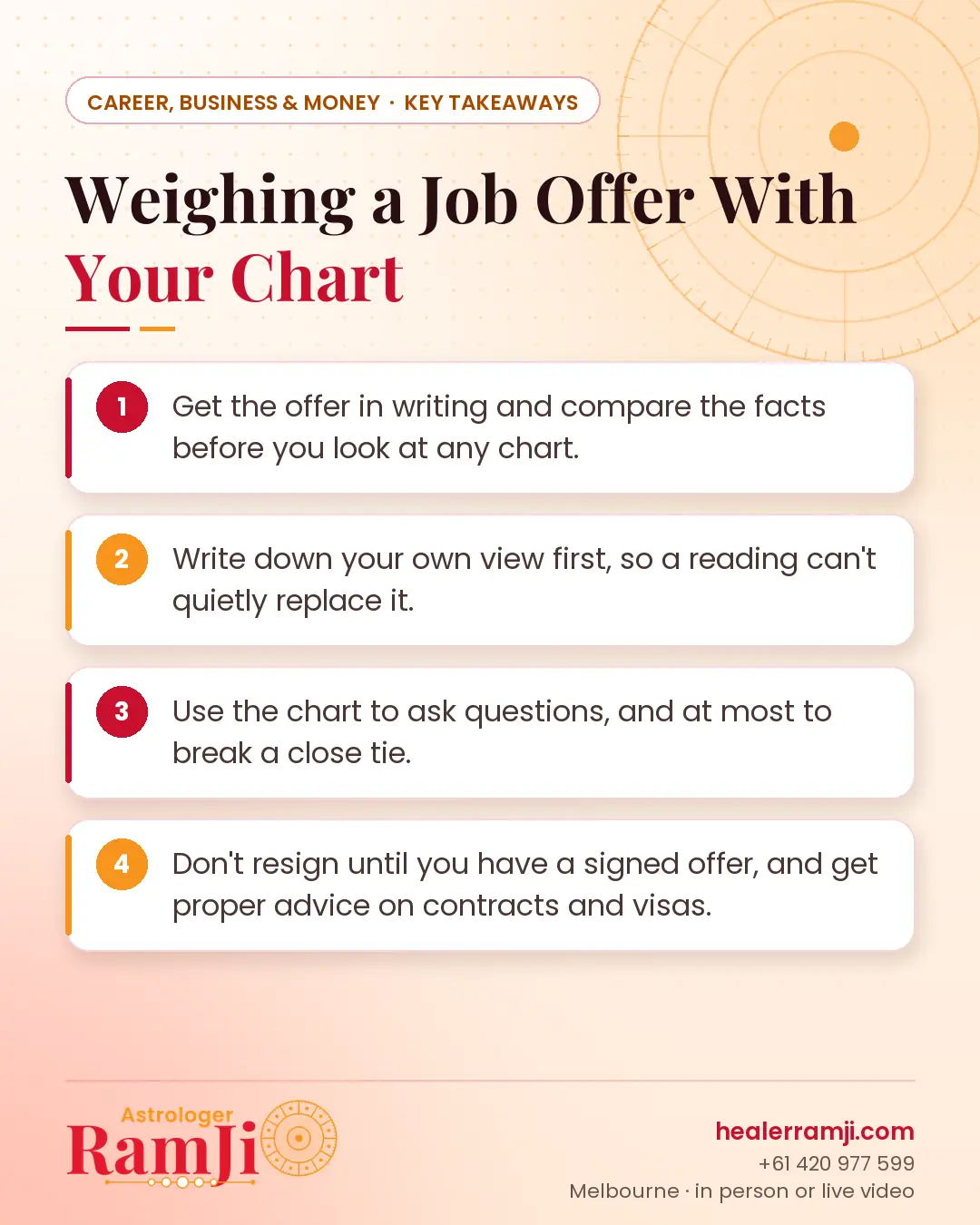
- Get the offer in writing and compare the facts before you look at any chart.
- Write down your own view first, so a reading can't quietly replace it.
- Use the chart to ask questions, and at most to break a close tie.
- Don't resign until you have a signed offer, and get proper advice on contracts and visas.
Step 1: What exactly is on offer?
A verbal offer is a good start, but you can't weigh it properly until you have it in writing. Check for these details:
- Job title, duties and who you will report to
- Base pay, super and any bonus, and how firm that bonus really is
- Full-time, part-time, casual or fixed-term status
- Hours, rosters, overtime and any work from home
- Probation and notice periods
- Any restraint clause that limits where you can work later
The Fair Work Ombudsman has free information on pay, conditions and notice, and it is the right place to check your entitlements. If a clause worries you, ask a lawyer or your union to look at it.
Step 2: How do the two jobs compare?
Put your current job and the offer next to each other, and give each one a score out of five on these questions:
- Money. What will you actually take home each week?
- Time. How long is the door-to-door trip? A move across Melbourne can quietly take hours from your week.
- Growth. What will you know in two years that you don't know now?
- People. What did you make of the manager? What are former staff saying?
- Stability. How steady is the employer and the role?
- Home. What does this do to school runs, care for parents and time with your partner?
Don't just add up the scores. Circle the one or two questions that matter most to you at this stage of life.

Step 3: What do you think already?
Before any reading, write down your answer in a sentence: "Right now, I lean towards yes, because..." Seal it away if you like. This step matters more than it looks. Without it, you may later credit the reading for a decision you had already made, or feel you have to go against your own good judgement.

Step 4: What can your chart add?
Now the chart has a place at the table. Astrology has not been shown to predict how a job will turn out, so treat this as reflection based on a tradition. Bring only a few questions:
- What period am I in? A reader will look at your dasha and whether it is usually read as a time for growth or for consolidation. See whether a chart can show a good time to change jobs.
- What do the career houses emphasise? The tenth house and the sixth house of daily work may suggest whether this role suits your preferred way of working.
- Where should I look more closely? A good reading may prompt you to ask more about the manager, the workload or your own patterns. If you have had the same trouble in several jobs, this page on repeating work conflict may be useful.
A job change reading is built around exactly this kind of specific choice.
What can't a chart tell you about this job?
It can't tell you whether the company is solvent, whether the manager is fair, or whether the pay is legal. It can't confirm that the offer is secure. It won't know how the role affects your visa or your tax. A reading that sounds certain about any of these is claiming more than the method can do.
Be wary, too, of any reader who says you must buy a ritual or a gemstone before you can safely accept. No decent reading ever attaches a price tag to a decision like this.
Step 5: How do you weigh it all up?
A simple rule helps:
- If the facts clearly favour one option, go with the facts, whatever the reading suggested.
- If the facts are close, the chart can serve as a tie-breaker if that sits well with you. So can your gut, or a trusted friend.
- If the reading unsettles you, ask what exactly bothers you, then see whether you can check it in the real world. A worry about "conflict" may become a phone call to someone who has worked there.
As a purely hypothetical case, say the new job pays more, has shorter travel and offers better training, while a reader describes your current period as one for staying put. The facts are lopsided here. A sensible response is to accept and take extra care in your first few months, not to turn it down out of fear.
Step 6: How do you respond in time?
It is normal to ask for a day or two to consider an offer, so long as you are polite and specific. Ask for what you need, such as the contract or a chat with the manager. Then respond by the date you agreed.
Some families like to sign or start on an auspicious day, using muhurta. If this matters to you, it can be a nice touch when there is room for it, and a reader can suggest options. But don't risk a good offer by making an employer wait weeks for a date, and don't treat an ordinary date as bad luck.

What should you sort out before you resign?
- Get the offer signed first. Hold off on resigning until you have the signed contract and any pre-employment checks are done.
- Check your notice period. It may come from your contract, award or enterprise agreement. The Fair Work Ombudsman can explain the rules.
- Check your visa. If your visa is linked to your employer, talk to a registered migration agent before you resign. Don't rely on a reader or a friend for this.
- Check your money. If there is a gap between jobs, make sure you can cover it. Questions about super or leave payouts can go to a registered financial adviser or your payroll team.
What if your family astrologer says no?
Many families have a trusted astrologer, and their word carries weight. Listen respectfully and ask them to explain their reasons. Then remember that you are the one who has to go to work. You can say, "I have heard you, and I'll take that into account." It is your call to make.
If you are wrestling with this, a career timing reading can give you a wider view of the years ahead. Sessions can be held by phone, WhatsApp or video, and fees are stated upfront. If you have a deadline, please get in touch.

Related service

Keep reading

Saturn and Work: The Slow Years
How Vedic astrology reads Saturn and career: why slow years at work can still count, and how to tell patient progress from being stuck.
Read article →
Restarting Your Career After Migrating
Restarting a career after migrating to Australia: getting overseas qualifications recognised, coping with the loss of professional identity, and pacing yourself.
Read article →
After a Redundancy: Steadying Yourself
Just been made redundant? Check your entitlements with official sources first, steady your money and wellbeing, then make room to reflect on what comes next.
Read article →Quick answers
Can a chart show a good time to change jobs?
A chart can suggest phases to reflect on, but it can't confirm a good time to move. Here is what can be estimated, and what to check before you resign.
Read answer →Can astrology help me choose a career?
Astrology can prompt useful questions about work, but it can't pick your career. Here is what a chart may suggest, its limits, and who to ask for real advice.
Read answer →Talk to Vijay Ramji
Tell us what you are facing. If a reading is unlikely to help, you will be told that plainly.