
Saturn's Return in Vedic Astrology
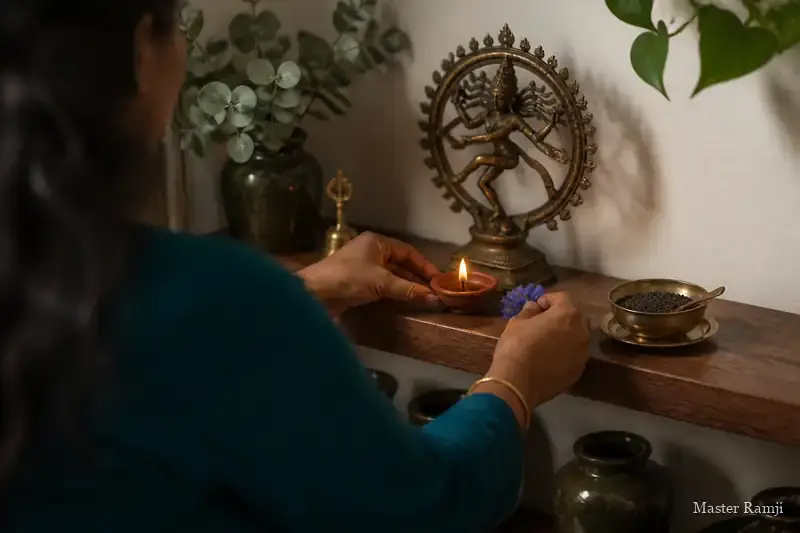
In Vedic astrology, Saturn's return is the period when Saturn moves back through the sign it occupied at your birth, roughly every 29 to 30 years. Astrologers read the late twenties and late fifties as years of restructuring and responsibility. It is a traditional interpretation, not a forecast of loss or failure.
Somewhere around 28 or 29, many people find that their life wants rearranging. A job stops fitting, a relationship asks for a decision, or a move overseas finally feels real. Astrologers have a name for this stretch: the Saturn return. It comes around again in the late fifties, often with a very different set of questions.
This page explains how the idea works in Jyotish, why your Vedic dates may not match a Western app, and how to use these years for steady rebuilding rather than worry.
Key takeaways
- A Saturn return is Saturn coming back to its birth position, about every 29 to 30 years.
- Vedic astrologers usually read it by sidereal sign, so dates often differ from Western charts.
- The house Saturn occupies in your chart shapes how the return is read, and it can overlap with Sade Sati.
- The tradition reads these as years of restructuring. They are not a sentence of bad luck.
What is a Saturn return?
Saturn moves slowly. NASA gives its orbit as about 29.4 years, so it spends roughly two and a half years in each sign. When it arrives back at the place it held when you were born, astrologers call this a return.
The term itself comes mostly from Western, or horoscopic, astrology. Western astrologers often treat the first return as influential from about age 27 to 30, with the second following around the late fifties. Some people live to see a third, in their late eighties.
Jyotish watches Saturn closely, but Vedic astrologers have traditionally talked about Saturn's transit, or gochara, through each house rather than about a single "return" event. In practice, many Vedic astrologers now use the phrase for Saturn's passage through the sign it occupied at your birth.
Why do Vedic and Western dates differ?
There are two reasons. First, Vedic astrology uses the sidereal zodiac, which currently sits more than 20 degrees away from the tropical zodiac used in most Western charts. Your natal Saturn may be in a different sign in each system, and Saturn enters and leaves that sign at different times.
Second, the methods differ. Many Western astrologers focus on the exact degree where Saturn sat at birth. Many Vedic astrologers look at the whole sign, which gives a broader window of around two and a half years. Saturn also appears to move backwards for part of each year, so it can cross the same point more than once before moving on.
None of this means one system is right. It means you should ask any astrologer which method they use before comparing dates with a friend's app.

How does a Vedic astrologer read your return?
Two people can turn 29 in the same month and have very different returns. A careful reader usually asks:
- Which house holds natal Saturn? Saturn returning to the tenth house is often read through work and public duty. In the seventh, it is read through partnership. In the fourth, through home and family.
- Where is Saturn from your Moon? If natal Saturn sits in the twelfth, first or second sign from your Moon, the return falls inside Sade Sati. The two cycles run on almost the same clock, so they may line up each time.
- How strong is Saturn in the chart? A well-placed Saturn may be read as patient building. A strained one may be read as heavier pressure.
- Which dasha are you in? Your planetary periods run on their own timeline. A Saturn return during a Saturn period may be read with more weight than one during a Jupiter or Venus period, which a dasha period analysis can map out.
What does the late-twenties return tend to bring?
The tradition links Saturn with structure, duty and lasting results. At the first return, astrologers often describe a shift from trying things out to committing to some of them. The themes people bring up tend to include:
- A career that was a stopgap now needing a real decision
- Relationships moving towards marriage, or ending
- Money becoming serious, perhaps a first loan or a first real savings goal
- Moving cities or countries, or settling after a move
- Family roles changing as parents age
It is fair to point out that the late twenties are a busy time for most people anyway. Study ends, careers take shape and families start forming whatever the planets are doing. A Saturn return gives you a frame for reflecting on those changes. It doesn't prove that Saturn caused them.

What about the second return in the late fifties?
The second return gets less attention online, but many astrologers consider it just as important. At around 58 or 59, the restructuring is often about what you will carry into later life. Common themes include:
- Planning for retirement or a change in working hours
- Children leaving home, marrying or needing support
- Caring for very elderly parents, sometimes in another country
- Paying more attention to health and daily routines
- Deciding what to keep, what to hand on and what to let go
Many people describe this return as quieter but deeper. The tradition reads it as a time for consolidating what you have built, not for starting from nothing.
Should you avoid big decisions during a Saturn return?
Not automatically. Avoiding every decision for two or three years would be impractical, and the tradition doesn't ask for it. A better approach is to make decisions more carefully:
- Slow down the big ones. Give yourself more time than usual to check facts and costs.
- Favour structure. Clear budgets, written plans and steady routines suit Saturn's themes.
- Finish before you start. Closing old commitments often matters more than opening new ones.
- Get the right advice. A chart can't judge a loan, a contract or a health concern. Take those to a licensed adviser, a lawyer or a GP.
If work is the main pressure, our piece on Saturn and the slow years at work looks at telling patient progress from being stuck.
Are there remedies for a Saturn return?
Traditional responses include Saturday prayers, Shani mantras, service to older people or those doing hard physical work, and simple discipline in daily life. These are devotional practices. They can give a difficult stretch some shape, but they can't change outside events or remove ordinary problems.
Be careful if anyone tells you a return will bring disaster unless you pay for a costly ritual or gemstone. Fear is not part of an honest reading, and nobody can sell you protection from a normal stage of life.
How can a reading help?
A Saturn and Jupiter transit reading can work out when Saturn crosses your natal sign, which houses it touches, and whether the return overlaps with Sade Sati or a significant dasha. If Sade Sati is the bigger concern, a Sade Sati consultation focuses on that cycle. Bring a reliable birth time if you have one, and say so if you don't, as house-based readings depend on it.
Sessions can be held by phone, WhatsApp or video, and fees are stated before any paid work begins. If you would like your own dates worked out, get in touch.
Related service
Keep reading

What a Jupiter Transit Actually Changes
Jupiter transit effects in Vedic astrology, explained plainly: why a good transit is read as an opening, not a reward, and how to use one without overreaching.
Read article →
Sade Sati Myths That Cause Needless Fear
Common sade sati myths set against what Vedic tradition actually says, from the idea that it ruins every life to the third-round scare. Calm and practical.
Read article →
The Three Phases of Sade Sati
Rising, peak and setting: what each phase of Sade Sati is traditionally linked with, why the edges blur, and how to use the themes without fear.
Read article →Quick answers
What is a kundli?
A kundli is a Vedic birth chart that maps the planets at your exact time and place of birth. Here is what it shows, in plain words.
Read answer →What details do I need for a kundli reading?
A kundli reading needs your date, time and place of birth, plus a clear question. Here is how exact each detail should be, and what to do if one is missing.
Read answer →Talk to Vijay Ramji
Tell us what you are facing. If a reading is unlikely to help, you will be told that plainly.