
Restarting Your Career After Migrating

To restart your career after migrating to Australia, first find out who recognises your qualification, because it depends on your occupation. Use free services such as Victoria's Skills and Jobs Centres, build local experience and contacts, and give yourself time. Losing your professional identity for a while is hard, and it is not a failure.
You may have been an engineer, a nurse, an accountant or a teacher for years. Then you land in Australia and the first question in every interview is about "local experience", which you can't have yet. Meanwhile the bills arrive on time.
This guide is about that gap. It covers the practical steps for getting your skills recognised, and the quieter problem that often hurts more: feeling that you have lost who you were.
Key takeaways
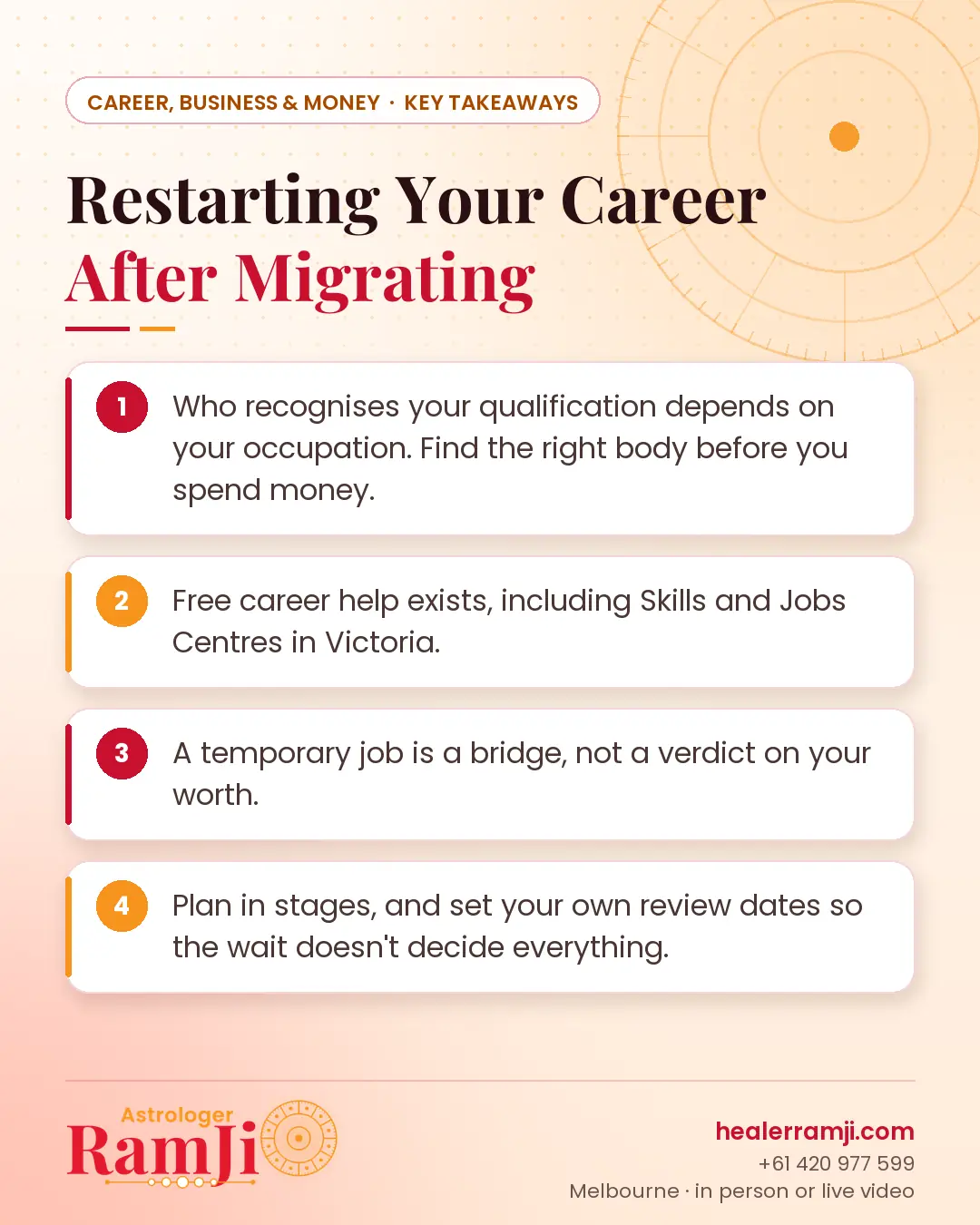
- Who recognises your qualification depends on your occupation. Find the right body before you spend money.
- Free career help exists, including Skills and Jobs Centres in Victoria.
- A temporary job is a bridge, not a verdict on your worth.
- Plan in stages, and set your own review dates so the wait doesn't decide everything.
Who decides whether my qualification counts?
There isn't one office for everyone. Roughly, it works like this:
- Regulated professions. Health, law, teaching, engineering in some fields and other licensed work have their own registration or accreditation bodies. For example, overseas-trained health practitioners must be registered with the National Board for their profession before they can practise, as Ahpra's guidance for international practitioners explains.
- Trades. Trades Recognition Australia assesses many trade skills, and some trades also need a state licence before you can do the work. Our article on moving from an overseas qualification to a local trade sets out those steps in more detail.
- Unregulated jobs. For many office, business and technical roles, there is no licence. The employer decides how much weight your overseas degree carries.
Rules and assessment services change from time to time. Always check the current official page for your occupation, not an old forum post. Visa questions are separate again. A registered migration agent or a lawyer should answer those.

Where can I get free help?
In Victoria, Skills and Jobs Centres offer free career, employment and training support to everyone, regardless of visa status. Services include career counselling, help with resumes and job searching, and workshops, one of which covers converting an overseas qualification. Book an appointment with your nearest centre.
Other useful steps:
- Professional associations. Many have migrant or early-career programs, mentoring and events. Membership can also help you understand local standards.
- Volunteering in your field. Short, well-chosen volunteer work can give you a local referee and something current to talk about.
- A local-style resume. Australian resumes tend to focus on achievements and skills. A careers counsellor can help you reshape yours.
- Your rights at work. Whatever job you take while you wait, check your pay and conditions with the Fair Work Ombudsman.
Be careful with anyone who promises a fast-tracked assessment or a guaranteed job for a fee. Check with the official body first.
Why does it hurt so much?
Work is more than income. For many people it is status, routine, friendships and a sense of being good at something. Migrating can remove all of that at once. You may go from leading a team to being the newest person in a warehouse, a call centre or a café.
That loss is real, and it deserves to be named. People often feel embarrassed, or angry with themselves for "wasting" years of study. Some hide their situation from family overseas. Others feel guilty for struggling when they know they chose to come.
None of that means you made a mistake. It means you are in the middle of a hard transition. Your skills haven't disappeared. They are waiting to be recognised in a new system.
How do you stay patient without giving up?
Patience works better with a plan. Many people find it helps to think in three tracks at once:
- Income now. A bridge job that pays the rent and leaves you some energy.
- Recognition. The steps your occupation requires, done in order, with copies of everything.
- Connection. One or two small actions a week to meet people in your field.
Then pick a date a few months away to review. Ask yourself what has moved, what it has cost, and whether a nearby role might use your experience sooner. Some people move into a related field and find they prefer it. Others stay the course. Both are reasonable.

Can a career reading help?
Some people find it steadying to look at a slow period through their chart. In Vedic astrology, the tenth house is linked with work and public standing, and a reader may look at your current dasha to describe what kind of phase you are in. Our guide to what the tenth house says about work explains the basics.
A chart can't tell you whether an assessment will succeed, how long a visa will take or which employer will call back. Don't time an application around a reading, and walk away from anyone who says a ritual will clear your paperwork. What a career timing reading can offer is a calm space to sort priorities and think about sequence.

What if it starts to affect your health?
Long waits and lost status can wear anyone down, and isolation often makes it worse. Our piece on loneliness after migrating looks at that side of things.
Please see a GP if you have felt low or anxious for more than a couple of weeks, you aren't sleeping, or you are relying on alcohol to get through. Beyond Blue is on 1300 22 4636. If things feel too heavy, call Lifeline on 13 11 14 at any hour. Asking for help is part of looking after the person who will one day be back at work in their field.

Want to talk it through?
Sessions can be held by phone, WhatsApp or video, which helps if you work shifts. What you share is confidential, and any fee is stated before paid work begins. If a calm conversation about timing and next steps would help, get in touch.
Related service

Keep reading

After a Redundancy: Steadying Yourself
Just been made redundant? Check your entitlements with official sources first, steady your money and wellbeing, then make room to reflect on what comes next.
Read article →
When Work Conflict Follows You From Job to Job
Same clash, different job? How to spot your own pattern in repeated workplace conflict, what a birth chart can add as a mirror, and when it's really bullying.
Read article →
Choosing What to Study With Your Family Watching
Choosing a study field when your Indian parents have strong views? How to understand their worries, research options together and keep the decision yours.
Read article →Quick answers
Can astrology help me choose a career?
Astrology can prompt useful questions about work, but it can't pick your career. Here is what a chart may suggest, its limits, and who to ask for real advice.
Read answer →Which house shows career in Vedic astrology?
In Vedic astrology, the tenth house is the main house of career. Here is what else a reader looks at, where views differ, and what a chart can't tell you.
Read answer →Talk to Vijay Ramji
Tell us what you are facing. If a reading is unlikely to help, you will be told that plainly.