
What Your Tenth House Says About Work
In Vedic astrology, the tenth house is the main house of career, public role and duty. A reader looks at its sign, its lord, planets placed there and your current dasha. It suggests themes and working styles, not a job title, and it is a tradition of interpretation, not a proven predictor.
People often come to a chart hoping for one clear answer: "What job am I meant to do?" The tenth house is where astrologers look first, and it can open up a useful conversation. But it won't print a job title.
This page explains what the tenth house covers in Vedic astrology, what a careful reader looks at, and why a good reading describes themes and leaves the decisions to you.
Key takeaways
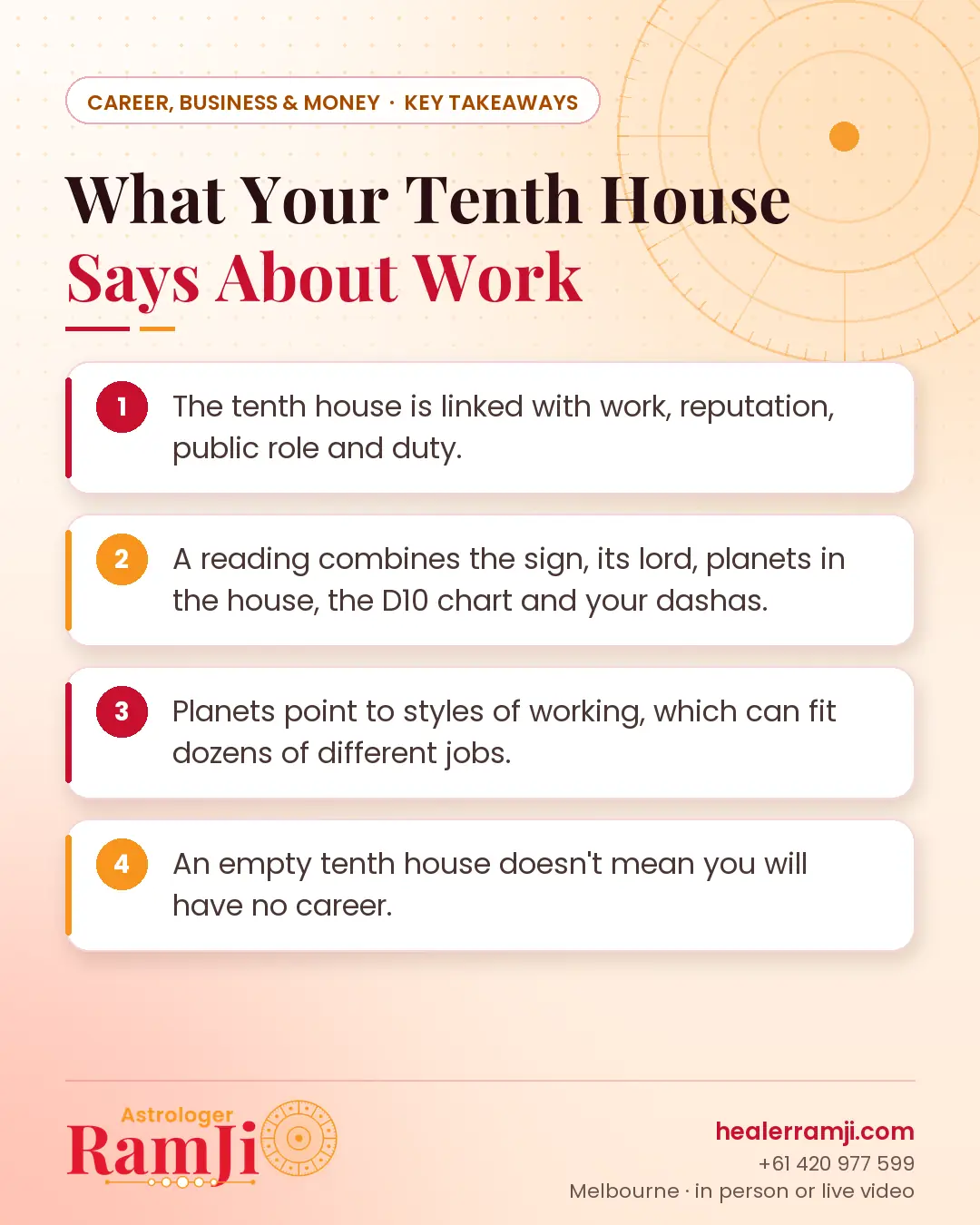
- The tenth house is linked with work, reputation, public role and duty.
- A reading combines the sign, its lord, planets in the house, the D10 chart and your dashas.
- Planets point to styles of working, which can fit dozens of different jobs.
- An empty tenth house doesn't mean you will have no career.
What does the tenth house cover?
The tenth house is often called karma bhava, the house of action. Counted from your lagna, or rising sign, it sits at the top of the chart and is linked with what you do in public view: your occupation, standing, authority and sense of duty.
Two traditional labels help explain how it is read. It is a kendra, or angular house, which is considered a strong position in the chart. It is also an upachaya, or house of growth, which traditionally suggests results that improve with effort and time. That is a helpful idea for anyone who feels they started late. For how it fits with the others, see our plain guide to the twelve houses.

What does a reader actually look at?
A single placement never settles the question. A reader normally works through several layers:
- The sign on the tenth house. This colours the style of work. An earth sign, for example, is often read as practical and steady.
- The tenth lord. This is the planet ruling that sign. The house where it sits suggests where your work energy tends to flow.
- Planets in or aspecting the tenth. These add their own themes, helpful or demanding.
- The natural significators. Many teachers look at the Sun, Mercury, Jupiter and Saturn for matters of status, skill, wisdom and labour.
- Related houses. The second (income), sixth (daily work and service) and eleventh (gains and networks) help fill in the picture.
- The D10 chart. The dashamsha divides each sign into ten parts and gives a closer view of career. It is used to refine the main chart and shouldn't be read alone.
- Timing. Your dasha periods and major transits show which of these themes may be more active.
Traditions differ here. Many readers also count the tenth from the Moon as well as the lagna. Jaimini astrologers give weight to the amatyakaraka, a planet chosen by its degree. House systems differ too. If two astrologers disagree, that is often why, and it's a fair question to ask them.
What do planets in the tenth suggest?
These are traditional themes, not forecasts:
- Sun: visibility, authority, leading or working in government
- Moon: dealing with the public, caring roles, work that changes often
- Mars: action, technical skill, competition, physical or urgent work
- Mercury: words, numbers, trade, analysis, communication
- Jupiter: teaching, advising, law, guidance
- Venus: design, beauty, hospitality, the arts, diplomacy
- Saturn: structure, endurance, service, slow advancement (see Saturn and work)
- Rahu and Ketu: unusual paths, foreign links, or a feeling of detachment from status
Most charts have some of these and not others, and each planet also behaves differently depending on its sign and strength.
Why can't a chart name your job?
Take Mars in the tenth house as a generic example. Older texts might connect it with soldiers and surgeons. Today the same theme could fit an electrician, a firefighter, a paramedic, a project manager under tight deadlines, or a sports coach. It could also describe someone who keeps clashing with their boss. The planet describes an energy, and you are the one who decides how it gets used.
Classical texts also never mentioned data analysts, disability support workers or app developers. Any reader who claims to see one exact profession is going beyond what the method can do. And a chart knows nothing about your qualifications, your visa, your family's needs or what the Melbourne job market is doing this year.

Is an empty tenth house a problem?
No, and it is one of the most common worries. A house with no planets in it still has a sign and a lord, and those are read in the usual way. Plenty of charts have an empty tenth. Treat any reader who uses it to frighten you, or to sell you a costly remedy, with suspicion.
The same goes for a difficult planet there. Traditional texts see challenge and effort, not a closed door.

What does a good reading sound like?
Compare these two statements:
- Overreaching: "You will be a doctor by thirty." "Business will never work for you."
- Careful: "Your chart emphasises service and structure. Do roles with clear responsibility suit you? How does that match what you've tried so far?"
The second kind gives you something to test against your own life. For a short version of this question, read which house shows career.
How much does birth time matter here?
Quite a lot. The lagna sets where the tenth house falls, so an uncertain time can change the whole reading. The D10 is more sensitive still. Each division spans only three degrees, which on average means a new D10 rising sign about every twelve minutes. If your time is only approximate, a reader should lean on the main chart and say so. Our guide to accurate birth details shows how to check yours.
What should you do with a tenth house reading?
Use it to form better questions. What sort of work has given you energy so far? Where have you felt out of place? Do you want a visible role or a quiet one?
Then take those questions to people who know the actual job market. Victoria's Skills and Jobs Centres offer free career and training advice, and they are open to everyone. A chart may help you reflect. A career practitioner can tell you what a path requires.
A career timing reading looks at your tenth house alongside your current periods. No reading can tell you what is certain to happen. Sessions can be held by phone, WhatsApp or video. To ask a question first, please get in touch.

Related service

Keep reading

Changing Careers at 40
Thinking about a career change at 40? What astrology can offer for timing reflection, and the money, training and family planning that must sit beside it.
Read article →
Weighing a Job Offer With Your Chart
Should you accept a job offer? A simple decision framework where astrology is one input, after the pay, contract, visa and family questions are answered.
Read article →
Saturn and Work: The Slow Years
How Vedic astrology reads Saturn and career: why slow years at work can still count, and how to tell patient progress from being stuck.
Read article →Quick answers
Can astrology help me choose a career?
Astrology can prompt useful questions about work, but it can't pick your career. Here is what a chart may suggest, its limits, and who to ask for real advice.
Read answer →Which house shows career in Vedic astrology?
In Vedic astrology, the tenth house is the main house of career. Here is what else a reader looks at, where views differ, and what a chart can't tell you.
Read answer →Talk to Vijay Ramji
Tell us what you are facing. If a reading is unlikely to help, you will be told that plainly.