
Sade Sati Myths That Cause Needless Fear

The commonest sade sati myths are that it always brings disaster, that a ritual can remove it, that nothing good can begin during it, and that a third round is fatal. The tradition itself supports none of these. Sade sati is a belief about Saturn's slow transit, and careful astrologers read it alongside the whole chart.
Few phrases in Vedic astrology cause as much worry as sade sati. Mention it at a family dinner and someone will have a story about a lost job, an illness or a marriage that went wrong "during Saturn's time". Stories like these travel fast, and they lose detail with every retelling.
This article takes the commonest scare stories one at a time and sets each against what the tradition actually teaches. If sade sati matters to your family, you don't have to dismiss it. You only need to see where fear has run well ahead of the teaching.
Key takeaways
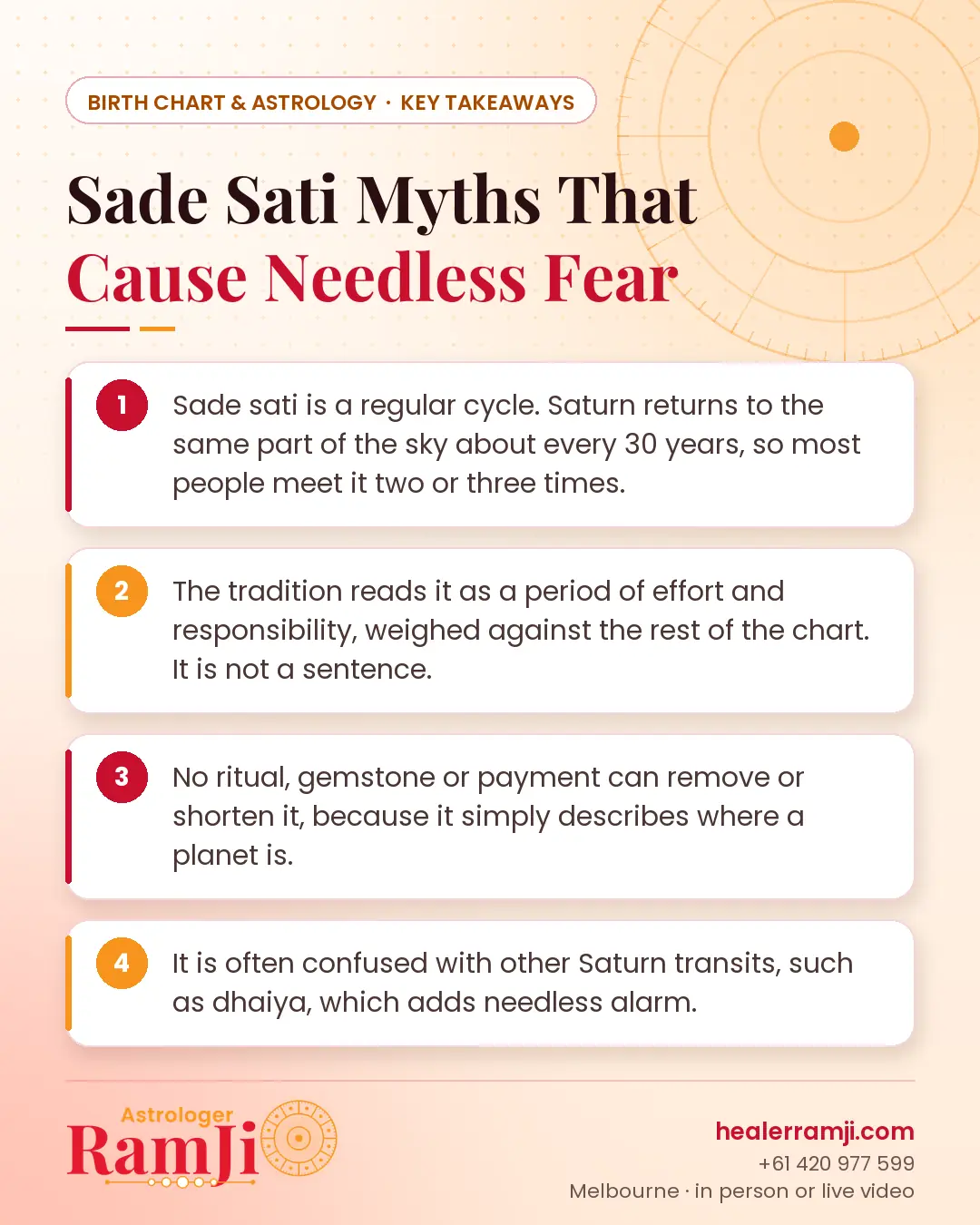
- Sade sati is a regular cycle. Saturn returns to the same part of the sky about every 30 years, so most people meet it two or three times.
- The tradition reads it as a period of effort and responsibility, weighed against the rest of the chart. It is not a sentence.
- No ritual, gemstone or payment can remove or shorten it, because it simply describes where a planet is.
- It is often confused with other Saturn transits, such as dhaiya, which adds needless alarm.
Does sade sati always bring disaster?
No. In Jyotish, Saturn is classed as a natural malefic. That sounds frightening until you look at what it governs: work, patience, duty, endurance and the slow results of effort. Many astrologers describe it as a strict teacher, not a punisher. For people with Taurus or Libra rising, Saturn is even counted as a yogakaraka, a planet expected to give good results, because of the houses it rules in those charts.
People finish degrees, buy homes, marry and raise children during these years. The tradition expects the period to ask more of you. It does not expect it to take everything away.
Is it rare, and a sign you are unlucky?
It is the reverse of rare. Sade sati covers Saturn's passage through the sign before your Moon sign, the Moon sign itself and the sign after it. Since three of the twelve Moon signs are always in it, a large share of the people you know are in it today. NASA gives Saturn's orbit as about 29.4 Earth years, which is why the cycle comes round again three decades later. Being in it says nothing about your luck. It only says where Saturn is. For a quick definition, see what sade sati is and how long it lasts.

Is the middle phase always the worst?
Not by any agreed rule. The three stages are often called rising, peak and setting, and folk wisdom treats the middle one, when Saturn crosses your Moon sign, as the hardest. Astrologers disagree. Some say the opening stage weighs more on certain Moon signs and the closing stage on others. Many hold that people with the Moon in Capricorn or Aquarius, the signs Saturn rules, often find the whole stretch milder. Others care more about Saturn's strength in the birth chart. Our guide to what each of the three phases is linked with sets out the traditional themes.
Is a dhaiya the same thing?
No, and this mix-up causes a surprising amount of worry. Shani dhaiya, sometimes called small panoti, is a separate transit of about two and a half years. It happens when Saturn moves through the fourth or eighth sign from your Moon. The eighth-house version is usually called ashtama Shani, and the fourth-house version is often called ardhashtama Shani, though names vary between lineages. These periods are also read with some care, but they are not sade sati, and they don't last seven and a half years. If someone tells you that you are "in sade sati again" only a few years after one ended, ask which transit they actually mean.

Can nothing good begin during sade sati?
This myth costs people the most, because it makes them wait. Seven and a half years is a long time to hold off on a wedding, a business or a family. Muhurat traditions choose good dates within sade sati all the time. A careful reader looks at your current dasha, where Saturn sits in your birth chart, and the specific date being chosen. Real decisions also rest on money, health, relationships and professional advice, none of which a transit can weigh for you.
Will a ritual or gemstone remove it?
No. Sade sati is the name for a planet's position, and Saturn keeps moving at its own pace whatever anyone does. Traditional practices such as prayer to Hanuman or Shani, a sesame oil lamp on Saturdays, fasting where health allows, and charity are acts of devotion. People do them to feel steadier and to honour Saturn's values of service and discipline. Nobody can show that they change outcomes. Iron rings and blue sapphires are often sold at these times, and many astrologers consider the sapphire unsuitable for a large number of charts. Our list of remedies that cost nothing covers simple practices that need no purchase at all.
A remedy sold with a deadline, a warning of disaster, or a price that keeps rising is a red flag, whatever the planet involved.
Does a child's sade sati harm the parents?
Some families believe one person's transit spills onto everyone in the house. That idea isn't part of the standard teaching. Each chart is read for its own person. It is also unkind to blame a child, a new daughter-in-law or an elderly parent for a family's difficult year because of their Moon sign. And an adult's chart should only be read with their consent.
Is the third sade sati fatal?
You may hear that the first round affects health, the second career, and the third brings death. This is a folk saying, not a rule in the classical texts, and it has no factual basis. Someone in a third sade sati is usually in their sixties or later, when health naturally needs more attention whatever the sky is doing. That is a good reason for regular check-ups with your GP. It is not a reason to fear a date.
If life is hard, is Saturn the cause?
Once you know you are in sade sati, every late train and tense meeting can look like proof. Psychologists call this confirmation bias: we notice what fits the story and forget what doesn't. Hard years have ordinary causes too. Poor sleep, tiredness, irritability and worry are common signs of stress, and they respond to practical help. If you have felt low or anxious for a while, please see your GP. If you need to talk to someone now, Lifeline is available on 13 11 14 at any hour.
What does the tradition actually ask of you?
Read generously, sade sati is a prompt to build steady habits: keep commitments, look after your health, finish what you start, and treat people who have less with respect. None of that needs fear or money.
If you'd like to know whether sade sati applies to you, which phase you are in and how it sits with the rest of your chart, a calm sade sati consultation can work through it with you. Fees are stated before any paid work, and sessions can be held by phone, WhatsApp or video. When you're ready, get in touch.
Related service

Keep reading

The Three Phases of Sade Sati
Rising, peak and setting: what each phase of Sade Sati is traditionally linked with, why the edges blur, and how to use the themes without fear.
Read article →
The 27 Nakshatras: A Beginner's Guide
A plain guide to the 27 nakshatras: why Jyotish puts the Moon's star ahead of your sun sign, how the stars are ordered, and what a birth star can't tell you.
Read article →
Choosing a Baby Name from the Birth Star
How families pick a baby name by nakshatra: finding the birth star and pada, using its syllable, and fitting it with Victorian registration rules.
Read article →Quick answers
What is Sade Sati?
Sade Sati is a Saturn transit of about seven and a half years in Vedic astrology. Here is how it is worked out, why dates differ, and why it needn't cause fear.
Read answer →What is a kundli?
A kundli is a Vedic birth chart that maps the planets at your exact time and place of birth. Here is what it shows, in plain words.
Read answer →Talk to Vijay Ramji
Tell us what you are facing. If a reading is unlikely to help, you will be told that plainly.