
When Work Conflict Follows You From Job to Job

Repeated workplace conflict often has a pattern you can learn to spot: the same trigger, the same kind of person, or the same stage in a job. A birth chart can act as a mirror, with Mars, Saturn, the Sun and the sixth house prompting questions. First rule out bullying, which is a safety issue, not a chart issue.
The first time, it was a difficult manager. The second time, a team that didn't pull its weight. By the third job, a quiet question starts to form. Why does this keep happening to me?
That question takes courage. Repeated workplace conflict deserves a better answer than "your stars are bad" or "everyone is against you". This article shows how to look for your own pattern, how a birth chart can be used as a mirror for that work, and how to tell a pattern from something more serious.
Key takeaways
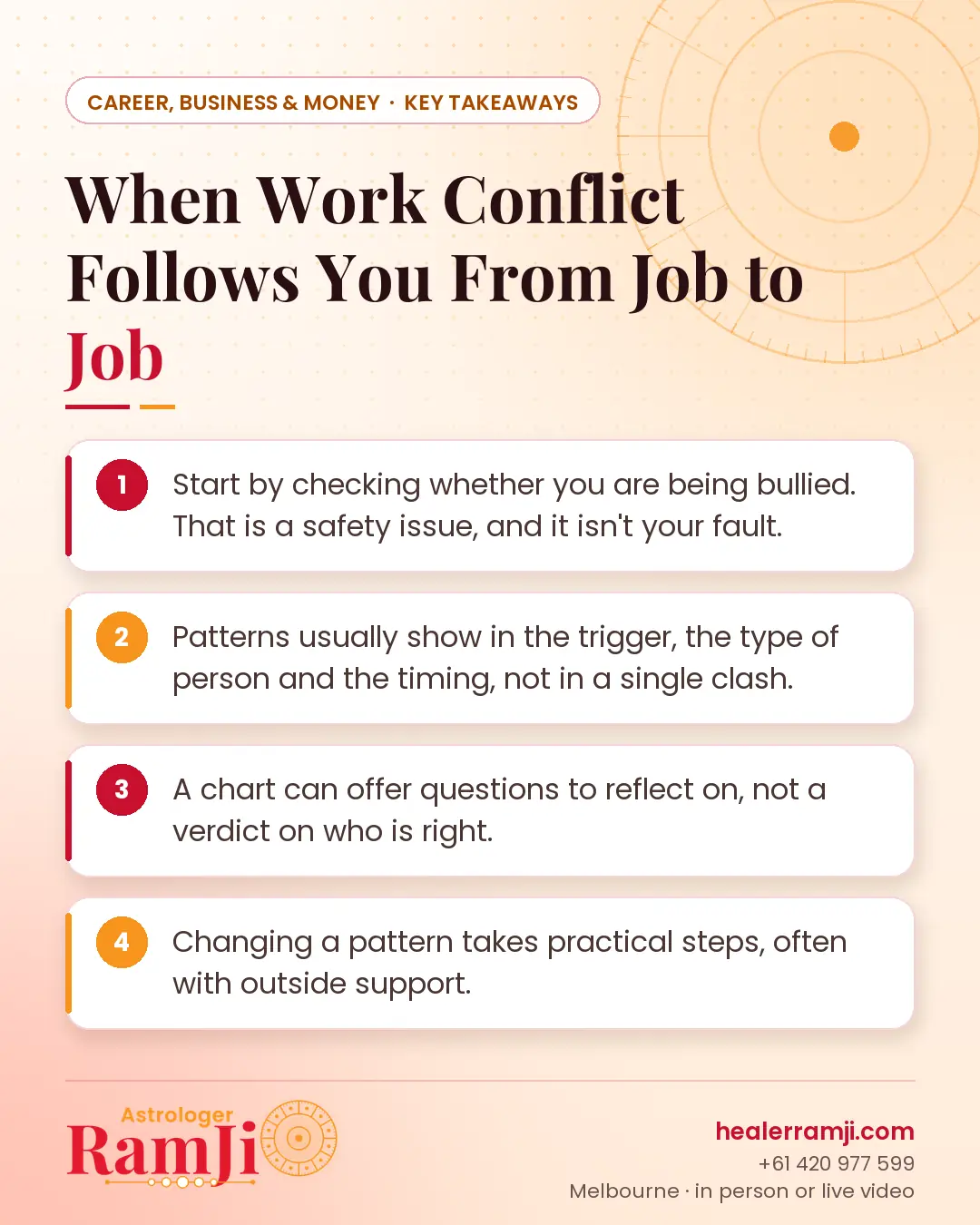
- Start by checking whether you are being bullied. That is a safety issue, and it isn't your fault.
- Patterns usually show in the trigger, the type of person and the timing, not in a single clash.
- A chart can offer questions to reflect on, not a verdict on who is right.
- Changing a pattern takes practical steps, often with outside support.
Is it a pattern, or is it bullying?
Ask this before anything else. WorkSafe Victoria defines bullying as repeated, unreasonable behaviour directed at a person or group that creates a risk to health and safety. If that describes what is happening to you, the issue is the behaviour, not your chart and not your personality.
In that case, keep a dated record of incidents, raise it through your workplace's process if it is safe to do so, and get advice. WorkSafe Victoria explains how to report it, and the Fair Work Ombudsman and your union can also advise. Being targeted in more than one job can happen, sadly, especially to people who are new to a country, young or in insecure work.
If what you face is ordinary friction that keeps recurring, read on.
How do you spot your own pattern?
Memory blurs conflicts together. Writing them down helps. For each job, note the two or three clashes you remember most, then ask:
- Who was it with? Bosses, peers, people you managed, or clients?
- When did it start? In the first few months, after a promotion, after a new manager arrived?
- What set it off? Feedback, being overlooked, unfair workloads, rules you thought were pointless, or being interrupted?
- What did you do next? Argue straight away, go quiet and resent it, escalate, or leave?
- How did it end? Repaired, avoided, or with you resigning?
Look across the jobs. Many people find one row repeats. Perhaps it is always someone in authority. Perhaps it always begins when you feel your work isn't recognised. That repeated row is your pattern, and it is worth more than any reading.

How can a chart work as a mirror?
Used well, a chart doesn't tell you who is to blame. It offers themes, and you check whether they match what you found. Astrologers commonly look at a few areas for work friction:
- The sixth house. Linked with daily work, service, competition and disputes. Planets here are read as how you handle rivals and routine pressure.
- Mars. Linked with drive, courage and anger. A strong or pressured Mars is often read as quick reactions and a readiness to fight.
- The Sun and Saturn. The Sun is linked with authority and self-respect, Saturn with rules and hierarchy. Tension between them is often read as friction with bosses or systems.
- Mercury. Linked with speech and how you explain yourself. Many workplace arguments are really misunderstandings.
- The Moon. Linked with feelings. A sensitive Moon may suggest you take criticism to heart.
Our guide to what the tenth house says about work covers the career side of the chart, which a reader would look at alongside these.
How do you turn a chart theme into a question?
A theme is only useful once it becomes something you can test. A few generic examples:
- "Strong Mars in the sixth" becomes: do I take on fights that aren't mine to fight?
- "Sun under pressure from Saturn" becomes: do I hear every rule as a judgement of me?
- "Afflicted Mercury" becomes: do I send the sharp email before I have checked what the other person meant?
- "Sensitive Moon" becomes: do I need more feedback, or kinder feedback, than I ask for?
If a question matches your conflict log, you have found something to work on. If it doesn't, drop it. The log outranks the chart.

Do conflicts cluster in certain periods?
Some people notice that clashes bunch together in particular years. An astrologer may compare those years with your dasha periods. Our article on Saturn and the slow years at work looks at one common example. A link like this can be a helpful way to reflect, but it isn't proof that a planet caused anything, and it doesn't excuse behaviour that needs changing.
What actually changes a pattern?
- A pause rule. If your trigger is criticism, agree with yourself to wait a set time, such as overnight, before replying.
- Asking before assuming. "What did you mean by that?" heads off many fights.
- Feedback you choose. Ask a trusted former colleague what they saw. It can sting, and it is usually useful.
- Outside support. If your employer offers an employee assistance program, it is often free and confidential. A psychologist or coach can help with anger, people-pleasing or fear of authority.
- Choosing workplaces with care. If you clash with rigid hierarchy, ask about team culture in interviews.
Ongoing conflict also takes a toll. Beyond Blue's guidance on work and mental health lists relationships at work among the things that shape how we feel, and it has tools to check how you are going. If you feel low for weeks, talk to your GP.
Where does a reading fit?
A reading works best after you have done the log. Bring your pattern, and use the chart to explore it, not to replace it. If you are now weighing a move, a job change reading looks at a specific offer against your current period, and it treats staying put as a real option.
One rule matters here. Don't ask for a manager's or colleague's chart to find out what is wrong with them. Reading someone's chart without their agreement is not fair to them, and it rarely helps. Your own chart is the right place to look. If you would like to talk your pattern through, get in touch.
Related service

Keep reading

Choosing What to Study With Your Family Watching
Choosing a study field when your Indian parents have strong views? How to understand their worries, research options together and keep the decision yours.
Read article →
Choosing a Launch Date for Your Business
How to choose an auspicious date to start a business without missing registration deadlines: two calendars, backup dates, and which moment a muhurat should mark.
Read article →
Which Moment Counts: Registration or Opening Day?
Should a business muhurat mark the registration or the opening? The two views in the tradition, what ASIC rules require, and how to pick the moment you can control.
Read article →Quick answers
Can a chart show a good time to change jobs?
A chart can suggest phases to reflect on, but it can't confirm a good time to move. Here is what can be estimated, and what to check before you resign.
Read answer →Can astrology help me choose a career?
Astrology can prompt useful questions about work, but it can't pick your career. Here is what a chart may suggest, its limits, and who to ask for real advice.
Read answer →Talk to Vijay Ramji
Tell us what you are facing. If a reading is unlikely to help, you will be told that plainly.