
From Overseas Qualification to Local Trade in Thomastown

If an overseas qualification is holding up your career in Thomastown, deal with the official bodies directly: Trades Recognition Australia for skills assessment, the Department of Home Affairs for visas and points, and Victorian regulators for licences. Meanwhile, keep records, use free career services, look after your health, and set your own date to review your plan.
Thomastown has been shaped by people arriving with skills from somewhere else. Victorian Places traces German settlers at nearby Westgarthtown in the 1850s, then later Italian, Greek and Macedonian families, with factories across the south of the suburb. Its High Street shops and Mernda line station still serve plenty of working families. Some of them may have run a workshop in another country and now work a line job while their paperwork moves slowly.
If that's you, this page won't tell you whether your application will succeed. Nobody here can. It's about keeping your work life and your self-respect steady during the wait, and thinking clearly about whether to keep going or change direction.
Key takeaways
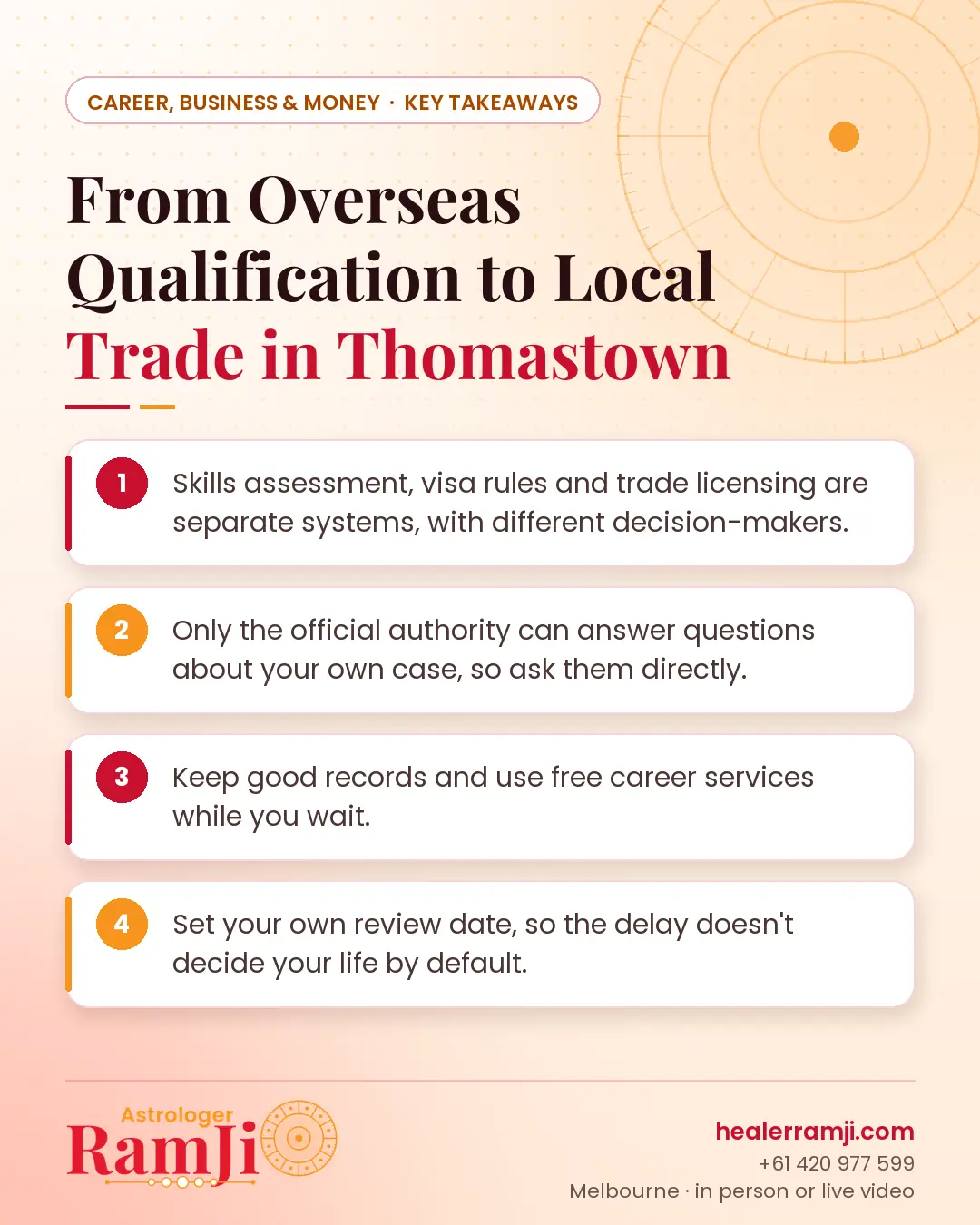
- Skills assessment, visa rules and trade licensing are separate systems, with different decision-makers.
- Only the official authority can answer questions about your own case, so ask them directly.
- Keep good records and use free career services while you wait.
- Set your own review date, so the delay doesn't decide your life by default.
Who actually decides what?
A lot of confusion comes from thinking of skills recognition in Australia as a single step. It usually isn't. Here is who to ask:
- Skills assessment for trades. Trades Recognition Australia is the Australian Government's assessing authority for many trades. Ask them which program applies to you, and what evidence they need.
- Visas and points. The Department of Home Affairs runs the visa system, including points tests and SkillSelect. Treat its own pages as the final word on points. For personal advice, use a registered migration agent or a lawyer.
- Electrical work. Energy Safe Victoria issues licences for electrical work. It says it doesn't assess overseas qualifications itself, and its website sets out the current steps for people trained overseas.
- Plumbing. The Building and Plumbing Commission handles plumbing registration and licensing in Victoria.
- Other occupations. VETASSESS and other assessing bodies cover different fields. Check which body your occupation falls under.
Rules change, and they differ by trade, by visa and by country of training. Be careful with advice from a friend, a Facebook group or a labour hire contact, even a kind one. What worked for them may not apply to you. Also, a positive skills assessment doesn't automatically mean you can legally do licensed work in Victoria. Don't take on work that needs a licence until you hold the right one.
Why do the delays hit so hard?
A delay isn't only about paperwork. You may have been the person others came to for answers, and now you're the newest person on a Thomastown factory floor, being told how to do something you could once have taught. Meanwhile, your family back home may be asking when you'll be "settled", while you are paying for assessments, courses and translations.
It can feel like losing part of who you are, and that can be hard to say out loud. It's a reasonable response to a hard situation, and it doesn't mean you've failed or that coming here was a mistake.

What can you do while you wait?
You can't speed up an assessor, but there is plenty you can control:
- Build one folder. Keep certificates, translations, payslips, references, job descriptions and photos of your work, along with copies of everything you send and receive.
- Keep a contact log. Write down who you spoke to, the date and what they said. This helps if the advice changes.
- Use free career help. Skills and Jobs Centres offer free career, employment and training support to all Victorians, regardless of visa status. Listed centres in the north include Melbourne Polytechnic at Preston, RMIT at Bundoora and Kangan Institute at Broadmeadows. Book first, as some need appointments.
- Check your pay and conditions. If you are in interim work, know your award. The Fair Work Ombudsman is the place to ask about pay and workplace rights, and being on a visa doesn't remove those rights.
- Keep your hand in. Short courses, English for your trade and local safety tickets can keep you ready, but check with the relevant authority before you pay for anything that promises to count towards recognition.
Beware of anyone who promises to get your assessment through for a fee, or who claims to know someone inside. Our general guide on restarting your career after migrating covers the wider picture, including networking.

Should you wait, or make a career change?
This is the hard question, and no one else can answer it for you. A few prompts may help you think it through, without pretending to predict the outcome:
- What would it cost to keep going for another year, in money, in energy and in family time?
- Which parts of your old work do you actually miss? Is it the tools, the responsibility or the status?
- Is there a nearby role that uses your experience, such as supervision, quality, estimating or training, and doesn't need the same licence?
- If you changed career, would you be closing the door forever, or simply pausing?
- Who else does this decision affect, and have you actually asked them?
Pick a date, perhaps a few months away, to look at this again. A review date means you're making a choice, rather than drifting while the months go by. If you also have to consider your visa or a loan, talk to a migration professional or a registered financial adviser before you act.
Can career astrology help?
Some people find it steadying to look at a difficult period through their chart. In Vedic astrology, the tenth house is traditionally linked with work and public standing, and Saturn with slow, disciplined effort. A reader may look at your dasha to talk about what kind of period you are in. Our guides on the tenth house and Saturn and the slow years explain these ideas, and traditions do differ.
These are beliefs, not facts about the Department or the assessor. A chart can't tell you whether you'll pass an assessment, how many points you'll get or when a visa will arrive. Don't time a lodgement or a course around a reading. If anyone tells you to pay for a ritual to clear your paperwork, walk away.
What a career timing session can offer is a calm space to sort out your priorities and check your thinking. For a short overview, see whether astrology can help you choose a career.
When is it time to ask for more help?
A long wait can wear anyone down. Please see a GP if you've been low or anxious for more than a couple of weeks, you aren't sleeping, or you are drinking more to get through. You can call Beyond Blue on 1300 22 4636. If things feel too heavy or you've thought about not going on, call Lifeline on 13 11 14 at any hour. People with trade skills are often used to fixing things alone. This is one job you don't have to do by yourself.
Sessions can be held by phone, WhatsApp or video, which helps if you work rotating shifts. You can read more about our work in Melbourne's northern suburbs or get in touch.

Related service

Keep reading

Midlife Career Questions in Ringwood
Thinking about a midlife career change in Ringwood? How a dasha reading can support reflection, and the free advice and money checks to do first.
Read article →
Graduating in Clayton: What to Do With Career Timing
Graduating in Clayton with a visa clock and family expectations? What to sort out first, where to get free advice, and what career astrology can't decide.
Read article →
Warehouse Shift Work in Truganina: Is It Time for a Change?
Thinking of leaving a warehouse job in Truganina? Weigh pay, sleep, notice and retraining first, then see where a reflective chart reading might fit in.
Read article →More from Melbourne's Northern Suburbs

Waiting for a Spouse Overseas: Advice From Roxburgh Park
Waiting for a spouse overseas from Roxburgh Park? Ways to stay close, share decisions and look after yourself, and who to ask about visa questions.
Read article →
Griha Pravesh in a New Wollert Home
Planning griha pravesh in Wollert with no fence, lawn or driveway yet? How to handle the threshold, open boundaries, building sites nearby and fire safety.
Read article →
Five Quiet Minutes for Busy Parents in Mernda
A five-minute morning meditation for busy parents in Mernda, with an optional mantra, realistic places to fit it in, and where to turn when it isn't enough.
Read article →Local pages

Quick answers
Can astrology help me choose a career?
Astrology can prompt useful questions about work, but it can't pick your career. Here is what a chart may suggest, its limits, and who to ask for real advice.
Read answer →Which house shows career in Vedic astrology?
In Vedic astrology, the tenth house is the main house of career. Here is what else a reader looks at, where views differ, and what a chart can't tell you.
Read answer →Talk to Vijay Ramji
Tell us what you are facing. If a reading is unlikely to help, you will be told that plainly.