
Staying or Leaving After Study in Geelong

Whether to build a career after study in Geelong or move to Melbourne depends on your field, costs, commute and the people you want nearby. Geelong has major employers in health, education and government. Compare real job ads first. A career reading can help you reflect, but it can't make the decision for you.
You finish your last unit at Waurn Ponds. Some of your friends are already looking at share houses in Melbourne. Your family may be asking when you will get a "proper" job, and where. And you may have a part-time job, a partner or a footy club holding you in Geelong.
Victorian Places puts Geelong about 65 km from central Melbourne (nearer 75 km by road) across the bay, with Deakin established at Waurn Ponds in 1974 and later taking over old warehouses overlooking the port. Close as they are, the two cities can feel like very different choices at 22. This guide helps you compare them on evidence, and it explains what a chart reading can and can't add.
Key takeaways
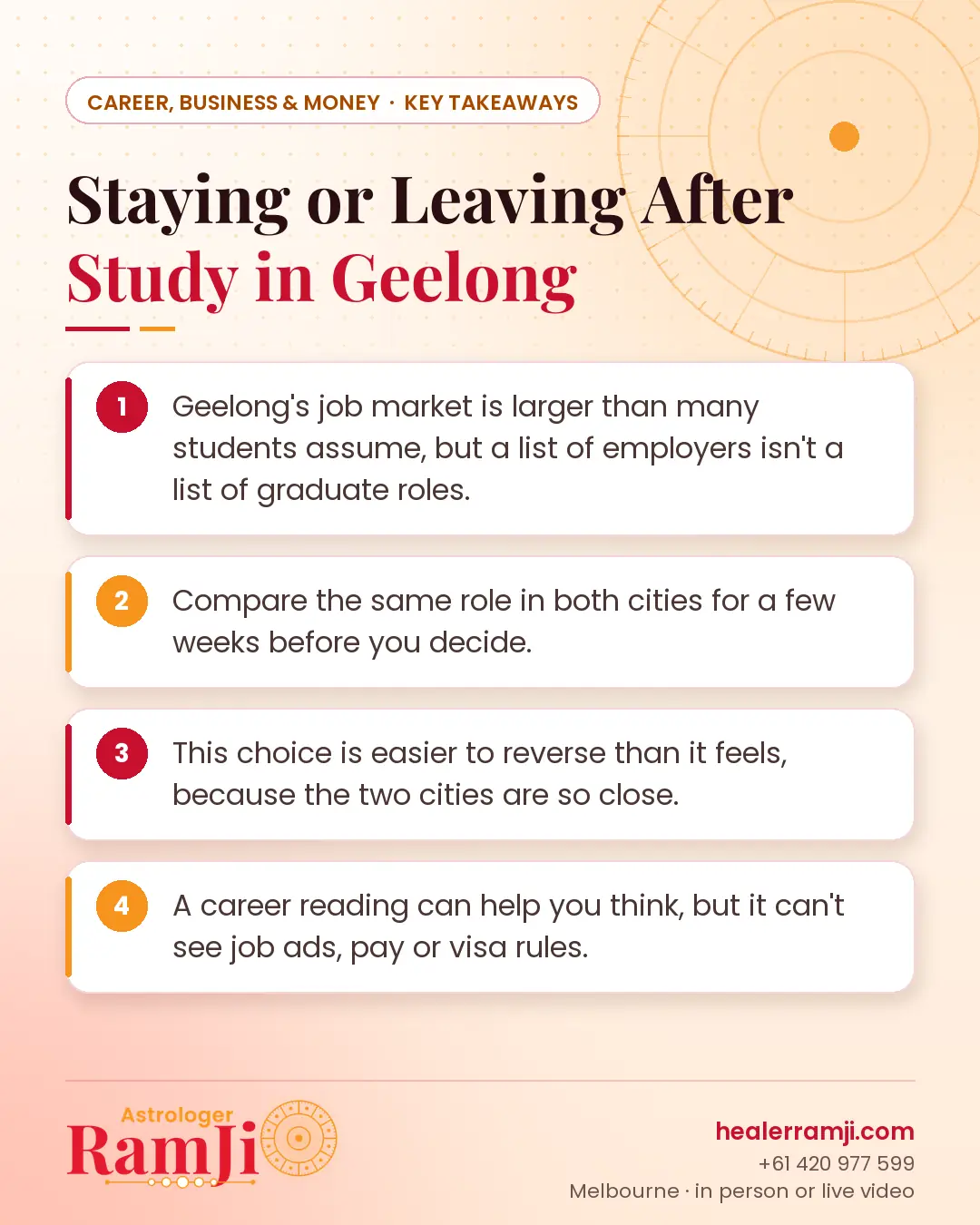
- Geelong's job market is larger than many students assume, but a list of employers isn't a list of graduate roles.
- Compare the same role in both cities for a few weeks before you decide.
- This choice is easier to reverse than it feels, because the two cities are so close.
- A career reading can help you think, but it can't see job ads, pay or visa rules.
What work is actually in Geelong?
More than people often expect. The Geelong Independent reported in June 2026, citing .id data, that health care and social assistance remained Geelong's largest industry by employment. Manufacturing led the year's jobs growth, with more than 11,400 jobs, a level not seen since before the Alcoa and Ford closures.
Government work is also unusually strong for a regional city. WorkSafe Victoria's head office is at 1 Malop Street. The National Disability Insurance Agency has its national office in Geelong, and the Transport Accident Commission is listed at Brougham Street. Barwon Health and Deakin itself are big local employers too.
Here is the catch. A large employer may hire few people at your level, or only in certain fields. So don't stop at the names. Ask who takes graduates, and when.

How do you compare Geelong with Melbourne fairly?
Run a small test instead of relying on what people tell you. For three or four weeks, keep a simple list:
- Search the same job titles in both places. Count only the roles you could apply for now, not the ones asking for five years' experience.
- Note the real pay and hours. Compare the ads rather than general salary claims.
- Look at actual rents. Use current listings for the suburbs you would really live in, including what a share house costs.
- Talk to two people ahead of you. Find one graduate who stayed and one who left. Ask what they would do differently.
- Ask your university careers team. They can tell you which employers recruit from your course.
Your field will shape the answer. If you trained in nursing, teaching or allied health, your placements may have already introduced you to Geelong employers. Some corporate roles may be more concentrated in Melbourne. These are rough patterns, so let your own list overrule them.
Could you live in one city and work in the other?
Many people do, which is why this doesn't have to be a clean break. The V/Line Geelong line runs from Waurn Ponds through Geelong to Southern Cross. Waurn Ponds adds time at the far end, and a door-to-door trip can run well beyond the train itself.
Try it before you commit. Do the trip at peak hour for a few days, and work out the fare. Check V/Line's service changes as well, because coaches sometimes replace trains on this line and can add a lot of time. Ask employers how many days they expect you in the office. A two-day commute and a five-day commute are very different lives.

What questions matter before you look at a chart?
Write short answers to these. Your answers will likely tell you more than any outside opinion:
- What are you moving towards? "A role in my field" is a reason. "Everyone else is going" may not be.
- What are you staying for? People and low costs are good reasons. Fear of starting over deserves a closer look.
- What would you need to save? A move with no buffer can force you to take the first job offered.
- Who else is affected? Partners, parents and siblings may have a stake, but they don't get the only vote.
- Are visas part of this? Work rights and regional rules are complicated and change often. Check with the Department of Home Affairs or a registered migration agent. Neither a friend nor an astrologer can answer this for you.
What if your family has a strong opinion?
Some families want you close. Others feel that a Melbourne job sounds more successful, particularly to relatives back home. Both views usually come from care, even when they land as pressure.
It helps to share your comparison rather than a feeling. "Here are the roles I found, here is the rent, and here is my plan for the first year" is harder to argue with than "I just think it's better". If your family has also been involved in what you studied, choosing what to study with your family watching may be useful.

Is this decision as permanent as it feels?
Probably not. Moving between the two cities isn't like moving overseas. You can take a 12-month lease in Melbourne and come back, or start in Geelong and apply to Melbourne roles after two years' experience. Treat your first job as a first step, not as the whole plan.
Set a review date. "I will look at this again next December" takes much of the weight off today's choice.
What can a career reading add?
If astrology matters to you, a chart offers another way to reflect. In Vedic astrology, the tenth house is linked with work and public standing, and the fourth with home and roots. The third is linked with short moves and your own effort, and the ninth with long-distance travel and higher learning. Dashas, or planetary periods, are used to talk about timing. Readers weigh these differently, and traditions vary. You can read more in what your tenth house says about work.
A reading can help you notice what you value, such as stability or independence. It can't know who is hiring, whether a role is right for you, or what your visa allows. An ethical reader should describe themes and ask good questions, and they shouldn't say "move or your career will fail". Astrology is a belief tradition, and it hasn't been shown to predict careers.
If you already have an offer in hand, weighing a job offer with your chart goes through that decision. A career timing reading looks at broader questions. You don't need to travel for it, as consulting from Geelong explains, because sessions can be held by phone, WhatsApp or video. You can also see our guides for regional Victoria or get in touch.

Related service

Keep reading
Vastu and Timing for a Small Office in Moonee Ponds
Leasing a small office in Moonee Ponds? Check the lease and heritage rules first, then use vastu and muhurta for desk placement and a simple, quiet opening.
Read article →
From Overseas Qualification to Local Trade in Thomastown
Waiting on skills recognition in Thomastown? Who decides what, how to steady yourself during delays, and how to weigh a career change in Melbourne.
Read article →
Midlife Career Questions in Ringwood
Thinking about a midlife career change in Ringwood? How a dasha reading can support reflection, and the free advice and money checks to do first.
Read article →More from Regional Victoria

Celebrating Diwali in Geelong
Looking for Diwali in Geelong? Which groups have held celebrations, how to confirm this year's plans, and a simple Lakshmi puja you can do safely at home.
Read article →
Ballarat's Ganesh Festival: A Newcomer's Guide
New to the Ganesh festival in Ballarat? What the community event involves, how to take part respectfully, and how to find this year's program.
Read article →
Moving to Ballarat as a Hindu Family
Thinking about moving to Ballarat as a Hindu family? What to know about the local community, worship, festivals and settling in during your first year.
Read article →Local pages

Astrologer for Geelong
For Geelong residents asking about vastu in Armstrong Creek, life after Deakin or worship in a smaller community. Sessions by phone, WhatsApp or video.
View area →Astrologer for Ballarat
For Hindu families settling in Ballarat: older homes, cold winters and keeping traditions going. Vedic astrology by phone, WhatsApp or video, from Ascot Vale.
View area →
Astrologer for Bendigo
For people in Bendigo far from Melbourne's big temples: finding a match, goldfields homes and home worship. Vedic astrology by phone, WhatsApp or video.
View area →Quick answers
Can astrology help me choose a career?
Astrology can prompt useful questions about work, but it can't pick your career. Here is what a chart may suggest, its limits, and who to ask for real advice.
Read answer →Which house shows career in Vedic astrology?
In Vedic astrology, the tenth house is the main house of career. Here is what else a reader looks at, where views differ, and what a chart can't tell you.
Read answer →Talk to Vijay Ramji
Tell us what you are facing. If a reading is unlikely to help, you will be told that plainly.