
Changing Careers at 40

For a career change at 40, astrology can offer a way to reflect on timing, such as which dasha or transit you are in. It cannot tell you whether to resign. Treat it as one view next to real planning: savings, training, family needs and advice from a qualified career practitioner or financial adviser.
At twenty-five, changing direction is called finding yourself. At forty, it can feel like a gamble with the mortgage, the school fees and your parents' expectations all sitting on the table. No wonder some people turn to a chart for a second opinion.
A chart can offer a useful pause for thought. It can't give you a plan. This page puts the two side by side: what timing reflection may add, and the practical planning you need whatever the reading says.
Key takeaways
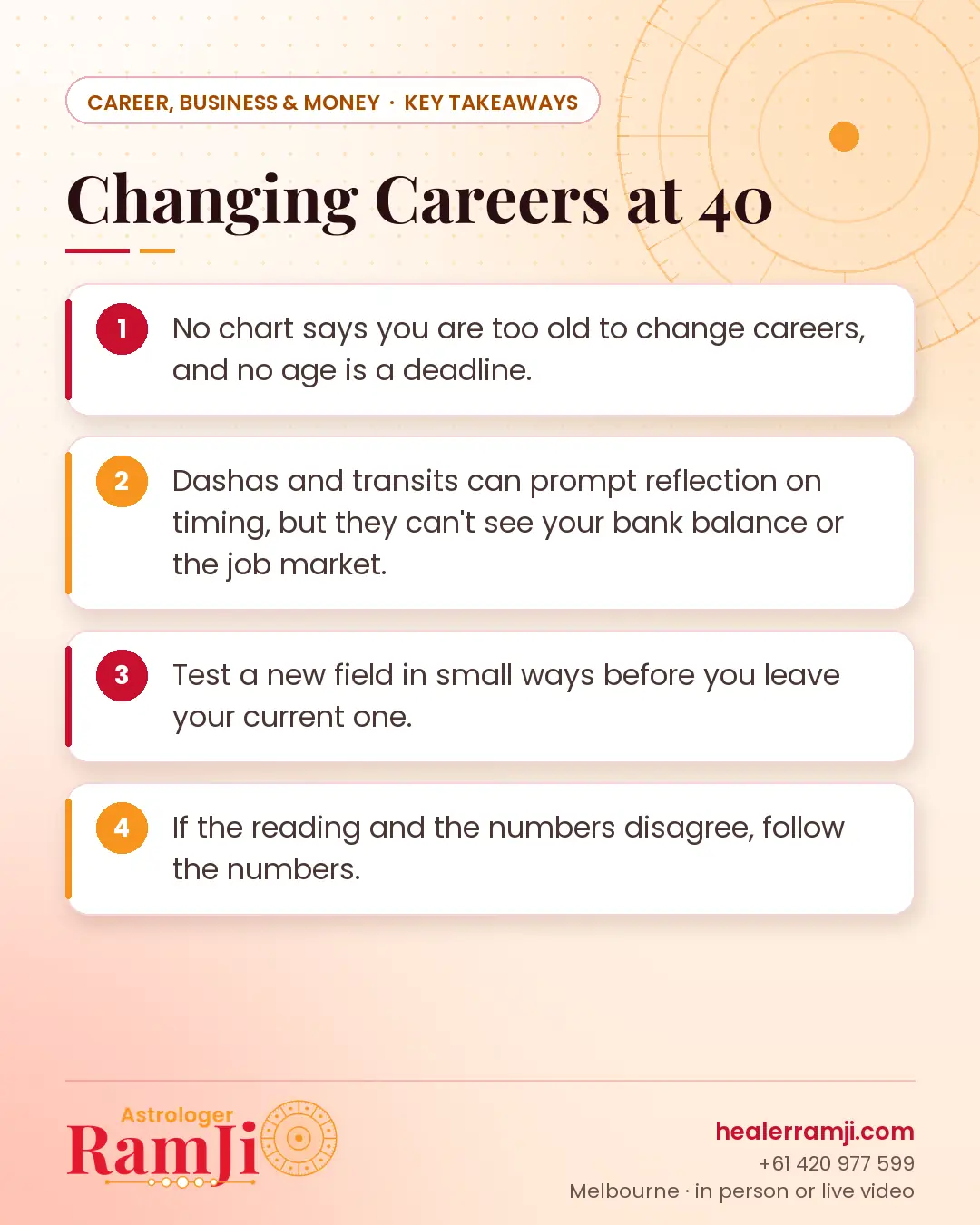
- No chart says you are too old to change careers, and no age is a deadline.
- Dashas and transits can prompt reflection on timing, but they can't see your bank balance or the job market.
- Test a new field in small ways before you leave your current one.
- If the reading and the numbers disagree, follow the numbers.
Why does 40 feel like a deadline?
Often it is the pile-up of responsibilities, not the number itself. You may have young children and ageing parents at the same time. If you migrated, you may have spent years rebuilding your standing here and feel you can't start over twice. Some people also carry a family script about what a respectable job looks like.
Jyotish doesn't say that a person must change course at a set age. Nor does it say the door closes at one. Any sense of "now or never" is worth examining before you let it drive a big decision.

What can astrology add to career change at 40?
A reader would usually look at a few things, as a way of framing your questions:
- Your dasha. Vimshottari mahadashas last from six to twenty years, and a new one starting around this age may be read as a change of emphasis.
- Your tenth house. The themes there can prompt you to ask whether your present work suits you. Our page on the tenth house goes into this.
- Saturn and Jupiter transits. Traditionally, these are read as times to consolidate or to expand.
A good reader will put this in plain, modest terms: "This looks like a time for preparing rather than leaping," for instance. It is a traditional way of interpreting a chart and has not been shown to predict job outcomes. Be wary of precise promises, such as a named month when your new career will take off.

What doesn't a chart know?
It has no idea how many months of expenses you have saved. It can't say whether nurses or electricians are in demand in your area, whether your overseas qualification is recognised, or whether your partner is happy to carry the household for a year. Those facts will decide most of the outcome, and they can all be checked.
What does a practical plan look like?
- Work out what is actually wrong. Is it the field, the employer, your manager or just exhaustion? Sometimes a change of workplace solves the problem at far less cost.
- Try it small. Do a short course, volunteer, shadow someone for a day, or take on weekend work in the new field. It is much cheaper to find out early that you don't like it.
- Know your numbers. Add up your essential costs, your debts and how long you could manage on less. Moneysmart has free tools for budgeting and super. A registered financial adviser can help with personal decisions.
- Check the entry rules. Many jobs require a licence, registration or a specific qualification. Find out the real time and cost before you start. If you are on a visa, talk to a registered migration agent about how a change could affect it.
- Get free advice. Victoria's Skills and Jobs Centres offer free career, training and job support, and they welcome experienced workers looking for a change. Free TAFE may also apply to some courses, so check whether you are eligible.
- Talk to people doing the work. Ask what the hours, pay and worst days are really like.

How do you put timing and planning side by side?
Here's a simple exercise. Write two columns. On the left, list what the reading suggested. On the right, list your plan and how ready it is. Then ask yourself:
- If the reading says "good time", would I have enough money to go ahead?
- If it says "wait", which small steps could I still take?
- Would I regret not trying, whatever the chart said?
Purely as an illustration, imagine a 41-year-old accountant who wants to become a teacher. A reader sees what they consider a period of consolidation. That doesn't need to mean giving up. It might mean checking the entry requirements, spending some time in a school and building up savings for the study years. Then, if the plan holds up, they might choose a start date based on the family's budget and the course intake.
What if the reading says wait, or go?
"Wait" should never mean doing nothing. Keep learning, keep saving and keep your options open. And "go" doesn't remove any risk. A favourable-looking period won't pay your rent if the new work takes longer to arrive than you hoped.
Try not to let a reading override a clear practical reality in either direction. If your finances say "not yet", a good chart isn't a reason to resign. If your job is making you ill, a difficult-looking period isn't a reason to stay.
What if your family disagrees?
Bring them into the plan early, and show them the numbers rather than asking for permission in the abstract. Parents who worry about stability often calm down once they see a budget and a backup. If you have recently moved to Australia, restarting your career after migrating may help. If the change has been forced on you, see what to do after a redundancy.

Is it restlessness, or something more?
Sometimes the urge to change everything comes from burnout or low mood. If you have felt flat for weeks, you aren't sleeping well, or nothing seems worth doing, please talk to your GP before making a big decision. Help with your health may change how the whole question looks. Our page on feeling stuck may also be useful.
Would a reading help?
It can, if you go in with specific questions and your plan already underway. A job change reading looks at your current period and the choice you are weighing, and it will leave the final decision with you. Sessions can be held by phone, WhatsApp or video, with fees stated upfront. To talk it through, please get in touch.
Related service
Keep reading

Weighing a Job Offer With Your Chart
Should you accept a job offer? A simple decision framework where astrology is one input, after the pay, contract, visa and family questions are answered.
Read article →
Saturn and Work: The Slow Years
How Vedic astrology reads Saturn and career: why slow years at work can still count, and how to tell patient progress from being stuck.
Read article →
Restarting Your Career After Migrating
Restarting a career after migrating to Australia: getting overseas qualifications recognised, coping with the loss of professional identity, and pacing yourself.
Read article →Quick answers
Can a chart show a good time to change jobs?
A chart can suggest phases to reflect on, but it can't confirm a good time to move. Here is what can be estimated, and what to check before you resign.
Read answer →Can astrology help me choose a career?
Astrology can prompt useful questions about work, but it can't pick your career. Here is what a chart may suggest, its limits, and who to ask for real advice.
Read answer →Talk to Vijay Ramji
Tell us what you are facing. If a reading is unlikely to help, you will be told that plainly.