
Job Change Reading
One real offer, weighed against your current period.

A job change reading weighs a specific decision, such as an offer in hand, against your current planetary period in Vedic astrology. It helps you think about timing and fit once you have compared the facts. It cannot tell you whether an employer is sound, and it is not employment or visa advice.
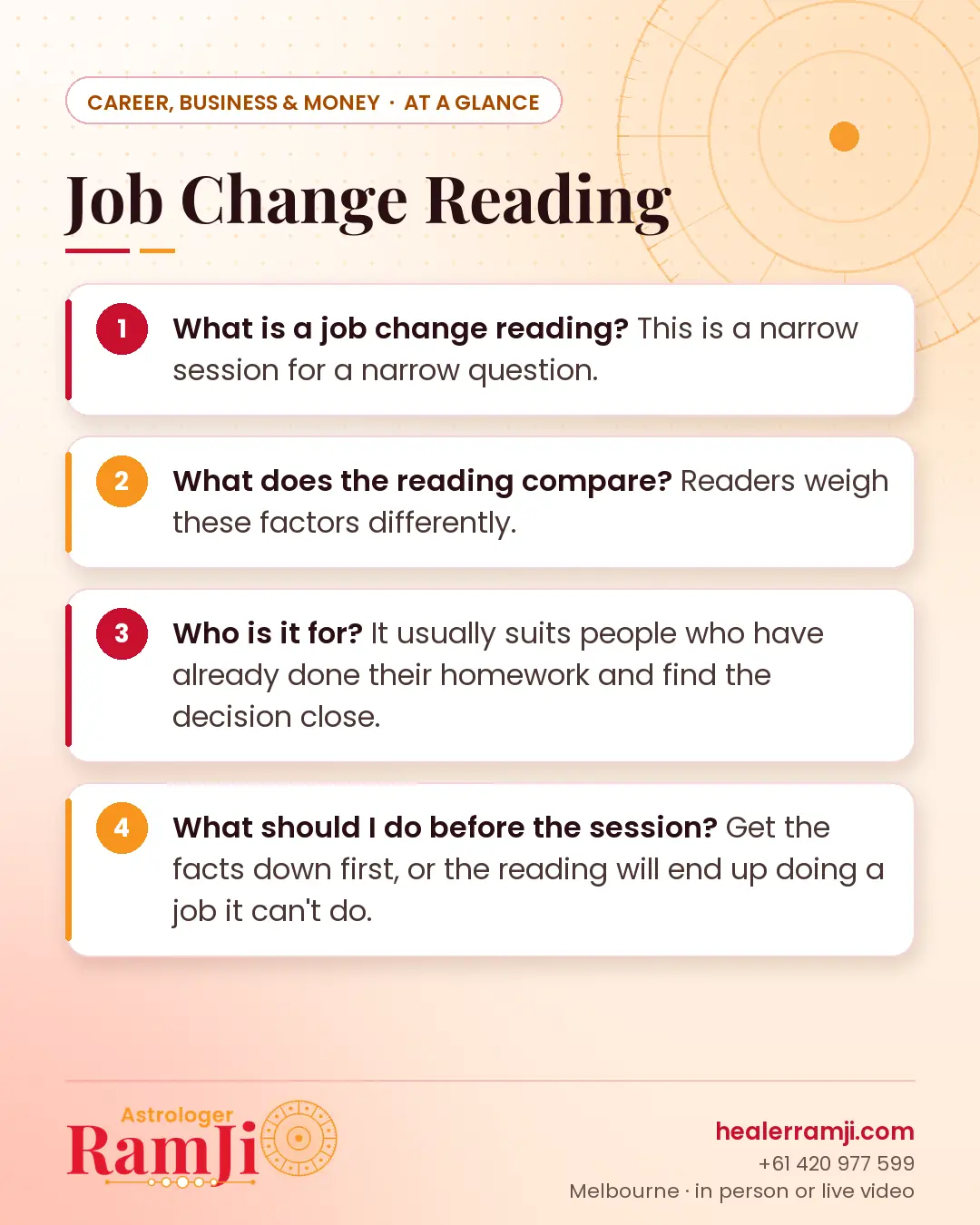
What is a job change reading?
This is a narrow session for a narrow question. You have a real choice in front of you, usually a written offer, and you want to weigh it against the period your chart is in. It treats "stay where I am" as an option with the same standing as "go", which people often forget to do when they feel restless.
If you don't have a specific choice yet and are asking about the next several years, a career timing reading is the better fit.
What does the reading compare?
- Where you are in your dasha. Is the period, and the shorter sub-period inside it, usually read as one for movement or for staying steady?
- When a sub-period changes. A move just before a shift in the timeline may be read differently from one just after, which can raise useful questions about a start date.
- The nature of the role against the sixth and tenth houses. The sixth is linked with daily work and friction, and the tenth with position and recognition. An offer that lifts your title but adds daily strain is a different trade from one that does the reverse.
- Saturn and Jupiter. These slow transits add context about whether the wider period feels like building or expanding.
Readers weigh these factors differently. You should expect to hear how confident the reading is, and two readers may not agree.

Who is it for?
It usually suits people who have already done their homework and find the decision close. Common examples include a better title with a longer commute, more money with less security, or a move out of a field altogether. Changing careers at 40 looks at the practical planning that a change like that needs.
It can also suit people who keep changing jobs and wonder why the same trouble follows them. In that case, the useful question may be about you and not about the employer. Our guide to work conflict that follows you from job to job is a good place to begin.
What should I do before the session?
Get the facts down first, or the reading will end up doing a job it can't do.
- Get the offer in writing, including pay, hours, probation and notice.
- Compare both jobs side by side. Weighing a job offer with your chart sets out a simple way to do it.
- Write one sentence saying which way you lean and why. It will stop a reading from quietly replacing your own judgement.
- Note your deadline and whether the start date can move.
- Have your birth date, time and place ready.
You don't need to name the employer or share confidential documents. A description of the role is enough.

What happens in a session?
You will usually be asked to describe the two options and the one sentence you wrote. The reader then looks at your current period and how the offer's timing sits within it. The discussion may bring up things worth checking, such as how you handled change in a similar past period, or a concern about workload that you could put to the hiring manager. You may also be asked what would have to be true for you to say yes.
How much weight should the reading carry?
Less than the facts. If one option is clearly better on pay, time, growth and family, go with it, even if a reader calls the period quiet. Take extra care in the first months if that eases your mind. If the two options are genuinely close, the chart can act as a tie-breaker, in the same way a trusted friend or your gut might.
If a reading unsettles you, turn the worry into something you can test. A vague warning about conflict can become a phone call to someone who has worked there.
What can't it do?
A chart can't tell you whether a company is solvent, a manager is fair or your pay is correct. This is not employment, legal or migration advice. The Fair Work Ombudsman has free information on pay and notice, and a lawyer or your union can look at a contract. If your visa depends on your employer, speak to a registered migration agent before you resign.
Be careful with any reader who says you must buy a ritual or a gemstone before you can safely accept. A decision about work should not come with a price tag attached.
What does it cost?
Ask when you get in touch. Any fee is stated before paid work begins, so you can decide without pressure.
How do I get in touch?
Call or send a WhatsApp message to +61420977599, or use the contact form, and mention any deadline you have. Vijay Ramji is based in Ascot Vale, with appointments arranged in advance, and sessions can be held by phone, WhatsApp or video.
Common questions
Can a chart really show a good time to change jobs?
It can show how the tradition reads a period, which some people find useful for reflection. It has not been shown to predict how a job turns out. Our short answer on what a chart can estimate about changing jobs covers the limits.
I have to answer the offer by Friday. Is that a problem?
Say so when you get in touch, as appointments are arranged in advance. If a session can't happen before your deadline, make the decision on the facts. An offer should never lapse while you wait for a reading.
Should I resign once the reading looks positive?
No. Wait until you have a signed contract and any pre-employment checks are finished, whatever a reading says. A reading is not a reason to give notice.
Can you pick my start date?
If there is room to choose, you can ask for a few suitable dates. Muhurat date selection covers this. Don't ask an employer to wait weeks for one, and don't treat an ordinary date as unlucky.
My family astrologer told me not to take it. What now?
Ask what the reasons were and listen with respect. Then weigh those reasons alongside the facts. You are the one who will do the job, so the decision is yours.
Related services

Business Launch Muhurat
A business opening muhurat in Melbourne, chosen around your lease, permits and launch deadlines. Several workable dates, calculated for local time, with no promises.
View service →
Business Partnership Compatibility
Comparing charts before you sign with a co-founder? Business partner compatibility astrology as a prompt for hard conversations, alongside a proper written agreement.
View service →Read more
Changing Careers at 40
Thinking about a career change at 40? What astrology can offer for timing reflection, and the money, training and family planning that must sit beside it.
Read article →
Weighing a Job Offer With Your Chart
Should you accept a job offer? A simple decision framework where astrology is one input, after the pay, contract, visa and family questions are answered.
Read article →
When Work Conflict Follows You From Job to Job
Same clash, different job? How to spot your own pattern in repeated workplace conflict, what a birth chart can add as a mirror, and when it's really bullying.
Read article →
Warehouse Shift Work in Truganina: Is It Time for a Change?
Thinking of leaving a warehouse job in Truganina? Weigh pay, sleep, notice and retraining first, then see where a reflective chart reading might fit in.
Read article →
Job Offer Across Town: Thinking It Through From Craigieburn
Offered a better job across Melbourne but live in Craigieburn? How to weigh pay and career growth against hours on the road or train, and where a chart fits.
Read article →Quick answers
Can a chart show a good time to change jobs?
A chart can suggest phases to reflect on, but it can't confirm a good time to move. Here is what can be estimated, and what to check before you resign.
Read answer →Can astrology help me choose a career?
Astrology can prompt useful questions about work, but it can't pick your career. Here is what a chart may suggest, its limits, and who to ask for real advice.
Read answer →Talk to Vijay Ramji
Tell us what you are facing. If a reading is unlikely to help, you will be told that plainly.