
The 27 Nakshatras: A Beginner's Guide
The 27 nakshatras are equal divisions of the zodiac, each 13 degrees 20 minutes wide, traced by the Moon's monthly path. In Jyotish, the star the Moon occupied at your birth often carries more weight than your sun sign, because it shapes dasha timing, matching and naming. It is a tradition, not a proven personality test.
Ask someone raised on Western horoscopes for their sign and they'll give you their sun sign. Ask an Indian grandmother and she may tell you a star instead: Rohini, Swati, Revati. That small difference points to a big one. Vedic astrology, or Jyotish, leans on the Moon far more than the Sun.
This beginner's guide explains what the 27 nakshatras are, why the Moon's star matters so much, and how to find and read your own without getting lost in trait lists.
Key takeaways
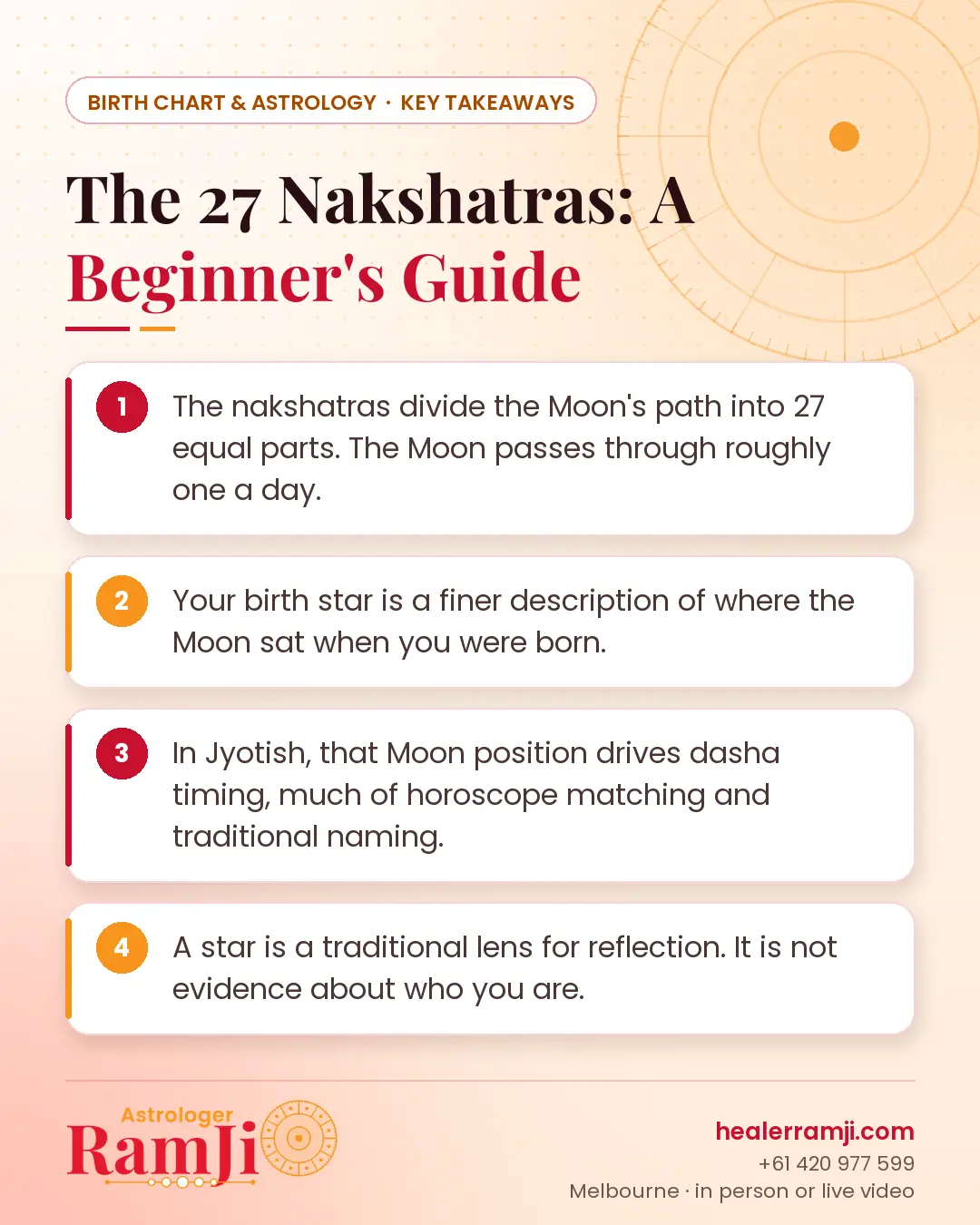
- The nakshatras divide the Moon's path into 27 equal parts. The Moon passes through roughly one a day.
- Your birth star is a finer description of where the Moon sat when you were born.
- In Jyotish, that Moon position drives dasha timing, much of horoscope matching and traditional naming.
- A star is a traditional lens for reflection. It is not evidence about who you are.
What exactly is a nakshatra?
Picture the band of sky that the Sun, Moon and planets appear to travel along. Jyotish cuts that band into twelve signs of 30 degrees each. It also cuts the same band into 27 nakshatras, or lunar mansions, of 13 degrees and 20 minutes each.
The number fits the Moon. It takes a little over 27 days to circle back to the same point among the stars, so it moves through about one nakshatra each day. Older lists used 28 mansions, adding one called Abhijit, and some traditions still use it for timing events. Most chart work uses 27.
Each nakshatra is split into four quarters called padas. Twenty-seven stars times four quarters gives 108, a number you will meet again in mantra practice.
Why does the Moon's star matter more than your sun sign?
There are three practical reasons, and each one shows up in a typical reading.
- The Moon moves fast. The Sun spends about a month in each sign, so everyone born in that month shares it. The Moon changes sign every two days or so and changes star roughly daily. That makes it a far more personal marker.
- It sets your timeline. In the widely used Vimshottari system, the ruling planet of your birth star decides which dasha, or planetary period, you were born into. How far the Moon had travelled through that star sets how much of the first period was left. Our guide to how the Vimshottari dasha system works follows this through.
- It is used for matching and naming. Several of the points in a traditional marriage match are worked out from the two birth stars, and many families take the first sound of a child's name from the birth pada.
Your sun sign still counts in a full chart. It just isn't the headline. Many Indian almanacs and family priests ask for your rashi, meaning your Moon sign, and your star, not the Sun's position.

Why might your sun sign be different in Jyotish anyway?
Jyotish uses the sidereal zodiac, which is tied to the fixed stars. Most Western astrology uses the tropical zodiac, tied to the seasons. The two are now about 24 degrees apart, so many people find their Vedic sun sign is the one before their Western sign. Our article on why your sign may change between systems explains the gap. The nakshatras are always counted in the sidereal zodiac.
What are the 27 nakshatras, in order?
The list starts at the beginning of Aries in the sidereal zodiac. The planet in brackets is each star's ruler in the Vimshottari system. Notice that the same sequence of nine rulers repeats three times.
- Ashwini (Ketu)
- Bharani (Venus)
- Krittika (Sun)
- Rohini (Moon)
- Mrigashira (Mars)
- Ardra (Rahu)
- Punarvasu (Jupiter)
- Pushya (Saturn)
- Ashlesha (Mercury)
- Magha (Ketu)
- Purva Phalguni (Venus)
- Uttara Phalguni (Sun)
- Hasta (Moon)
- Chitra (Mars)
- Swati (Rahu)
- Vishakha (Jupiter)
- Anuradha (Saturn)
- Jyeshtha (Mercury)
- Mula (Ketu)
- Purva Ashadha (Venus)
- Uttara Ashadha (Sun)
- Shravana (Moon)
- Dhanishta (Mars)
- Shatabhisha (Rahu)
- Purva Bhadrapada (Jupiter)
- Uttara Bhadrapada (Saturn)
- Revati (Mercury)
Spellings vary a lot. You may see Aswini, Mrigasira or Dhanishtha, and regional names differ again in Tamil, Telugu, Malayalam and Bengali calendars. They are the same stars.
How do you find your own birth star?
You need your date, time and place of birth. A reliable kundli program will give your star and usually your pada. Three things trip people up in Australia: the wrong time zone, daylight saving not being applied, and an app set to the tropical zodiac. If two tools disagree, check those settings first.
The time matters less here than for many parts of a chart. Because the Moon stays in one star for about a day, a rough time often settles it. The exception is a birth close to the moment the Moon changed star. Then even an hour can decide it, and an honest reader will say both stars are possible.
How should a beginner read their star?
Each star has a symbol, a presiding deity and a ruling planet. Rohini's symbol is often given as a chariot or cart, and Revati's as a fish or a drum, though sources differ. These images are where the traditional descriptions come from.
Here is a sensible way to start:
- Read two or three descriptions of your star from different writers, and notice how much they disagree.
- Keep only the themes that turn up in all of them.
- Ask whether those themes match how you actually behave, and how people who know you well would describe you.
- Drop anything that sounds like a sentence passed on you.
Look at the ruling planet too. If your star is ruled by Saturn, for instance, it can be worth reading about Saturn's traditional meanings in our guide to the nine grahas and what they represent.
Is any star lucky or unlucky?
You will hear that some stars are difficult, especially the six gandmool stars that sit where a water sign meets a fire sign. Families can choose to mark a custom around this, and that is their right. But no star makes a person good or bad, and traditions disagree about how much any of it matters. Be wary of anyone who uses a star to frighten you or sell you a remedy.
What can't a birth star tell you?
It can't tell you your future, who to marry, or which job to take. It hasn't been shown to describe personality in any tested way. It is a centuries-old language for thinking about temperament and timing, and that is how it is best used.
It is also only one part of a chart. Your rising sign, the houses and the planets' positions all add context that a star alone can't give.
Where can you go from here?
If you are naming a child, our page on choosing a baby name from the birth star covers the syllables. Remember that in Victoria you can generally choose any name within the limits set by Births, Deaths and Marriages, so a syllable is a choice, not a rule.
For a one-to-one look at your star and pada, a nakshatra reading goes through the symbol, deity and ruler with you and checks them against your experience. Sessions can be held by phone, WhatsApp or video, and fees are stated before paid work. If you'd like to ask a question first, get in touch.
Related service

Keep reading
Choosing a Baby Name from the Birth Star
How families pick a baby name by nakshatra: finding the birth star and pada, using its syllable, and fitting it with Victorian registration rules.
Read article →
Using Your Varshphal as a Yearly Planner
Turn a varshphal reading into a working calendar: find your return date, map the year's periods to real dates, and review honestly as the months pass.
Read article →
What to Do If You Do Not Know Your Birth Time
Don't know your birth time? Which records to request first, what a Vedic chart can still show from the date alone, and why dasha dates stay uncertain.
Read article →Quick answers
What is a kundli?
A kundli is a Vedic birth chart that maps the planets at your exact time and place of birth. Here is what it shows, in plain words.
Read answer →What details do I need for a kundli reading?
A kundli reading needs your date, time and place of birth, plus a clear question. Here is how exact each detail should be, and what to do if one is missing.
Read answer →Talk to Vijay Ramji
Tell us what you are facing. If a reading is unlikely to help, you will be told that plainly.