
What to Do If You Do Not Know Your Birth Time
If you don't know your birth time, first request hospital records and search family papers, as a written note beats any estimate. Without a time, planetary signs are usually clear, but the rising sign, houses and dasha dates are not. Dasha dates can move by months or even years. Rectification, palm reading or a limited kundli reading remain options.
Plenty of adults have no idea what time they were born. Certificates often leave it off, parents forget, and the only record may sit in a hospital in another country. If an astrologer has asked for your time and you drew a blank, you are far from alone.
This page sets out where to look before you pay anyone, and what can honestly be read while the time stays unknown.
Key takeaways
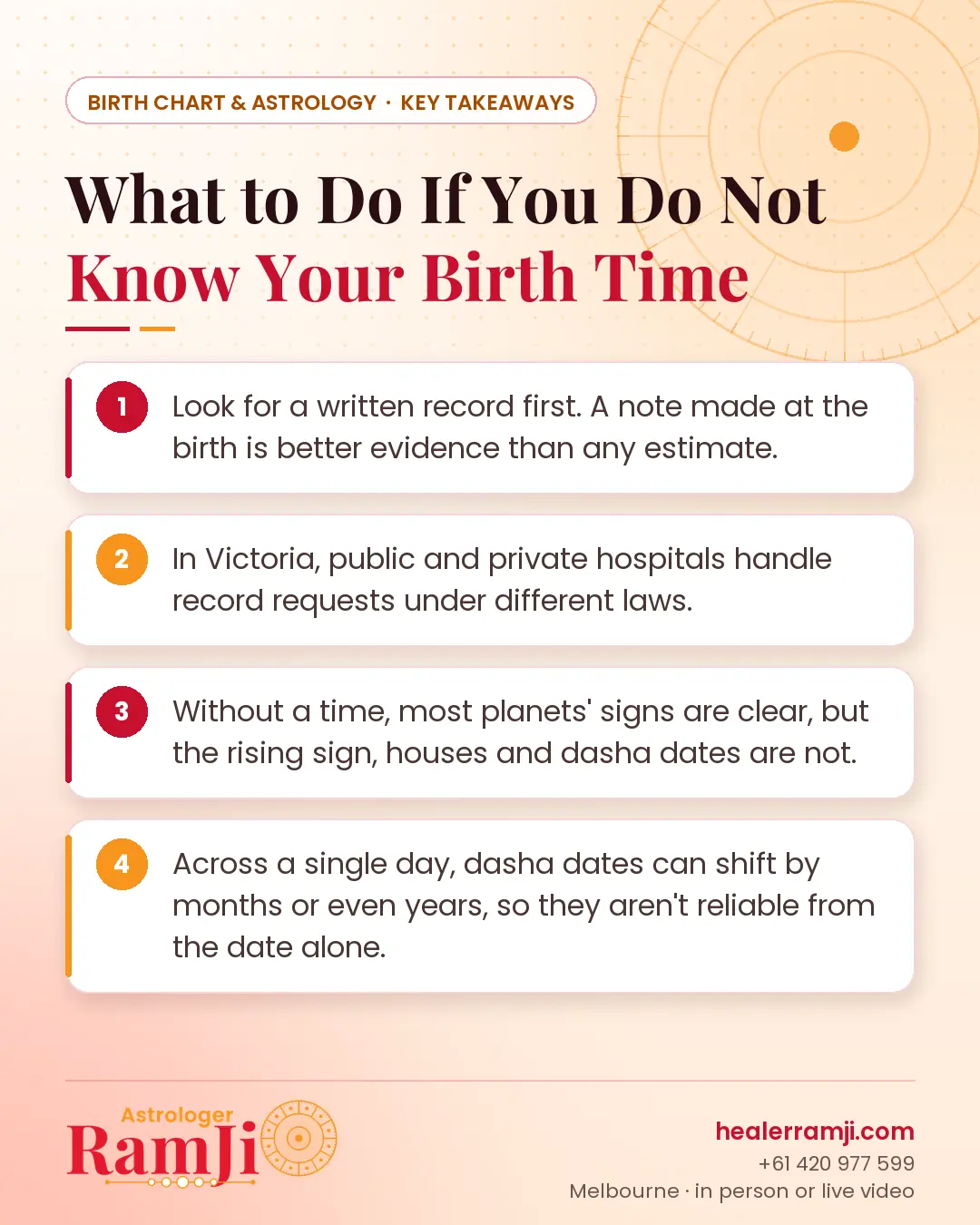
- Look for a written record first. A note made at the birth is better evidence than any estimate.
- In Victoria, public and private hospitals handle record requests under different laws.
- Without a time, most planets' signs are clear, but the rising sign, houses and dasha dates are not.
- Across a single day, dasha dates can shift by months or even years, so they aren't reliable from the date alone.
Which records should you request first?
Work through these roughly in order of how reliable they tend to be:
- Hospital birth records. Contact the hospital where you were born and ask what it holds. In Victoria, the Department of Health explains that requests to public hospitals go through Freedom of Information, while private hospitals and practitioners fall under the Health Records Act. Ask the records team how to apply. The birth may be filed under your mother's record, and older files may no longer exist, so ask about that too.
- Records from overseas. If you were born in India or elsewhere, the hospital, nursing home or local birth registry may still hold something. A relative living nearby may find it easier to ask in person. Check what each document actually shows, as many list only the date and place.
- Your birth certificate and any older copies. Look, but don't be surprised by a blank. Many certificates show no time.
- Family papers. A janam patri drawn up after your birth will normally note the time it was cast for. Baby books, letters, diaries and old greeting cards are worth a look as well.
- Relatives' memories. Ask each person separately, so one answer doesn't shape another. Ask what was happening, not just what the clock said. "Just before sunrise" or "during the evening news" can narrow a window a great deal.
Whatever you find, write down where it came from. A time noted by a midwife carries more weight than one recalled forty years later. Our guide to why accurate birth details matter explains how much a small error can change.
What can be read without a birth time?
More than you might think, though less than a full chart:
- Most planets' signs. Apart from the Moon, the planets move slowly enough that their signs are usually settled by the date alone. The exception is a planet changing sign that very day.
- Usually the Moon sign. The Moon covers roughly 12 to 15 degrees a day and spends about two and a quarter days in each sign. On many dates its sign is clear. On others it changes sign partway through the day, which leaves two options.
- Possibly the birth star. Each nakshatra is 13 degrees 20 minutes wide, close to one day of the Moon's movement. On most days the Moon enters a new star at some hour, so you may be left with two possible birth stars.
- A Moon-based chart. When the rising sign is unknown, many Jyotish readers use the Moon's sign, called chandra lagna, as the starting point for the houses. It is a recognised technique, but it is not the same as a full chart.
- Slow transits from the Moon. Once the Moon sign is settled, slow movements such as Saturn's sade sati can be discussed.
What can't be read with any confidence is the rising sign, which changes about every two hours, the houses built from it, the divisional charts such as the navamsa, and fine timing.

Why are dasha dates so uncertain without a time?
In the Vimshottari dasha system, the period you are born into, and how much of it is left, depend on the Moon's exact position within its nakshatra. Because the Moon crosses close to a whole nakshatra in one day, the balance left at birth could fall almost anywhere within that first period. The periods range from six years for the Sun to twenty for Venus.
In plain terms, an error of an hour can move your dasha dates by months, and a completely unknown time can move them by years. That affects every later period too, because each one follows on from the first. A reader who gives exact dasha dates from your birth date alone is claiming more than the chart can support. If the Moon also changed sign or star that day, you may hear that there are two quite different timelines.
What are your options once the search is done?
Depending on what you found, these are the usual routes:
- Work with what is stable. A kundli reading can still be done with an uncertain time, as long as it stays with the parts of the chart that hold steady and says so plainly.
- Estimate the time. Birth time rectification tests possible times against dated events in your life, such as a marriage, a migration or the birth of a child. It produces a reasoned estimate with a stated level of confidence, not a recovered record. Keep it out of official paperwork.
- Ask a single question. Some traditions cast a chart for the moment a question is asked, known as prashna, which needs no birth details.
- Choose a method that skips the clock. A palm reading uses your hands, not your birth data.

What should you tell your astrologer?
Share what you know, what you don't and where each piece came from. If your family can narrow the time to part of the day, say so. If you have two different times, give both. Never pass off a guess as a recorded time, because everything built on it inherits the error.
A careful reader will ask about your sources, explain which parts of the reading are firm and which are not, and avoid precise claims the details can't support. Sessions can be held by phone, WhatsApp or video, and any fee is stated before paid work begins. If you'd like help working out which route suits you, get in touch.
Related service

Keep reading
What Free Kundli Apps Get Right and Wrong
Free kundli apps calculate charts well but read them poorly. See which settings change your chart, why auto reports mislead, and how to use an app sensibly.
Read article →
Ten Questions to Bring to Your First Reading
Get more from a first reading. Ten questions to ask an astrologer, how to sharpen a vague worry into a clear question, and which questions to leave out.
Read article →
Why a Muhurat from India May Not Work in Melbourne
Why a muhurat worked out for India can't simply be converted to Australian time: local sunrise, day length, the rising sign and daylight saving all change it.
Read article →Quick answers
What is a kundli?
A kundli is a Vedic birth chart that maps the planets at your exact time and place of birth. Here is what it shows, in plain words.
Read answer →What details do I need for a kundli reading?
A kundli reading needs your date, time and place of birth, plus a clear question. Here is how exact each detail should be, and what to do if one is missing.
Read answer →Talk to Vijay Ramji
Tell us what you are facing. If a reading is unlikely to help, you will be told that plainly.