
Using Your Varshphal as a Yearly Planner

To use a varshphal chart as a planner, start a birthday-to-birthday calendar and enter the dates that can't move. Then pencil in the themes and busier stretches from your reading, turn any mudda dasha periods into date ranges, choose one or two actions, and review every few months. Treat it as a prompt, not a forecast.
A varshphal reading can feel vivid on the day and vague a month later. The notes sit in a folder, the year rolls on, and by the next birthday nobody remembers what was said. The fix is simple. Put the reading into the same calendar you already use for work, school and family.
The steps below run from finding the right start date to checking, at the end of the year, whether the chart was worth the attention.
Key takeaways
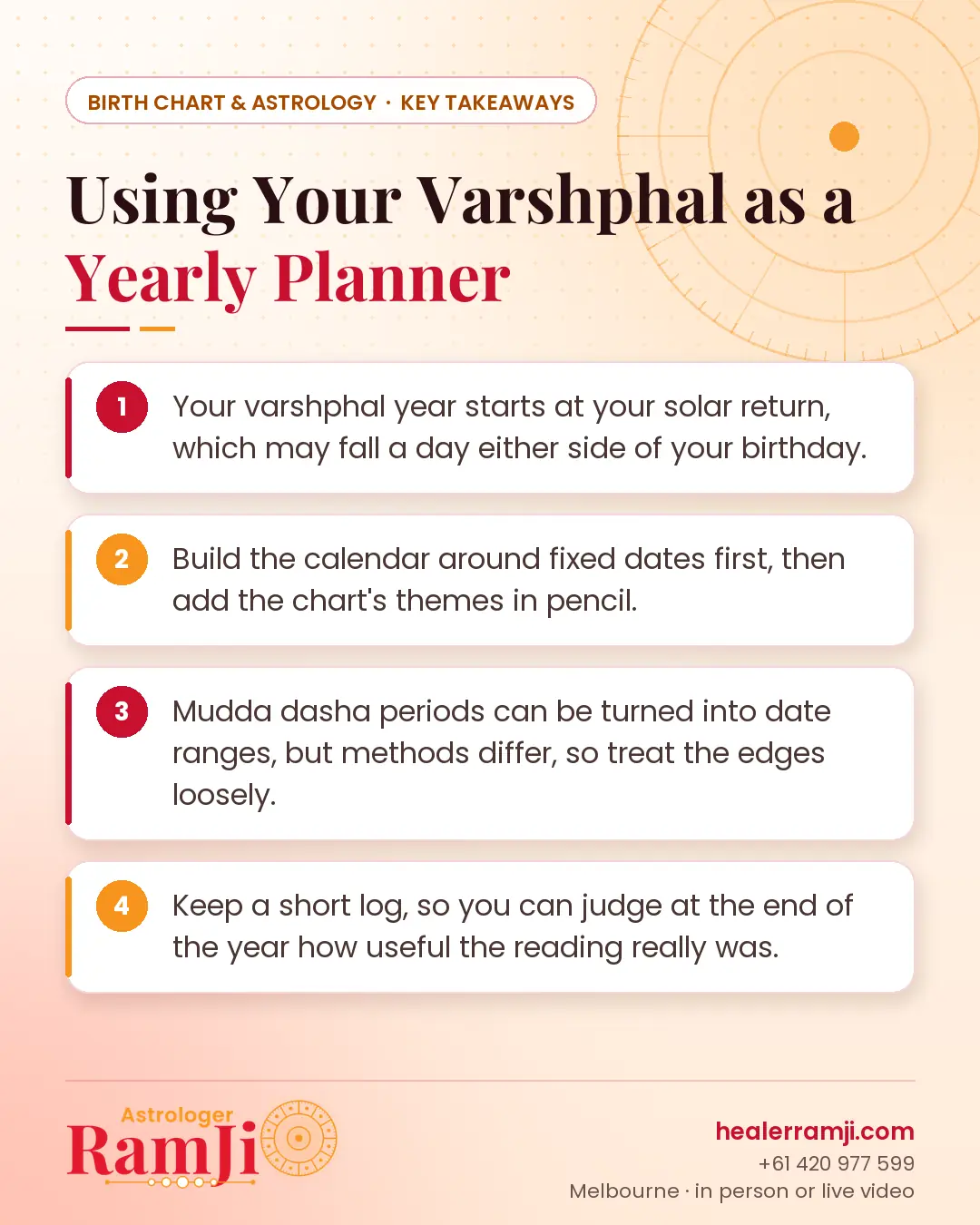
- Your varshphal year starts at your solar return, which may fall a day either side of your birthday.
- Build the calendar around fixed dates first, then add the chart's themes in pencil.
- Mudda dasha periods can be turned into date ranges, but methods differ, so treat the edges loosely.
- Keep a short log, so you can judge at the end of the year how useful the reading really was.
When does your varshphal year actually start?
A varshphal belongs to the Tajika system of Indian astrology. Its year begins at the moment the Sun returns to the same longitude it held at your birth, and it runs to the next return. That moment is close to your birthday, but not always on it. The return can land a day early or a day late, and at any hour.
So the first job is to get the return date and time in local clock time. If your birthday falls in the warmer months, check that daylight saving has been applied correctly under Victoria's summer time law. Free apps sometimes get this wrong. If you moved during the year, ask your reader which place the chart was cast for, as traditions differ between birthplace and current home.
Write the return date on the first page of your planner. That is day one of your year, not 1 January.
How do you set up a birthday-to-birthday calendar?
Most diaries run from January to December, so your year will cross two of them. A simple answer is to number your own months. Month 1 starts on your return date, month 2 a month later, and so on to month 12. A paper diary, a spreadsheet or a phone calendar in its own colour all work.
Then fill in everything that can't move:
- Work dates, such as rosters, leave, contract ends and the end of the financial year on 30 June
- School terms, exams and any big changes for children
- Housing dates, such as a lease renewal or a settlement
- Family events, travel and festivals
- Appointments and paperwork deadlines
Only now does the reading come in. Our Berwick article on lining up a yearly chart with school terms and rosters shows how this looks for a busy family.

How do you turn mudda dasha periods into dates?
Many astrologers use mudda dasha in an annual reading. It squeezes the nine periods of the long Vimshottari dasha sequence into a single year, so each planet rules a short stretch in proportion to its full length. In the common version, which spreads them over 360 days, the lengths work out roughly like this:
- Ketu about 21 days, Venus about 60 and the Sun about 18
- The Moon about 30, Mars about 21 and Rahu about 54
- Jupiter about 48, Saturn about 57 and Mercury about 51
The sequence doesn't always begin with Ketu. It starts from a planet chosen by rule for that year, then follows the usual order. Ask your reader for the start and end date of each period, and write them into your planner as bands, not single days.
Two cautions apply. Some astrologers stretch the periods across the full solar year, and others use a different annual period system altogether, so dates from two readers may not match. Also, an error in your birth time moves the return moment by a similar amount, which can change the annual rising sign and everything read from it. If your time is uncertain, estimating your birth time from life events is worth considering before you lean on fine dates.
What goes in the planner, and in what form?
It helps to sort what the reading said into three kinds of note:
- Themes. The year lord, the house the muntha falls in and any houses that stood out. Write these as one or two lines on the front page, such as "a work-heavy year with family duties in the background".
- Stretches. The busier or quieter periods discussed. Mark them in pencil or a pale colour across the weeks they cover.
- Actions. One or two things you decided to do after the conversation, each with a date beside it.
Keep actions small and sensible on their own merits. Leaving slack around a heavy work month, booking a holiday in a calmer stretch or having an overdue family talk are all good examples. If an action would only make sense because a chart said so, think again.
Leave some things out entirely. Health decisions belong with your GP, money decisions with a licensed adviser and legal questions with a lawyer. A chart should never move a medical appointment or a court date.

How often should you check the plan?
Three short check-ins usually do the job:
- At the end of month 3. Is the calendar still accurate? Add anything new.
- Around month 6. Compare the first half with what was discussed, then adjust the second half.
- A few weeks before your next return. Look back over the whole year before you book another reading.
At each check-in, write two or three lines in a log. What happened? Did a stretch marked as busy feel busy? Did any action help? Be fair to yourself and to the chart. Note the misses as well as the hits, because memory tends to keep the hits and drop the rest.
How do you judge whether it was worth it?
Astrology is a traditional practice, and there is no scientific evidence that an annual chart can predict events. So the honest test is a practical one. Did the planner help you pace the year, prepare for heavy months and make time for what matters? If so, it earned its place. If the chart and your year kept pulling in different directions, give it less weight next time, or keep the planning habit and drop the chart.
A hard-looking year is not a sentence, either. Nobody should use your annual chart to frighten you into paying for a remedy.
What should you bring to the next reading?
Bring your filled-in calendar for the coming year, last year's log and your birth details, including how sure you are of your time. With those in hand, a varshphal annual reading can spend less time on generalities and more on your actual year. Sessions can be held by phone, WhatsApp or video, and any fee is stated before paid work begins. If you would like to plan your next year this way, get in touch.
Related service

Keep reading

What to Do If You Do Not Know Your Birth Time
Don't know your birth time? Which records to request first, what a Vedic chart can still show from the date alone, and why dasha dates stay uncertain.
Read article →
What Free Kundli Apps Get Right and Wrong
Free kundli apps calculate charts well but read them poorly. See which settings change your chart, why auto reports mislead, and how to use an app sensibly.
Read article →
Ten Questions to Bring to Your First Reading
Get more from a first reading. Ten questions to ask an astrologer, how to sharpen a vague worry into a clear question, and which questions to leave out.
Read article →Quick answers
What is a kundli?
A kundli is a Vedic birth chart that maps the planets at your exact time and place of birth. Here is what it shows, in plain words.
Read answer →What details do I need for a kundli reading?
A kundli reading needs your date, time and place of birth, plus a clear question. Here is how exact each detail should be, and what to do if one is missing.
Read answer →Talk to Vijay Ramji
Tell us what you are facing. If a reading is unlikely to help, you will be told that plainly.