
Choosing a Baby Name from the Birth Star
To choose a baby name by nakshatra, families find the Moon's birth star and its pada at the time of birth, then start the name with the syllable tradition links to that pada. It is a custom, not a rule. Many families pick a name they love and keep the star syllable for a second or religious name.
Many Hindu families wait for one piece of information before they settle on a baby's name: the birth star. The custom is to begin the name with a sound linked to the Moon's position at birth. For parents raising a child in Australia, that custom now sits beside school rolls, Medicare cards and relatives in two time zones.
This article explains how the syllable is worked out, where traditions differ, and how to fit it with the practical side of naming a baby here.
Key takeaways
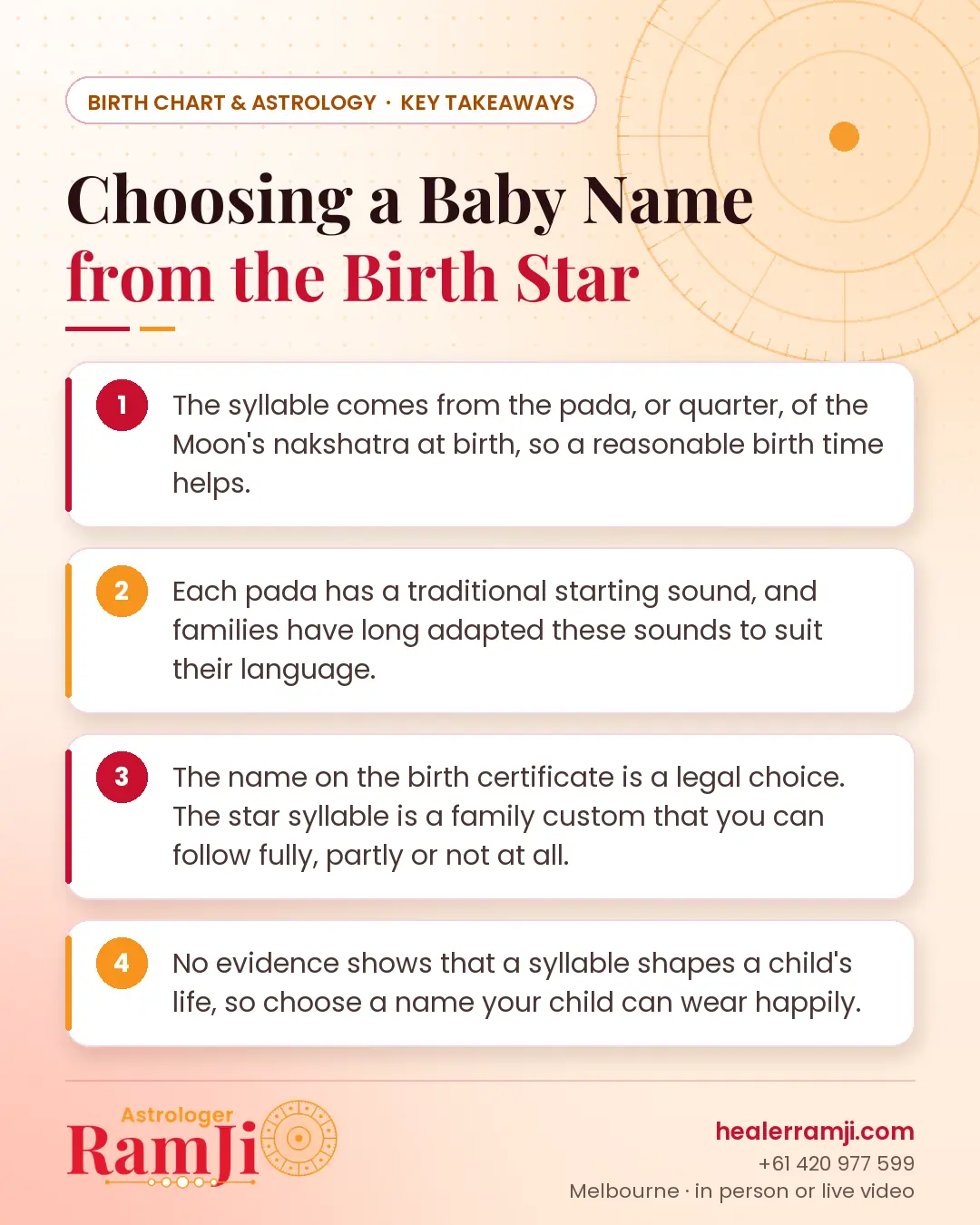
- The syllable comes from the pada, or quarter, of the Moon's nakshatra at birth, so a reasonable birth time helps.
- Each pada has a traditional starting sound, and families have long adapted these sounds to suit their language.
- The name on the birth certificate is a legal choice. The star syllable is a family custom that you can follow fully, partly or not at all.
- No evidence shows that a syllable shapes a child's life, so choose a name your child can wear happily.
How does naming by nakshatra work?
The Moon's path is divided into 27 nakshatras, and each is split into four padas. That gives 108 quarters, and each quarter carries a syllable that is traditionally used as the first sound of a child's name. If you want the background on the stars themselves, start with our beginner's guide to the 27 nakshatras.
So the process has three steps. First, the birth star is calculated from the date, time and place of birth. Next, the pada is found. Last, the family looks for names that start with that pada's sound.
What do the syllables look like?
A few examples show the pattern. These follow a common table, and you will see small differences between sources:
- Ashwini: Chu, Che, Cho, La
- Bharani: Li, Lu, Le, Lo
- Krittika: A, I, U, E
- Rohini: O, Va, Vi, Vu (often written Ba, Bi, Bu)
- Pushya: Hu, He, Ho, Da
- Revati: De, Do, Cha, Chi
Notice the Va and Ba overlap. Sanskrit sounds don't map neatly onto English letters, and regional languages say them differently. A Tamil family and a Gujarati family may hear the same syllable in different ways. Most families treat the sound as a guide, not a spelling test, so "Vi" can lead to a name beginning with V or B.

Why does the birth time matter for the syllable?
The Moon stays in one nakshatra for roughly a day, but it moves through a pada in about six hours. A baby born at 2 am and a baby born at 9 am on the same day can easily have different syllables, and sometimes different stars.
Ask your midwife or the hospital to confirm the recorded time of birth before you go home, and write it down somewhere safe. Check the place and time zone too, and remember that daylight saving applies in Victoria for part of the year. Our article on why accurate birth details matter explains how small errors creep in. If the Moon was close to the edge of a pada, an astrologer may give you two possible syllables, and either is a reasonable choice.
Do all families use the pada syllable?
No. Practice varies a lot:
- Some families use the pada syllable for the main name, as described above.
- Some use a set of letters linked to the Moon sign, which gives a wider choice.
- Some give a star-based name in the naming ceremony and use a different name day to day.
- Some follow a grandparent's wish, a family deity's name or a name passed down instead.
None of these is more correct than the others. If two sides of the family follow different customs, it helps to agree early on which one you will use, before anyone falls in love with a particular name.
What if you don't like any name with that sound?
This happens often. The syllable might only lead to names that are hard to spell, already taken by a cousin, or likely to be teased at school. You have several options:
- Use the syllable for a middle name. Your child carries the custom without it being the name they answer to.
- Keep a separate religious name. Many families use the star name in prayer and family rites only.
- Check the other padas. If the birth time is uncertain, a neighbouring syllable may be just as valid.
- Let it go. Choosing a name you love is not a failure of duty. Plenty of devout families do exactly this.
What does Victorian law say about the name?
The custom is yours, but registration has its own rules. Births, Deaths and Marriages Victoria says babies born in Victoria need to be registered, and parents have 60 days from the birth to do it. Its page on registering a birth has the details. The name you put on that registration becomes your child's legal name.
On the choice itself, the registry says parents can usually choose any name. Its guidance on naming your child explains that a name can be refused if it is obscene or offensive, impractical (such as being too long or containing symbols), or misleading. A traditional Sanskrit or regional name with an ordinary spelling should raise no issue. If you are unsure about a spelling or accent mark, check with the registry before you lodge.
Timing can be tight. If your family holds the naming ceremony later than the registration deadline, you may need to settle the legal name first. A namkaran can still bless and announce that name, or a religious name alongside it.
What practical checks are worth doing?
Before you decide, try the name out in your child's future life:
- Say it with your family name, and write out the initials.
- Ask how a teacher or a sports coach would read it aloud from a list.
- Think about spelling. A transliteration that is easy for you may be misspelt for decades.
- Check the meaning in your family's language, and in any others your child will grow up around.
Some families also bring in numerology. Our piece on numerology and baby names covers that approach and keeps family wishes first.
What can a birth star name not do?
A syllable is a link to tradition, to grandparents and to a sense of welcome. That has real value. It cannot protect your child, decide their character or improve their prospects. There is no evidence that it does, and traditions themselves disagree about the details. Be wary of anyone who says a "wrong" letter will bring bad luck, or who charges extra to fix one.
The same caution applies to reading the chart itself. A newborn's chart is best used for the name and family customs, not for predictions. Our short answer on whether parents should get a child's chart read explains why labels can stay with a child.
Would a reading help?
If you have the birth details and want the star, pada and syllable checked carefully, a nakshatra reading can do that and explain the options when the Moon sits near a boundary. Bring your shortlist of names if you have one. Fees are stated before any paid work, and sessions can be held by phone, WhatsApp or video. To arrange a time, please get in touch.
Related service

Keep reading

Using Your Varshphal as a Yearly Planner
Turn a varshphal reading into a working calendar: find your return date, map the year's periods to real dates, and review honestly as the months pass.
Read article →
What to Do If You Do Not Know Your Birth Time
Don't know your birth time? Which records to request first, what a Vedic chart can still show from the date alone, and why dasha dates stay uncertain.
Read article →
What Free Kundli Apps Get Right and Wrong
Free kundli apps calculate charts well but read them poorly. See which settings change your chart, why auto reports mislead, and how to use an app sensibly.
Read article →Quick answers
What is a kundli?
A kundli is a Vedic birth chart that maps the planets at your exact time and place of birth. Here is what it shows, in plain words.
Read answer →What details do I need for a kundli reading?
A kundli reading needs your date, time and place of birth, plus a clear question. Here is how exact each detail should be, and what to do if one is missing.
Read answer →Talk to Vijay Ramji
Tell us what you are facing. If a reading is unlikely to help, you will be told that plainly.