
How the Vimshottari Dasha System Works
Vimshottari dasha works by dividing a 120-year cycle into nine planetary periods of set lengths, from Sun at 6 years to Venus at 20. The nakshatra holding your Moon at birth picks your first period, and the Moon's progress through it sets how much is left. Each period then splits into smaller sub-periods.
Open any kundli app and you will find a column of dates headed something like "Ve-Sa" or "Ra-Ju". That is your Vimshottari timeline. It looks technical, but the logic behind it is simple once you see the pieces.
This guide explains how the cycle is built, how your own start point is found, and how to read the dates without taking them too literally.
Key takeaways
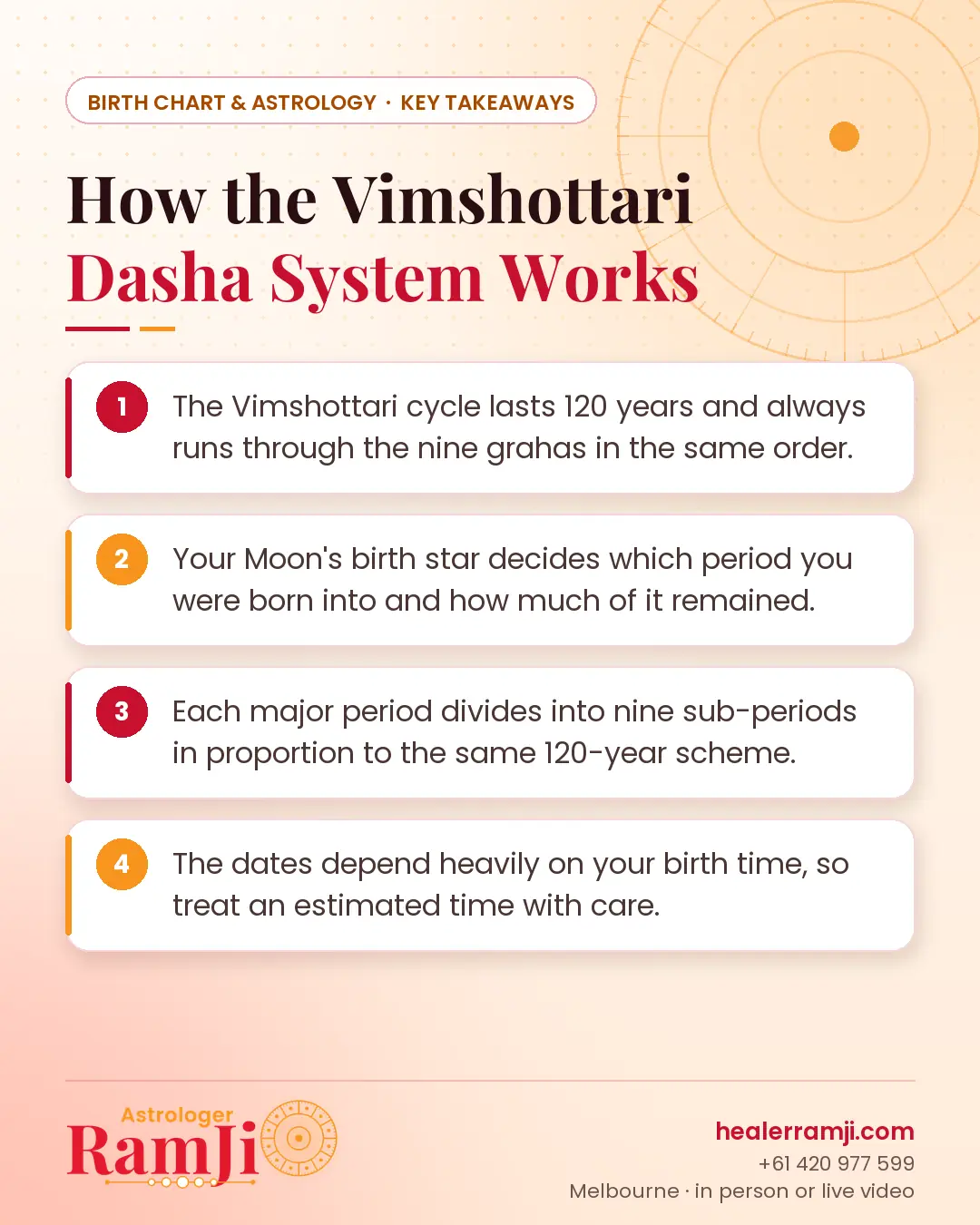
- The Vimshottari cycle lasts 120 years and always runs through the nine grahas in the same order.
- Your Moon's birth star decides which period you were born into and how much of it remained.
- Each major period divides into nine sub-periods in proportion to the same 120-year scheme.
- The dates depend heavily on your birth time, so treat an estimated time with care.
What is the 120-year cycle?
Vimshottari means "one hundred and twenty". The Vimshottari dasha system gives each of the nine grahas a fixed number of years, and those numbers add up to 120:
- Ketu, 7 years
- Venus, 20 years
- Sun, 6 years
- Moon, 10 years
- Mars, 7 years
- Rahu, 18 years
- Jupiter, 16 years
- Saturn, 19 years
- Mercury, 17 years
After Mercury the sequence returns to Ketu. Almost nobody is born at the very start of a period, and nobody lives through all 120 years, so a long life usually spans somewhere between five and seven major periods. Explanations for the individual lengths vary, and many astrologers simply accept them as part of the system as handed down.
How is your starting period found?
The zodiac is divided into 27 nakshatras, or lunar mansions, each spanning 13 degrees and 20 minutes. Each nakshatra is ruled by one graha, following the same order as the dasha list:
- Ketu: Ashwini, Magha, Mula
- Venus: Bharani, Purva Phalguni, Purva Ashadha
- Sun: Krittika, Uttara Phalguni, Uttara Ashadha
- Moon: Rohini, Hasta, Shravana
- Mars: Mrigashira, Chitra, Dhanishta
- Rahu: Ardra, Swati, Shatabhisha
- Jupiter: Punarvasu, Vishakha, Purva Bhadrapada
- Saturn: Pushya, Anuradha, Uttara Bhadrapada
- Mercury: Ashlesha, Jyeshtha, Revati
Find the nakshatra your Moon was in at birth. Its ruler gives your first mahadasha. Our beginner's guide to the 27 nakshatras describes each birth star in more detail.
How much of the first period was left?
This is called the dasha balance. If the Moon had only just entered the nakshatra, almost the whole period lay ahead. If it was nearly through, only a little remained.
Take a generic example. Rohini runs from 10 degrees to 23 degrees 20 minutes of sidereal Taurus, and its ruler is the Moon, with a 10-year period. Someone born with the Moon at 16 degrees 40 minutes of Taurus is exactly halfway through Rohini. So half the Moon's period, five years, remained at birth. After that come Mars for 7 years, then Rahu for 18, then Jupiter for 16, and so on down the list.
How are the sub-periods worked out?
Each mahadasha divides into nine antardashas, sometimes called bhuktis. The first sub-period belongs to the major period's own graha, and the rest follow the usual order.
The length of each sub-period follows one formula: the major period's years, multiplied by the sub-period graha's years, divided by 120. For example:
- Saturn within Saturn: 19 times 19, divided by 120, is just over three years.
- Jupiter within Rahu: 18 times 16, divided by 120, is 2.4 years, or about two years and five months.
- Sun within Moon: 10 times 6, divided by 120, is half a year.
The nine sub-periods always add back up to the full major period. The same method divides each sub-period again into pratyantardashas, which can last only weeks. Most readers focus on the first two levels.
How do you read your own timeline?
Once you have your list of dates, try this:
- Mark where you are now. Note your current mahadasha and antardasha, and when each ends.
- Look back before you look forward. Write down when past periods changed, and set those dates beside real events such as a move, a new job or a marriage. If the changes line up with nothing at all, your birth time may need checking.
- Note what each graha rules in your chart. A planet's name tells you little. Its house and rulership in your chart say much more.
- Treat the edges loosely. The months around a change are known as dasha sandhi. Many readers see them as a transition, not a cliff.
If a change is coming up soon, preparing for a dasha change without fear offers a calm planning approach. If you are already in a hard stretch, getting through a difficult dasha focuses on practical steps.

Why do apps give different dates?
Small settings make a big difference. Software may use a different ayanamsa, which shifts the Moon's sidereal position slightly. Some programs count a dasha year as 365.25 days, while others use a 360-day year, and the gap grows over decades. Ask which settings were used before comparing two timelines.
How much does birth time matter?
A great deal. The Moon moves about 13 degrees a day, close to one whole nakshatra. If your birth time is unknown, you may not even know which period you were born into. An error of an hour can shift your dates by months, and more in the long periods such as Venus or Saturn.
If your time is an estimate, say so. Birth time rectification tries to narrow it down using past events, though it remains a judgement and not a proof.

What can a dasha timeline not do?
A dasha is a traditional framework for thinking about phases of life. There is no scientific evidence that planetary periods cause events, and no timeline can tell you that a job, a relationship or a health result will turn out a certain way. Medical, legal and money decisions need qualified advice first.
Be wary of anyone who says a coming period will bring disaster unless you pay for a remedy. A period is not doomed because of its planet's name.
Want help reading yours?
A dasha analysis sets out your periods on a calendar and relates them to decisions you are actually facing. Sessions can be held by phone, WhatsApp or video, and any fee is stated before paid work begins. Bring your birth details and a few dated life events, then get in touch.
Related service

Keep reading

Getting Through a Difficult Dasha
Told you are in a hard dasha? A calm, practical plan for a tough planetary period: check the dates, protect the basics, and keep decisions in your own hands.
Read article →
Rahu and Ketu Explained Without the Fear
What Rahu and Ketu mean in Vedic astrology, why they are always opposite each other, and how to read them as desire and release rather than doom.
Read article →
Saturn's Return in Vedic Astrology
How Vedic astrology reads Saturn's return around the late twenties and late fifties, why the dates differ from Western charts, and what to do with those years.
Read article →Quick answers
What is a dasha in astrology?
A dasha is a planetary period in Vedic astrology. See how long each one lasts in the Vimshottari system, and what a dasha can and can't tell you.
Read answer →What is a kundli?
A kundli is a Vedic birth chart that maps the planets at your exact time and place of birth. Here is what it shows, in plain words.
Read answer →Talk to Vijay Ramji
Tell us what you are facing. If a reading is unlikely to help, you will be told that plainly.