
Sidereal or Tropical: Why Your Sign May Change

Sidereal and tropical astrology differ in where the zodiac begins. Tropical astrology ties it to the seasons, while sidereal, used in Vedic astrology, ties it to the stars. The gap is now about 24 degrees, so many placements fall one sign earlier. Neither is proven, so use the system that fits your tradition.
You have read Leo horoscopes in magazines for years. Then a relative hands you a janam patri, or you try a Vedic app, and it says your Sun is in Cancer. Nothing has gone wrong with the calculation. You are looking at two different ways of dividing the same sky.
This guide explains why the two systems disagree, how far apart they are, and how to decide which one to use for your own questions.
Key takeaways
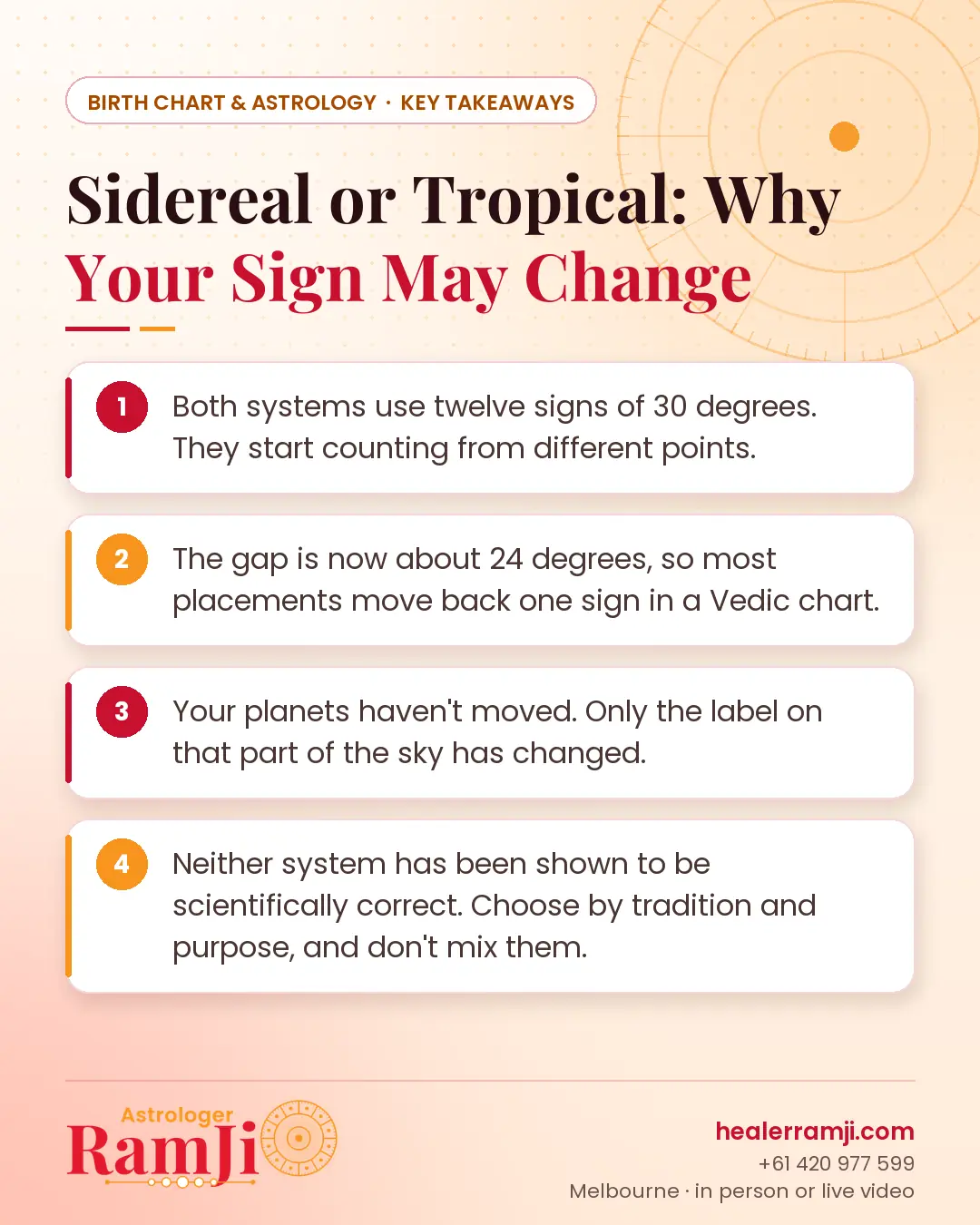
- Both systems use twelve signs of 30 degrees. They start counting from different points.
- The gap is now about 24 degrees, so most placements move back one sign in a Vedic chart.
- Your planets haven't moved. Only the label on that part of the sky has changed.
- Neither system has been shown to be scientifically correct. Choose by tradition and purpose, and don't mix them.
What is the difference between sidereal and tropical?
The tropical and sidereal zodiacs answer the question "where does Aries begin?" in different ways.
- Tropical. Used in most Western astrology. Aries begins at the March equinox, so the signs stay fixed to the seasons of the northern hemisphere.
- Sidereal. Used in Vedic astrology, or Jyotish. Aries begins from a reference point tied to the fixed stars.
Long ago, the two starting points were close together. They aren't now, and the gap keeps growing.
Why did the two zodiacs drift apart?
The Earth wobbles slowly on its axis, a bit like a spinning top. Astronomers call this axial precession. Because of it, the position of the equinox slips backwards against the stars by about one degree every 72 years.
Tropical astrology moves with the equinox, while sidereal astrology stays with the stars. Each generation, the gap widens a little more.
The size of that gap is called the ayanamsa. Under the Lahiri ayanamsa, by far the most common choice in India, it is about 24.2 degrees in 2026. Other Vedic astrologers use slightly different values, such as Raman or Krishnamurti, so software may offer you a choice. Those differences are usually small, but they can matter for a planet or lagna close to the edge of a sign.

Why does your sign change, and why not always?
A sign covers 30 degrees. Subtract about 24 degrees from a Western position and most placements land in the previous sign. Roughly the last six degrees of each Western sign are the exception, because they stay in the same sign after the shift.
The Sun makes this easy to see, because it covers about a degree a day. Tropical Aries begins around 20 March. The Sun enters sidereal Aries in the middle of April, marked in many Hindu calendars as Mesha Sankranti. So, as a general illustration:
- Someone born on 1 April has a tropical Sun in Aries and a sidereal Sun in Pisces.
- Someone born on 18 April has a tropical Sun in Aries and a sidereal Sun in Aries too.
The same shift applies to your Moon, your rising sign and every other planet, so a whole chart can read very differently. The exact dates vary a little from year to year, so check a calculated chart rather than a table.

Is the change only about the zodiac?
No, and this is where comparisons get confusing. The two traditions also tend to emphasise different things:
- Main sign. Western horoscope columns focus on the Sun sign. Vedic practice gives great weight to the Moon sign, or rashi, and to the lagna.
- Houses. Many Vedic astrologers treat each sign as one whole house, while many Western astrologers use systems that divide the sky by other methods. Practice differs within each tradition.
- Moon's position. Vedic astrology adds the 27 nakshatras, which have their own beginner's guide.
- Timing. Vedic readings commonly use dashas, or planetary periods, alongside transits.
So even if your Sun sign were identical in both, the readings might still differ. A change of label is only part of it.
Which one is correct?
Each camp has its own argument. Sidereal astrologers point out that their signs stay close to the stars. Tropical astrologers reply that their signs are tied to the Sun's yearly cycle and were never meant to follow the constellations. Both are descriptions of a tradition, and neither argument proves that a sign affects your life.
The evidence doesn't settle it in favour of either side, because astrology hasn't been shown to work as a science. Note too that the signs in both systems are equal slices of 30 degrees. They aren't the same as the actual star groups, which vary in size. A sidereal chart is close to the stars by reference point, not a photograph of the sky.
The honest answer is that you are choosing a framework for reflection, not choosing the true one.
Which one should you use?
A few simple questions will usually decide it:
- What tradition matters to you and your family? If your family reads a janam patri or checks a nakshatra for naming, the sidereal chart will be the one they mean.
- What is the question for? Horoscope matching, dasha timing and a muhurat all belong to Jyotish, so they need a sidereal chart. If you enjoy Western astrology for self-reflection, tropical is the natural fit.
- Who will read it? Ask any reader which zodiac and which ayanamsa they use. A careful reader will tell you without any fuss.
Try not to mix the two. Reading a tropical position with Vedic rules, or the reverse, gives you an answer that belongs to neither tradition. For the same reason, don't panic if a Western column and a Vedic reading seem to disagree about you.

What should you do if your sign changed?
You don't need to give up anything you liked about your old sign or start believing you are a different person. A sign isn't an identity, and a personality is far bigger than a label. Notice which description rings true and which doesn't, and hold both lightly.
Be wary of anyone who treats the change as bad news. A different sign is not a warning, and it is no reason to buy a remedy or a gem. Our short answer on whether astrology can predict the future exactly covers what a chart can't do.

How can you see your sidereal chart?
You will need your date, time and place of birth. From there, the first thing to look at is your rising sign, explained in our guide to your lagna. If you are comparing a partner's chart, you may also like love compatibility beyond Sun signs.
A kundli reading goes through your sidereal chart with you and explains why it differs from what you've read elsewhere. If you would like to ask about one, get in touch.
Related service

Keep reading

Your Lagna Explained for Beginners
Your lagna is the sign rising in the east when you were born. Learn how this Vedic ascendant sets out your chart, what the lagna lord is, and what it can't tell you.
Read article →
A Plain Guide to the Twelve Houses
What does each of the twelve houses in Vedic astrology cover? A plain guide with everyday examples, the main house groups, and what houses cannot tell you.
Read article →
The Nine Grahas and What They Represent
What the nine grahas of Vedic astrology stand for, why none of them is simply good or bad, and how a reader weighs them in your own birth chart.
Read article →Quick answers
What is a kundli?
A kundli is a Vedic birth chart that maps the planets at your exact time and place of birth. Here is what it shows, in plain words.
Read answer →What details do I need for a kundli reading?
A kundli reading needs your date, time and place of birth, plus a clear question. Here is how exact each detail should be, and what to do if one is missing.
Read answer →Talk to Vijay Ramji
Tell us what you are facing. If a reading is unlikely to help, you will be told that plainly.