
Your Lagna Explained for Beginners

A lagna is the Vedic ascendant: the zodiac sign rising on the eastern horizon at the moment and place of your birth. It sets the order of the twelve houses, so it is the starting point of a reading. It is one part of the chart, and it does not decide your character or future.
Ask a Vedic astrologer about your chart and the first thing they check is rarely your Sun sign. They look for your lagna. Everything else in the reading is arranged around it, so if the word is new to you, this is the best place to begin.
This beginner's guide explains what a lagna is, how it organises a chart, how to find yours, and where people tend to give it more weight than it deserves.
Key takeaways
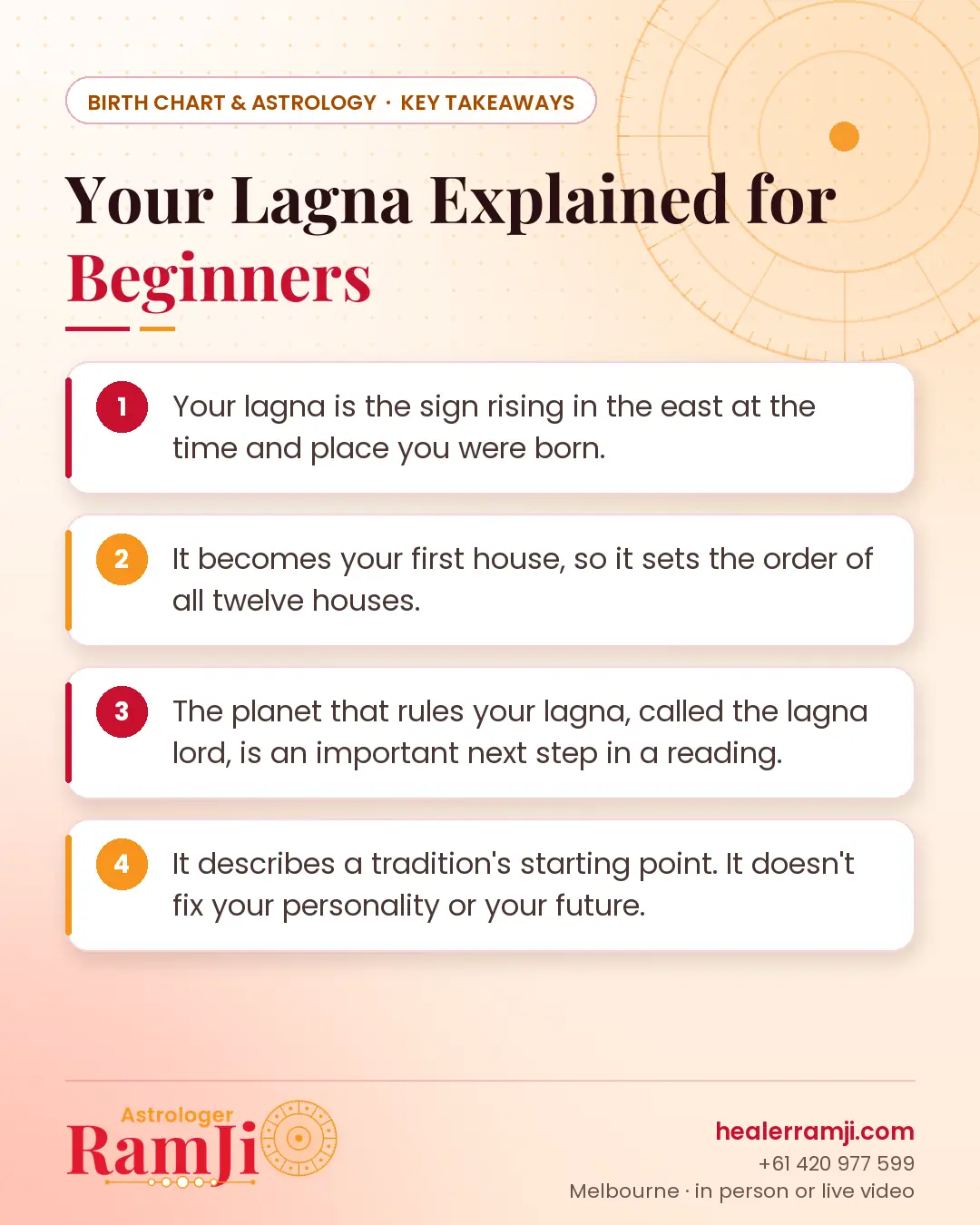
- Your lagna is the sign rising in the east at the time and place you were born.
- It becomes your first house, so it sets the order of all twelve houses.
- The planet that rules your lagna, called the lagna lord, is an important next step in a reading.
- It describes a tradition's starting point. It doesn't fix your personality or your future.
What is a lagna in Vedic astrology?
As the Earth turns, the signs of the zodiac appear to rise one after another over the eastern horizon. The sign coming up at the moment you were born is your lagna. In English, the same idea is called the ascendant or rising sign.
In Vedic astrology, the word is also used for the exact degree rising at that moment. So you might hear "my lagna is Virgo" or "my lagna is twelve degrees of Virgo". Both are in common use.
If you already know your Western rising sign, don't assume it's the same. Vedic astrology uses a different starting point for the zodiac, so the two may differ. Our guide to sidereal and tropical astrology explains why.

Why does a reading start with the lagna?
Your Sun and Moon signs tell you where those bodies were. The lagna does something different. It connects the sky to your own place on Earth at one moment, and that's what turns a general picture of the planets into a personal chart.
The lagna becomes your first house. The next sign becomes the second house, and so on around the zodiac. In the common whole-sign method, this means one choice decides the layout of the entire chart. Our plain guide to the twelve houses goes through what each one covers.
Here is a simple illustration of the same planet in two charts. Suppose Saturn is in Taurus for two people born on the same day:
- For someone with a Taurus lagna, Saturn sits in the first house, which is read in terms of self and body.
- For someone with a Scorpio lagna, Saturn sits in the seventh house, which is read in terms of partnership.
The planet is in the same place in the sky, yet the reading takes a different direction. That is why two people with the same birthday can get very different readings.
What does the lagna describe?
Traditionally, the first house and its sign are read for the body, general temperament and the way you meet the world. Astrologers often describe the lagna as the lens through which the rest of the chart is seen.
Traditions and teachers differ on the details, and the descriptions you see online are usually broad. Treat them as prompts for reflection. If a description of your lagna feels wrong, that may say more about the description than about you.
What is a lagna lord?
Each sign has a traditional ruling planet in Jyotish. The ruler of your lagna sign is called your lagna lord, and a reader will usually look at it early on:
- Aries and Scorpio: Mars
- Taurus and Libra: Venus
- Gemini and Virgo: Mercury
- Cancer: Moon
- Leo: Sun
- Sagittarius and Pisces: Jupiter
- Capricorn and Aquarius: Saturn
The house and sign where the lagna lord sits are read as showing where much of your attention tends to go. A lagna lord in the tenth house, for instance, is often linked with a strong focus on work. That is an interpretation within the tradition, not a forecast of your job. To learn more about these planets, see the nine grahas.
How do you find your lagna?
You need your date, time and place of birth. Any decent Vedic software can then calculate it, but check that it is using a sidereal zodiac and your actual birth town.
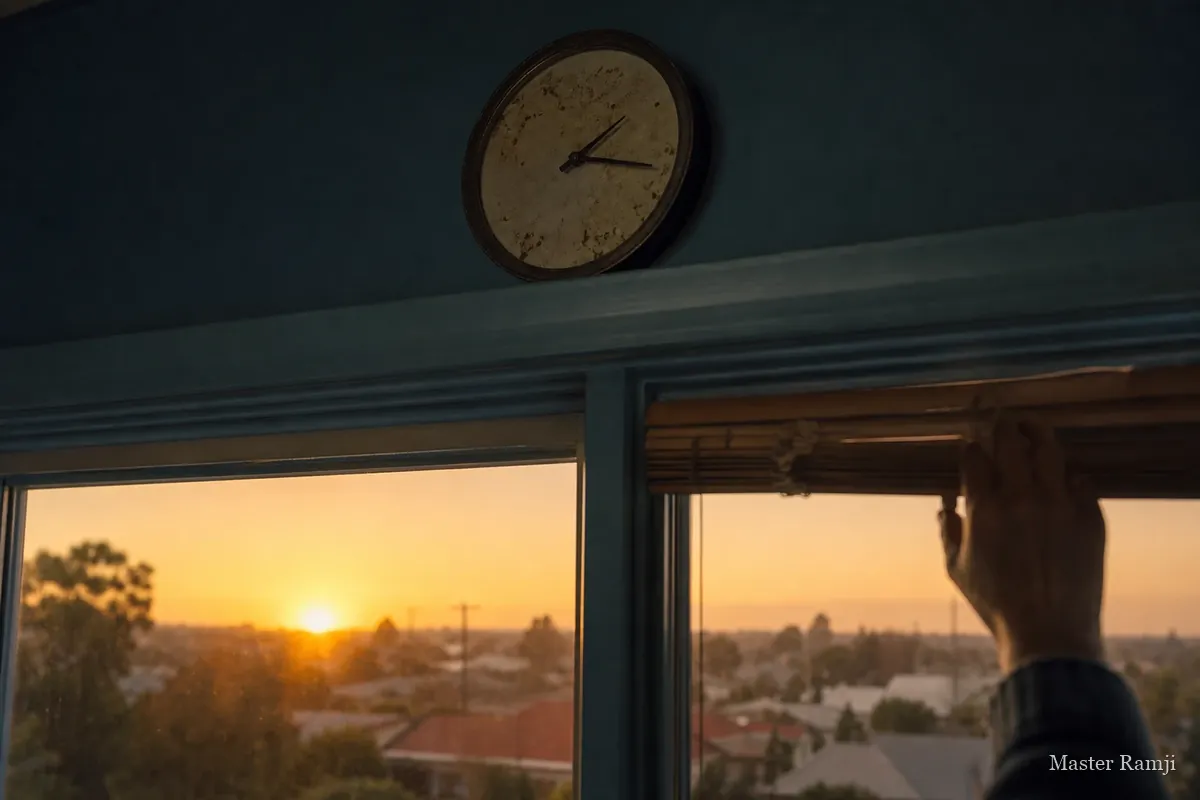
The time matters most. A new sign rises roughly every two hours on average, though some signs take noticeably longer than others, and this varies with latitude. If you were born near a changeover, a small error could give you the neighbouring sign. Australian clock changes are another easy way to end up an hour out, as covered in our piece on daylight saving and your birth chart.
If you don't have a reliable time, try not to settle on a lagna just because its description sounds right. See what to do if you don't know your birth time, or ask about birth time rectification. Even then, the result is an estimate.

What about the Moon lagna?
Many Vedic astrologers also read the chart a second way, counting the houses from the sign holding your Moon. This is called Chandra lagna, or the Moon lagna. Some also count from the Sun.
The Moon lagna is especially useful when a birth time is uncertain, because the Moon's sign is often clear from the date alone. The two views are usually read together, so a theme that appears in both tends to be given more attention.
What can your lagna not tell you?
This is where beginners most often get led astray:
- It isn't a verdict on your character. Nobody is "difficult" or "lucky" because of a rising sign.
- There isn't a good or bad lagna. Be wary of anyone who says yours needs an expensive fix.
- It doesn't decide compatibility. Two lagnas alone can't tell you whether a relationship will last.
- It isn't medical information. Although the first house is linked with the body, any health concern belongs with a GP.
Astrology is a belief system and has not been proven as a science. Your lagna is a useful way into the tradition, but your own decisions and circumstances count for far more.
What should you do next?
Find your lagna, then look up the lagna lord and see which house it occupies. That small exercise will teach you how a chart fits together better than reading a dozen sign descriptions.
If you want someone to go through it with you, a kundli reading starts from your lagna and works outward, with room for your own questions. To ask about one, get in touch.
Related service
Keep reading

A Plain Guide to the Twelve Houses
What does each of the twelve houses in Vedic astrology cover? A plain guide with everyday examples, the main house groups, and what houses cannot tell you.
Read article →
The Nine Grahas and What They Represent
What the nine grahas of Vedic astrology stand for, why none of them is simply good or bad, and how a reader weighs them in your own birth chart.
Read article →
How the Vimshottari Dasha System Works
How the 120-year Vimshottari dasha cycle is calculated from your birth star, how sub-periods are worked out, and how to read your own timeline sensibly.
Read article →Quick answers
What is a kundli?
A kundli is a Vedic birth chart that maps the planets at your exact time and place of birth. Here is what it shows, in plain words.
Read answer →What details do I need for a kundli reading?
A kundli reading needs your date, time and place of birth, plus a clear question. Here is how exact each detail should be, and what to do if one is missing.
Read answer →Talk to Vijay Ramji
Tell us what you are facing. If a reading is unlikely to help, you will be told that plainly.