
A Plain Guide to the Twelve Houses

The twelve houses in Vedic astrology divide a birth chart into areas of life, counted from your lagna. They cover themes such as self, money, home, children, work and partnership. Each house is read through its sign, its ruling planet and any planets inside it. They offer a framework for reflection, not fixed predictions.
A birth chart can look like a puzzle of numbers and symbols. Houses are the part that brings it down to earth. Planets and signs describe qualities. Houses describe where in your life those qualities are read as showing up.
This guide goes through all twelve in plain language, with an everyday example for each. The examples are only there to make the themes easy to remember. They aren't predictions.
Key takeaways
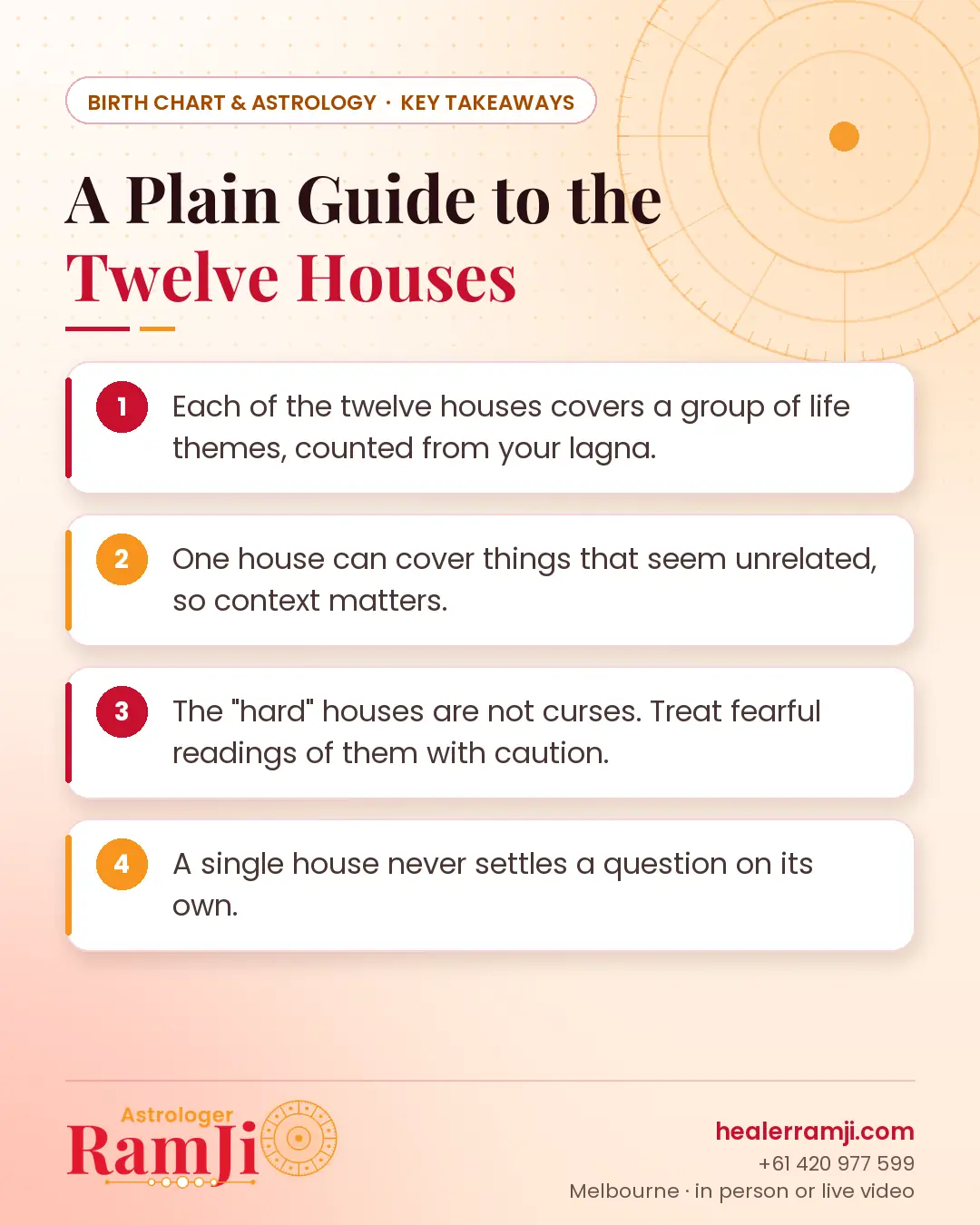
- Each of the twelve houses covers a group of life themes, counted from your lagna.
- One house can cover things that seem unrelated, so context matters.
- The "hard" houses are not curses. Treat fearful readings of them with caution.
- A single house never settles a question on its own.
What are houses in a birth chart?
In Sanskrit, a house is called a bhava. In Vedic astrology, the first house usually begins from your lagna, and the others follow in zodiac order. Astrological houses appear in Western astrology too, but the methods and emphasis differ. Many Vedic astrologers treat each whole sign as one house, while others divide the chart differently.
A reader looks at three things for each house: the sign it holds, where that sign's ruling planet sits, and any planets inside it. An empty house isn't a problem. It simply means the reader looks to its ruling planet instead.
What does each house govern?
Here are the common traditional themes. Teachers vary on some of the details.
First house: self
Body, temperament and how you meet the world. Everyday example: the way you walk into a new workplace on your first day.
Second house: resources and family
Savings, family of origin, speech and food. Everyday example: the way you talk about money at the family dinner table.
Third house: effort and siblings
Brothers and sisters, courage, skills, communication and short trips. Everyday example: teaching yourself a new skill, or the regular drive to see your sister in Geelong.
Fourth house: home and mother
Mother, home, vehicles, inner comfort and basic education. Everyday example: how settled you feel in your flat, whether you rent or own.
Fifth house: children and creativity
Children, study, creative work, past merit and romance. Everyday example: helping a child with homework, or the hobby that makes you lose track of time.
Sixth house: daily struggles and service
Conflict, debts, illness, daily work and service to others. Everyday example: a demanding roster, or a dispute with a colleague you have to work through.
Seventh house: partnership
Spouse, committed relationships and business partners. Everyday example: the way you share decisions with a partner. There's more in our guide to your seventh house.
Eighth house: change and the hidden
Sudden change, shared or inherited assets, secrets and long life. Everyday example: dealing with paperwork after a relative's death, or a big change you didn't choose.
Ninth house: belief and fortune
Father, teachers, faith, higher learning, fortune and long-distance travel. Everyday example: a university course, a pilgrimage, or a mentor who changes how you think.
Tenth house: work and public life
Career, duty, reputation and standing. Everyday example: your job title, and what people in your field know you for. See also which house shows career.
Eleventh house: gains and networks
Income, friends, older siblings and wishes fulfilled. Everyday example: a community group or a friend who tells you about a job opening.
Twelfth house: letting go and distance
Expenses, loss, sleep, foreign lands, solitude and spiritual release. Everyday example: the quiet of a retreat, or life far from where you grew up.

How are the houses grouped?
Traditional texts sort the houses into groups, and you will often hear these terms in a reading:
- Kendra (1, 4, 7, 10). The angular houses, seen as pillars of the chart.
- Trikona (1, 5, 9). The trinal houses, generally seen as favourable.
- Upachaya (3, 6, 10, 11). Houses said to improve with time and effort.
- Dusthana (6, 8, 12). The difficult houses, linked with struggle, disruption and loss.
The last group is where fear tends to creep in, and it deserves a closer look.
Should you be afraid of the sixth, eighth or twelfth?
No. A planet in one of these houses isn't a sentence. The sixth is also the house of service and overcoming problems. The eighth is also linked with research and deep change. The twelfth also covers spiritual life and foreign lands, which is why some readers take a mixed view of it for people who have migrated.
Some things a house simply can't tell you:
- The sixth can't diagnose you. For anything about your health, see a GP.
- The eighth can't tell you when anyone will die. Be wary of a reader who claims it can. If that fear has been planted in you, it's fine to walk away.
- The twelfth can't settle a visa or a move. Those depend on the law and your circumstances, so speak with a registered migration agent or lawyer.
- The second and eleventh aren't financial advice. Take money decisions to a registered financial adviser.

How do the houses work together?
One house rarely answers a question by itself. A reader looking at career might consider the tenth along with the sixth, the second and the eleventh, then the current dasha period. Two people with the same planet in the same house can also read very differently, depending on the rest of the chart.
Houses also connect through their rulers. If the ruler of your fourth house sits in your tenth, for example, a reader might explore links between home and work. Perhaps you work from home, or perhaps a family business comes to mind. Either way, it's a question to discuss rather than a fact about your life.

How can you use this guide?
Try this short exercise. Find your lagna, label the houses in order, and write down which ones contain planets. Then ask yourself whether those themes feel busy in your life at the moment. Some will, some won't, and either answer is useful.
Keep in mind that astrology is a tradition of interpretation, not a proven science. It can give you a language for reflecting on your life, but it doesn't determine what happens next.
If you would like to see how the houses fit together in your own chart, a kundli reading goes through them in plain language. It's also worth reading what a kundli is first. When you're ready, get in touch.
Related service
Keep reading
The Nine Grahas and What They Represent
What the nine grahas of Vedic astrology stand for, why none of them is simply good or bad, and how a reader weighs them in your own birth chart.
Read article →
How the Vimshottari Dasha System Works
How the 120-year Vimshottari dasha cycle is calculated from your birth star, how sub-periods are worked out, and how to read your own timeline sensibly.
Read article →
Getting Through a Difficult Dasha
Told you are in a hard dasha? A calm, practical plan for a tough planetary period: check the dates, protect the basics, and keep decisions in your own hands.
Read article →Quick answers
What is a kundli?
A kundli is a Vedic birth chart that maps the planets at your exact time and place of birth. Here is what it shows, in plain words.
Read answer →What details do I need for a kundli reading?
A kundli reading needs your date, time and place of birth, plus a clear question. Here is how exact each detail should be, and what to do if one is missing.
Read answer →Talk to Vijay Ramji
Tell us what you are facing. If a reading is unlikely to help, you will be told that plainly.