
Daylight Saving and Your Birth Chart

A daylight saving error in an Australian birth chart happens when software applies the wrong clock rule to your birth time. Rules differ by state and have changed over the decades, so today's dates may not match your birth year. An hour's error can change your rising sign, so check the offset used.
Free chart apps make a birth time look simple. You type it in and a chart appears. Behind the screen, the software also has to work out which clock was in use where and when you were born. In Australia, that answer depends on your state, your year and sometimes your town.
This guide sets out the rules that have applied, where the traps sit, and how to check your own chart in a few minutes. For the wider picture, start with our guide to accurate birth details.
Key takeaways
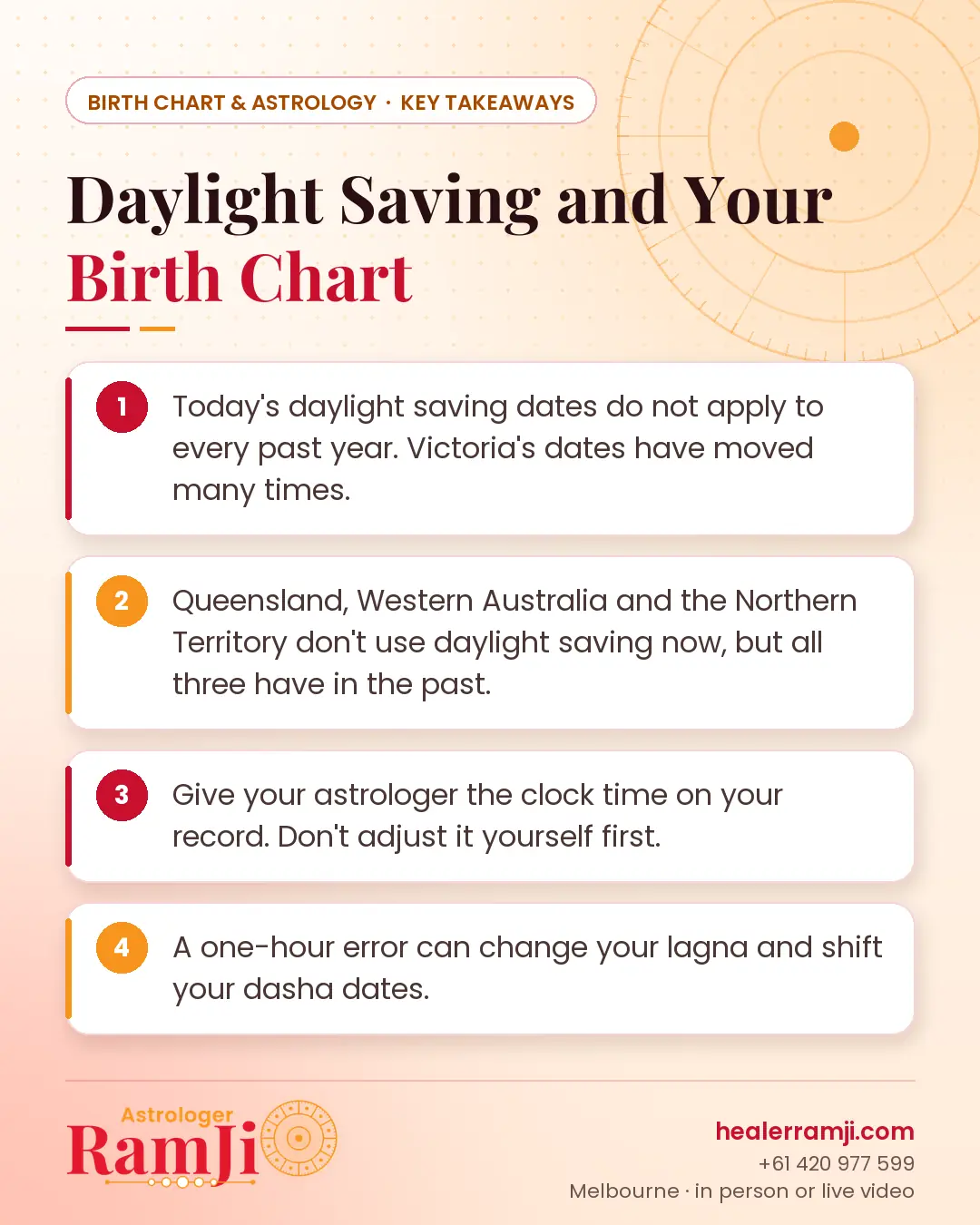
- Today's daylight saving dates do not apply to every past year. Victoria's dates have moved many times.
- Queensland, Western Australia and the Northern Territory don't use daylight saving now, but all three have in the past.
- Give your astrologer the clock time on your record. Don't adjust it yourself first.
- A one-hour error can change your lagna and shift your dasha dates.
Which parts of Australia use daylight saving?
Today, New South Wales, Victoria, South Australia, Tasmania and the ACT put their clocks forward each summer. Queensland, Western Australia and the Northern Territory stay on standard time all year. The past is messier, as this history of daylight saving in Australia shows:
- The two World Wars. All states and territories used it for short periods under federal law.
- Tasmania. It came back in 1967 during a drought and has been used every summer since.
- New South Wales, Victoria, South Australia and the ACT. They have used it every summer since 1971.
- Queensland. It took part in 1971 to 1972, then ran a trial from 1989 to 1992. A referendum in February 1992 rejected keeping it.
- Western Australia. It used daylight saving in the summers of 1974 to 1975, 1983 to 1984 and 1991 to 1992, then in a trial from late 2006 to 2009. Voters have rejected it at four referendums, most recently in 2009.
- Northern Territory. It has not used daylight saving since 1944.

How have Victoria's rules changed?
Daylight saving in Victoria is set under the Summer Time Act 1972. The current pattern runs from the first Sunday in October to the first Sunday in April. It is easy to assume that was always so. It wasn't. The public time zone database used by most software records these changes for Melbourne:
- Wartime. 1 January to 25 March 1917, then three periods between January 1942 and March 1944.
- The first modern summer. 31 October 1971 to 27 February 1972.
- Start dates. The last Sunday in October in most years up to 2007, but the third Sunday in 1986 and 1987.
- End dates. The first Sunday in March from 1973 to 1985, the third Sunday from 1986 to 1990, the first Sunday again from 1991 to 1994, then the last Sunday in most years from 1995 to 2007.
- Two one-off changes. Clocks went forward early on 27 August 2000 for the Sydney Olympics. They went back a week late on 2 April 2006 for the Melbourne Commonwealth Games.
- Since 2008. The first Sunday pattern we use today.
What does this look like with real dates?
These are date examples only, not anyone's actual chart. Melbourne's offset from Coordinated Universal Time (UTC) is +10 on standard time and +11 on daylight time. Suppose a program applied today's rule to these Melbourne births:
- 15 January 1970. The correct offset is +10, because Victoria had no daylight saving that summer. Today's rule would wrongly give +11.
- 20 March 1985. The correct offset is +10, because clocks had gone back on 3 March. Today's rule would wrongly give +11.
- 5 September 2000. The correct offset is +11, because of the Olympic early start. Today's rule would wrongly give +10.
- 10 October 2005. The correct offset is +10, because clocks did not go forward until 30 October. Today's rule would wrongly give +11.
Good software holds this history and may get all four right. Others may not, so it's worth looking.
What other time zone traps should you watch for?
- Border towns. Tweed Heads in New South Wales sits beside Coolangatta in Queensland. In summer, their clocks are an hour apart. Enter the town you were actually born in.
- Broken Hill. It is in New South Wales but keeps South Australian time, half an hour behind Sydney.
- South Australia and the Northern Territory. Their standard offset is +9:30. If someone rounds that to a whole hour, the chart will be out by 30 minutes.
- Lord Howe Island. Its clocks move by only half an hour, which catches out anyone who assumes a full hour.
- Settings left on India. Software set up in India may default to +5:30. A Melbourne time entered with that offset gives a badly wrong chart. Never convert your birth time into Indian time first, either. A chart is calculated from the local time where you were born.
- Changeover nights. Under today's rule, 2am to 3am doesn't exist on the October changeover morning, and the same hour happens twice in April. A birth in that April hour needs extra care, because a record may not say which one it means.

How much can a one-hour error change?
A new sign rises roughly every two hours on average, so a one-hour error can easily move you into the next lagna. If it does, every house in your chart is read differently.
The Moon moves a little over half a degree in an hour. That sounds tiny, but the starting point of your dasha timeline is worked out from the Moon's position within its nakshatra. A one-hour error can shift dasha dates by several months. The signs of the slower planets will usually stay the same.
This is a question of calculating the chart properly. Getting the clock right doesn't make astrology a proven science, and it doesn't make any reading certain. It simply means the tradition is being applied to the right sky.
How can you check your own chart?
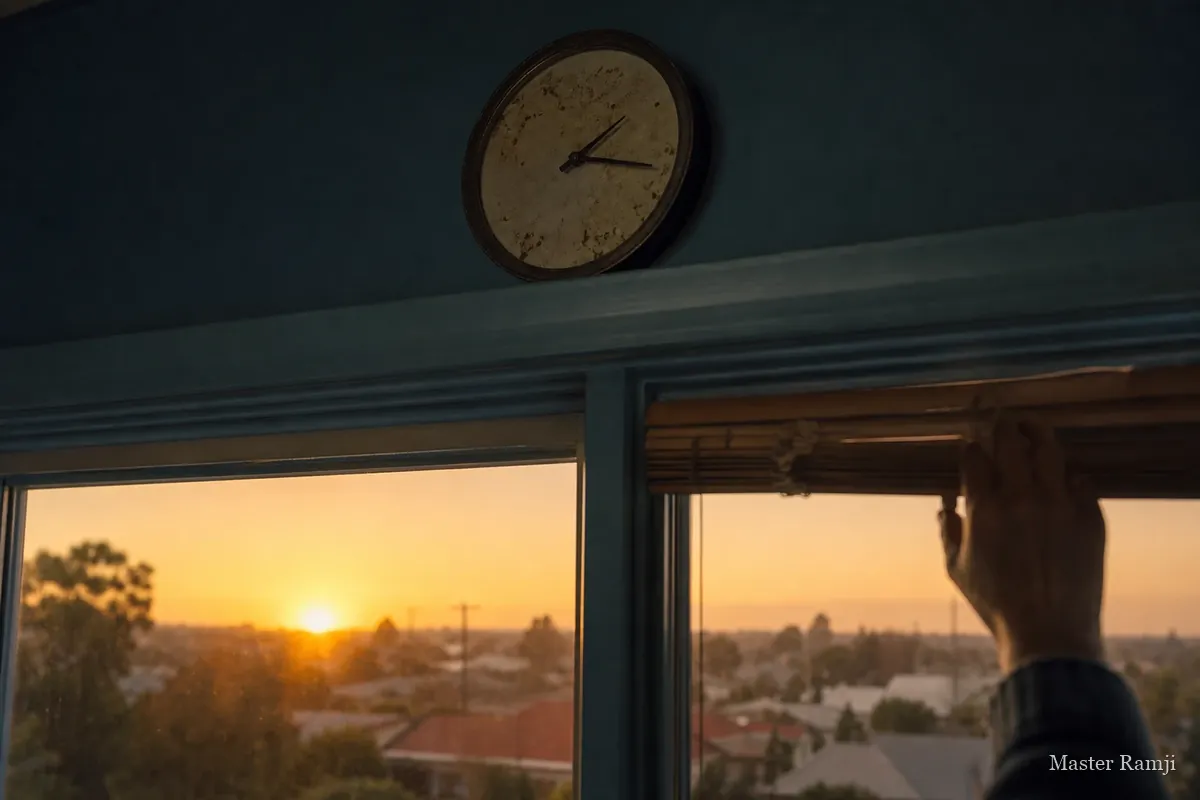
- Write down the clock time exactly as your record shows it.
- Enter your town, not just the state or the nearest big city.
- Find the offset the software used. Most programs show it in the chart details, sometimes as a time zone or as UTC.
- Compare it with the rules above for your state and birth year.
- Check any daylight saving setting. If the program applies it automatically and you add an hour yourself, the correction happens twice.
The time zone database is a strong guide, but old records are not perfect. If something looks odd, treat it as a question rather than a final answer.
What if you can't tell which time your record used?
Most records simply show what the clock said at the time. If you know otherwise, or a hospital's records team can tell you more, pass that on. A time passed down through family should be treated as approximate, whichever clock it came from.
If you still have doubts, birth time rectification compares possible times against dated events in your life. That is a judgement within the tradition, not proof of the right time.

Who should check this for you?
A careful kundli reading should begin with your details and the offset used, so ask to see them. Our guide to what free kundli apps get right and wrong covers other limits of software. Clocks matter for chosen dates too, as explained in why a muhurat from India may not work in Melbourne. To ask about a reading, get in touch.
Related service
Keep reading
Sidereal or Tropical: Why Your Sign May Change
Your Vedic sign may differ from your Western one. Learn why the sidereal and tropical zodiacs differ, what an ayanamsa is, and which system suits your question.
Read article →
Your Lagna Explained for Beginners
Your lagna is the sign rising in the east when you were born. Learn how this Vedic ascendant sets out your chart, what the lagna lord is, and what it can't tell you.
Read article →
A Plain Guide to the Twelve Houses
What does each of the twelve houses in Vedic astrology cover? A plain guide with everyday examples, the main house groups, and what houses cannot tell you.
Read article →Quick answers
What is a kundli?
A kundli is a Vedic birth chart that maps the planets at your exact time and place of birth. Here is what it shows, in plain words.
Read answer →What details do I need for a kundli reading?
A kundli reading needs your date, time and place of birth, plus a clear question. Here is how exact each detail should be, and what to do if one is missing.
Read answer →Talk to Vijay Ramji
Tell us what you are facing. If a reading is unlikely to help, you will be told that plainly.