
Why Accurate Birth Details Matter More Than You Think

Accurate birth details matter because a Vedic chart is built from the exact time and place you were born. The rising sign changes roughly every two hours, and finer details can shift within minutes. Your date, town and best-known time, along with how reliable that time is, all affect the reading.
Two people can share a birthday and have very different charts. In Vedic astrology, your date of birth is only the beginning. The time and place decide how the whole chart is arranged, which is why the first thing a careful astrologer checks is not your question but your details.
This guide explains which details matter, how much a small error can change, and how to track down a birth time you may not have seen in years.
Key takeaways
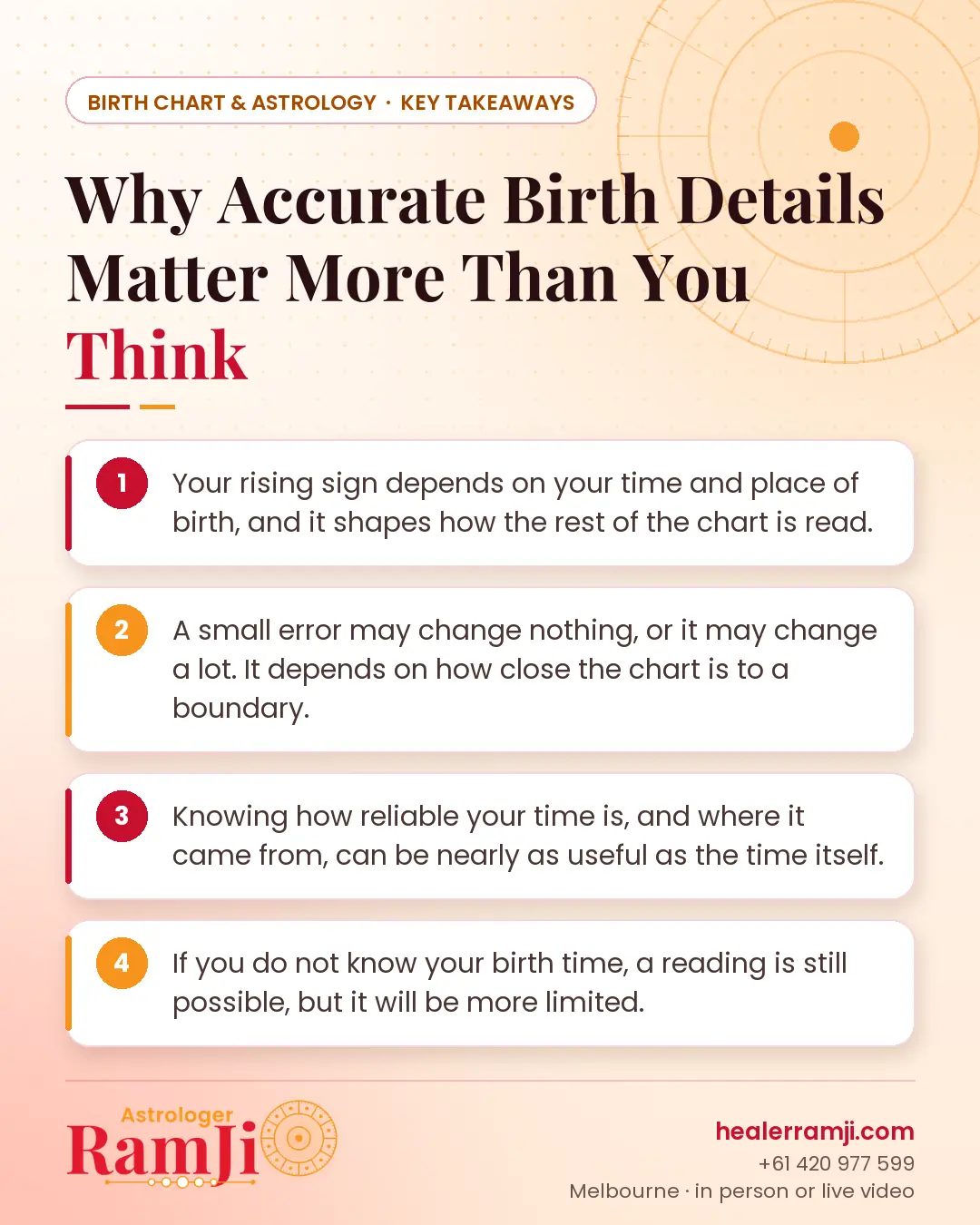
- Your rising sign depends on your time and place of birth, and it shapes how the rest of the chart is read.
- A small error may change nothing, or it may change a lot. It depends on how close the chart is to a boundary.
- Knowing how reliable your time is, and where it came from, can be nearly as useful as the time itself.
- If you do not know your birth time, a reading is still possible, but it will be more limited.
Which birth details does an astrologer need?
A chart needs three things:
- Date of birth. This places the slower planets and is usually reliable, although families sometimes remember one date while an official record shows another.
- Time of birth. This sets your rising sign, or lagna, and the order of the twelve houses.
- Place of birth. Your latitude and longitude change the time of local sunrise and the sign rising on the horizon, and they also determine which time zone was in use.
Your name is not needed to calculate a chart. It is simply a way to keep track of whose chart is whose.
What happens if your birth time is a little wrong?
The Earth's rotation brings a new sign over the eastern horizon approximately every two hours. That means your rising sign usually won't change because of a few minutes, unless you happen to be born close to the point when the sign changes. If you are, even a small error could give you a different lagna, and every house in the chart would be read differently.
Other parts of the chart are even more sensitive. Divisional charts, such as the navamsa used in many marriage readings, slice each sign into smaller sections, so they can change with a much smaller shift in time. At the other end of the scale, the Moon moves through its nakshatra over roughly a day. Your birth star usually stays the same unless the Moon was changing nakshatra around the time you were born.
In practice, a time recorded to the nearest five or ten minutes is often workable. A time remembered as "around lunchtime" or "early morning" is another matter. It can still be used, but the reading should lean less on the finest details.

Why does the place of birth matter so much?
Many people give the state or the nearest big city, and that can be close enough for some purposes. Still, a town is better. Sunrise differs from one location to another, and so does the local time used for the calculation.
Older birth records can be surprisingly tricky. Time zones and clock rules have changed over the decades in many countries, and daylight saving has been introduced and altered at different times. A good chart calculation takes this into account, but it helps to tell your astrologer exactly where you were born, particularly if the town has changed its name. Australian daylight saving can trip up free apps, so check the settings if you use one.
Where can you find your birth time?
Start with whichever of these you can reach:
- Your birth certificate. Check it first, but be prepared for it to show no time. Many certificates, in Australia and elsewhere, don't include one.
- Hospital or maternity records. The hospital where you were born may hold a record. Requests and retention periods vary, so ask their records team what is available. In Victoria, the rules on access to health records differ between private and public hospitals.
- Family papers. In many South Asian families, a parent or grandparent had a janam patri made soon after a child was born. Look for it among old documents.
- Baby books and letters. A note written close to the time is often more reliable than a memory.
- Your relatives. Ask more than one person, and ask what they remember happening around the birth. A detail like "just after evening prayers" can narrow things down.
Whatever you find, note where it came from. There is a real difference between a time from a hospital record and one a relative recalls after forty years. Clocks in delivery rooms weren't always exact either, and times were often rounded.
What if you have two different times?
This is more common than you might think. Tell your astrologer about both, and share where each came from. Rather than picking one at random, a careful astrologer can compare the two against dated events in your life, such as a marriage, a move overseas or a change of career, and see which version seems to fit better.
Even so, this comparison is a judgement call and not a proof. A reader should tell you how confident they are.

What if you can't find your birth time at all?
You still have options. The planets' signs and your Moon sign are often clear from the date alone, so some themes can still be discussed. Dasha dates are less certain, as they depend on the Moon's exact position, and the Moon moves enough in a day to shift those dates by months or even years. If the Moon was moving between signs that day, you may be given more than one possibility.
You could also ask about birth time rectification, which estimates a likely time from your life events. Some people prefer a palm reading, as it needs no birth details at all. Whichever you choose, it's better to admit uncertainty than to give a guessed time as though it were exact.
How can you prepare for your reading?
Before you book a kundli reading, try writing down the following on one page:
- Your date of birth, and any doubts you have about it
- Your time of birth, its source, and how sure you feel about it
- The town, state and country where you were born
- The dates of three to five major life events
- The questions you most want to ask
A short list like this saves time and makes the reading more useful. It also gives you a way to judge your reader. A careful reader will ask about your source and allow for uncertainty. Be wary of anyone who makes very precise claims without ever checking your details.
Finally, remember what a chart is for. Even a perfectly timed chart offers a way of reflecting on your life and does not fix your future. It works best alongside your own judgement and, where needed, professional advice. For a simple overview, see what details you need for a kundli reading.

Related service
Keep reading

Daylight Saving and Your Birth Chart
Australian clock rules have changed many times. See which states use daylight saving, how Victoria's dates moved, and how to spot a chart that is an hour out.
Read article →
Sidereal or Tropical: Why Your Sign May Change
Your Vedic sign may differ from your Western one. Learn why the sidereal and tropical zodiacs differ, what an ayanamsa is, and which system suits your question.
Read article →
Your Lagna Explained for Beginners
Your lagna is the sign rising in the east when you were born. Learn how this Vedic ascendant sets out your chart, what the lagna lord is, and what it can't tell you.
Read article →Quick answers
What is a kundli?
A kundli is a Vedic birth chart that maps the planets at your exact time and place of birth. Here is what it shows, in plain words.
Read answer →What details do I need for a kundli reading?
A kundli reading needs your date, time and place of birth, plus a clear question. Here is how exact each detail should be, and what to do if one is missing.
Read answer →Talk to Vijay Ramji
Tell us what you are facing. If a reading is unlikely to help, you will be told that plainly.