
What Free Kundli Apps Get Right and Wrong

Free kundli apps are usually accurate in the calculation itself. If your birth details and settings are right, the planets, birth star and dasha dates should be correct. The weak point is interpretation. Automatic reports judge each placement alone, flag many doshas and can't weigh the whole chart or your real life.
A free app can draw your kundli faster than you can make a cup of chai. For many people in Australia, that is now the first chart they ever see, long before they speak to anyone about it. That's not a bad thing. The software is often very good at one part of the job and quite poor at another.
This article separates the two. It covers where you can trust the screen, which hidden settings can change what you see, and where interpretation begins.
Key takeaways
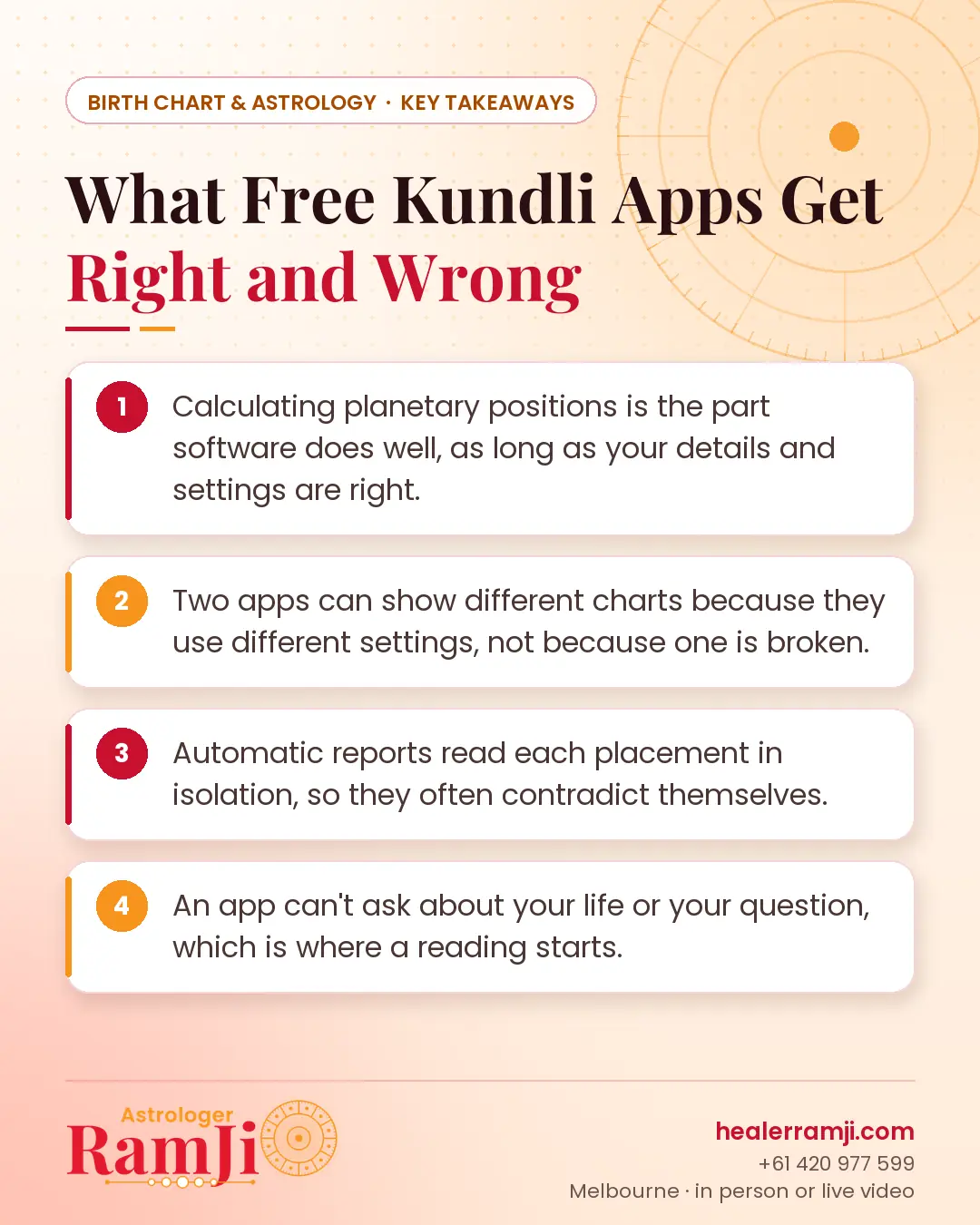
- Calculating planetary positions is the part software does well, as long as your details and settings are right.
- Two apps can show different charts because they use different settings, not because one is broken.
- Automatic reports read each placement in isolation, so they often contradict themselves.
- An app can't ask about your life or your question, which is where a reading starts.
What does a free kundli app get right?
The arithmetic. Working out where the Sun, Moon and planets were at a given moment is an astronomy problem, and computers handle it well. Once the positions are known, a good program can work out your rising sign, your Moon's nakshatra, the divisional charts and your Vimshottari dasha dates without the slips a person can make with printed tables.
So if you enter a checked birth time, the correct town and the right time zone, a reputable app will usually give you the same basic chart an astrologer would calculate. That is the honest headline on accuracy: the maths is rarely the problem.
Why can two apps show different charts?
Because they make different choices behind the screen. Most apps pick sensible defaults, but few explain them. These are the settings that matter most.
The ayanamsa
Vedic astrology uses the sidereal zodiac, which needs a correction called the ayanamsa. Several versions exist. Lahiri is the most widely used in India, but others such as Raman or Krishnamurti differ from it by anything from a fraction of a degree to more than a degree. That is usually harmless. If a planet or your rising point sits near the edge of a sign or nakshatra, though, it can cross the line.
Mean or true Rahu and Ketu
The lunar nodes can be calculated as a smoothed average, called the mean node, or as the actual wobbling position, called the true node. Traditions differ on which to use. The gap is small, but it can matter near a boundary.
House method
Many apps place each sign in one house from the rising sign. Others also show a bhava chalit chart, which divides the houses by degree. A planet can sit in your tenth house in one view and your eleventh in the other. Neither is an error. They are different methods, and astrologers disagree about how to combine them.
Dasha year length
Some programs count a dasha year as a solar year, while others use a 360-day year. Over several decades, the dates drift apart. If your app's timeline and a family patri disagree by months, check this setting before you assume anyone made a mistake.
Chart style
North Indian charts use a diamond layout, and South Indian charts use a fixed square. The same chart can look completely different in each. Before you compare two printouts, make sure they use the same style.

Where do your inputs trip the software up?
An app trusts whatever you type. A wrong offset is the most common problem, and Australian clock rules have changed many times, as our guide to daylight saving errors in Australian birth charts explains. The other trap is a missing time. Some apps quietly fill in a default if you leave the field blank, then present the result as if it were exact. If you don't know your time, read what can still be read without a birth time before trusting any dasha dates. The Moon moves far enough in a day to shift them by months or even years.
Where does interpretation begin?
The moment the app starts writing sentences. Most automatic reports are built from stock paragraphs, one for each placement. Saturn in your seventh house brings up one paragraph. Jupiter aspecting it brings up another. The software rarely weighs one against the other, so you may read that marriage will be delayed and, two screens later, that it will be early and happy.
In the tradition, a placement is only part of the picture. A reader looks at a planet's strength, the house it rules, what aspects it, which dasha you are in and how all of that fits your rising sign. Two people with the same placement can be read quite differently. Then there is the most important input of all, which no app collects: what is actually happening in your life, and what you want to know.
That is not a claim that a human reading is scientific. Astrology is a traditional practice and hasn't been shown to predict events. It simply means that a tradition built on judgement can't be fully automated.
Why do apps flag so many doshas?
Because the rules are easy to code and alarming results keep people clicking. A free report may announce Mangal dosha, Kaal Sarp dosha and a long list of yogas, each in bold. Many of these flags ignore the exceptions and cancellations that traditional texts describe, and some yogas are so loosely defined that most charts contain several.
A red warning on a screen can feel final. It isn't. If a free report frightens you and then offers a paid remedy on the next page, treat that as a sales tactic. Close the app, sleep on it, and ask someone with nothing to sell.
What about your privacy?
Your full name, birth date, time and place are personal information. Some apps ask for an account, your contacts or your location, and some exist mainly to sell reports or collect data. Check the permissions and privacy policy, and think twice before entering a relative's details without asking them. The Office of the Australian Information Commissioner explains your privacy rights in Australia.
How can you use an app sensibly?
- Find the settings page. Note the ayanamsa, node type, dasha year and time zone the app used.
- Check the time zone shown. It should match the clock in use where and when you were born.
- Compare with an older chart. If your family has a janam patri, see whether the rising sign and birth star agree.
- Ignore the auto report. Use the chart itself and skip the paragraphs underneath.
- Save a copy. A screenshot of the chart and settings is useful if you later see a reader.
When is a reader worth it?
Not always. If you are curious and the app has answered your curiosity, that may be enough. A person can help when the auto report has worried you, when two apps disagree, or when you have a real question about timing. A kundli reading starts by checking the chart the software drew, then talks through what it may suggest and what it can't tell you. Our list of questions to ask before booking a reading can help you judge any reader. If you would like to bring your app chart along, get in touch.
Related service
Keep reading

Ten Questions to Bring to Your First Reading
Get more from a first reading. Ten questions to ask an astrologer, how to sharpen a vague worry into a clear question, and which questions to leave out.
Read article →
Why a Muhurat from India May Not Work in Melbourne
Why a muhurat worked out for India can't simply be converted to Australian time: local sunrise, day length, the rising sign and daylight saving all change it.
Read article →
What to Expect at a First Reading in Ascot Vale
Booking a first reading with an astrologer based in Ascot Vale? How it works by phone, WhatsApp or video, what to prepare, and what a reading cannot do.
Read article →Quick answers
What is a kundli?
A kundli is a Vedic birth chart that maps the planets at your exact time and place of birth. Here is what it shows, in plain words.
Read answer →What details do I need for a kundli reading?
A kundli reading needs your date, time and place of birth, plus a clear question. Here is how exact each detail should be, and what to do if one is missing.
Read answer →Talk to Vijay Ramji
Tell us what you are facing. If a reading is unlikely to help, you will be told that plainly.