
Dasha Period Analysis
Your planetary periods, mapped against the next few years.

A dasha analysis maps your Vimshottari planetary periods onto the calendar, then relates the current and coming periods to decisions you face over the next few years. It is a Vedic astrology framework for reflection and timing. It is not a prediction of fixed events, and it does not replace professional advice.
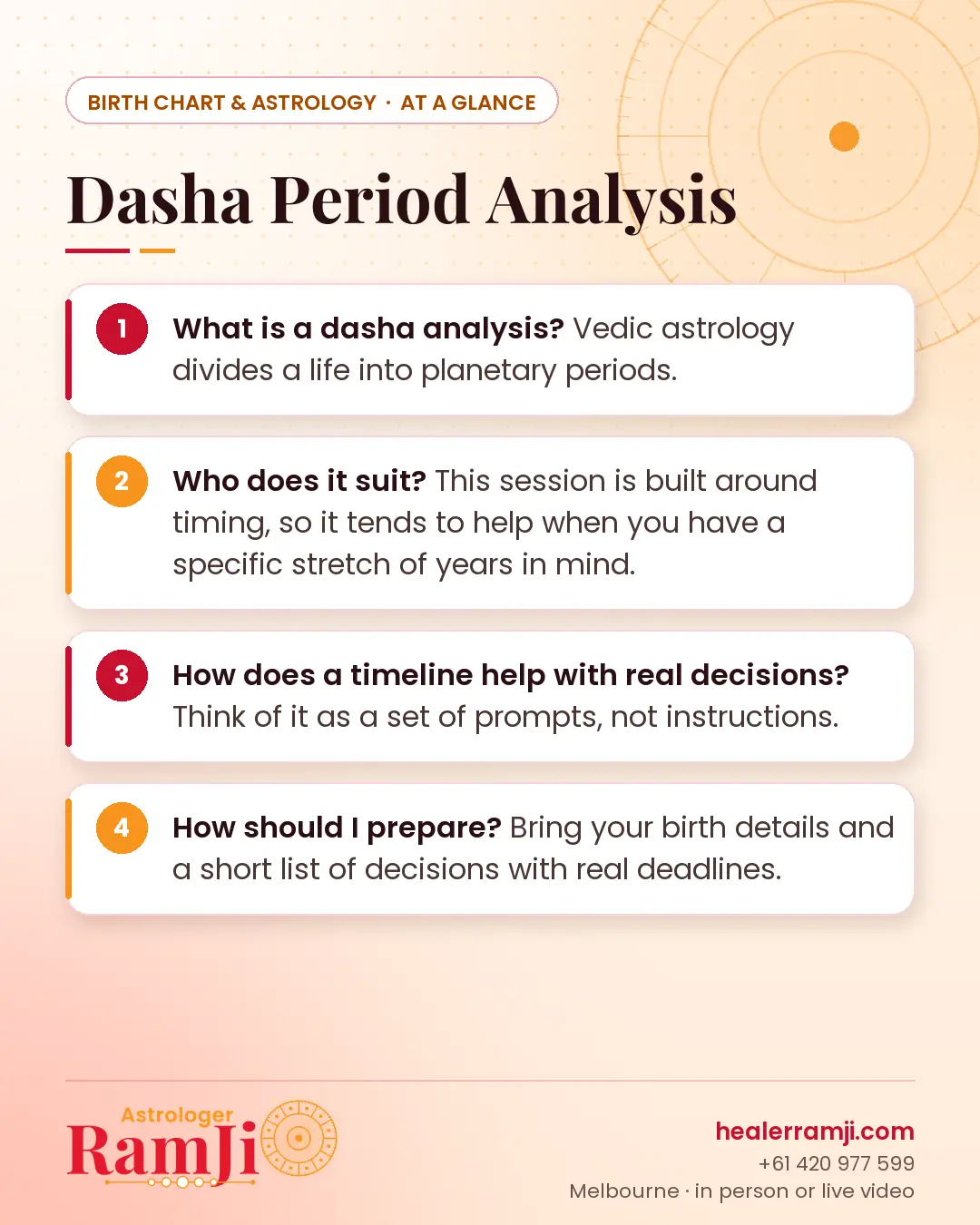
What is a dasha analysis?
Vedic astrology divides a life into planetary periods. The best known system, Vimshottari dasha, is a 120-year cycle of nine major periods, each called a mahadasha. A full kundli reading looks across the whole chart. A dasha analysis asks a narrower question: what kind of time is this, and when does it change? For a one-paragraph definition, read what a dasha is in astrology.
The major periods always run in the same order, and each has a set length:
- Ketu, 7 years
- Venus, 20 years
- Sun, 6 years
- Moon, 10 years
- Mars, 7 years
- Rahu, 18 years
- Jupiter, 16 years
- Saturn, 19 years
- Mercury, 17 years
Your starting point depends on your birth star. The nakshatra holding the Moon when you were born selects your first period, and the Moon's progress through that star sets how much of it was left. Each major period then divides into antardashas and finer levels. Our guide to how the Vimshottari system works shows how to read your own timeline. Other systems exist, such as Yogini dasha, and astrologers differ on when to use them.
Who does it suit?
This session is built around timing, so it tends to help when you have a specific stretch of years in mind. It may suit you if:
- A period is about to change and you want to think ahead. Preparing for a dasha change without fear is a good place to start.
- You face decisions with a long lead time, such as further study, a move interstate or overseas, or a change of career.
- Someone has told you that you are in a bad dasha, and you would like a calmer second opinion.
- You have already had a birth chart reading and want more detail on the timing.
If your question is about the slow planets rather than your periods, a Saturn and Jupiter transit reading may fit better. The two are often read side by side.

What happens in a session?
- Your details are checked. You will be asked for your date, time and place of birth, and where the time came from.
- The timeline is set out. This usually covers your current mahadasha and antardasha, along with the next changes coming up.
- Each planet is read in your chart. The planet's name says little by itself. What matters is the houses it rules, where it sits and how it relates to the rest of the chart.
- Past periods may be compared with your life. You may be asked how earlier changes of period lined up with real events. A poor match is a reason for more caution.
- Your decisions are placed on the timeline. You talk through what is coming up and how confident the reading is.
How does a timeline help with real decisions?
Think of it as a set of prompts, not instructions. Take a generic example. Someone is weighing a course that starts next year, and their sub-period changes eighteen months from now. The reading can raise useful questions. Which part of life does the coming planet point to in this chart? Would the course suit that theme, or compete with it? What would they do anyway if astrology had never come up?
The facts of the course, the cost and the family's needs still decide the matter. Where money is involved, read independent guidance from Moneysmart and speak to a licensed adviser. A dasha is no basis for buying, selling or borrowing.
Astrologers also talk about dasha sandhi, the junction where one period gives way to the next. Tradition treats these months as unsettled. In practice, that is a reason to keep plans flexible, not a reason to panic. If a stretch already feels heavy, planning through a difficult dasha offers practical steps.

How should I prepare?
Bring your birth details and a short list of decisions with real deadlines. Add the dates of a few major past events, because they give the reading something to test against.
Your birth time matters more here than you might expect. The Moon moves about half a degree an hour, and that position sets the start of the whole timeline. An error of one hour can shift your period dates by several months, and by more if your timeline begins in one of the long periods. If your time is a family estimate, say so at the start.
What can't a dasha analysis do?
Astrology is a traditional practice, and there is no scientific evidence that planetary periods shape events. A timeline cannot tell you that a job will come through, that a relationship will end or how an illness will go. Health, legal and money questions belong with a qualified professional first.
Be wary of anyone who says a coming period will bring disaster unless you pay for a ritual. That is pressure, not insight, and you are free to walk away.
What does it cost?
Ask when you get in touch. Any fee is stated before paid work begins, so you can compare it with your budget before agreeing to anything.
How do I get in touch?
Call or send a WhatsApp message to +61420977599, or use the contact form and mention the decision or period you are thinking about. Vijay Ramji is based in Ascot Vale, with appointments arranged in advance, and sessions can be held by phone, WhatsApp or video.
Common questions
What is the difference between a mahadasha and an antardasha?
A mahadasha is one of the nine major periods, lasting from 6 to 20 years. An antardasha is a smaller period inside it, lasting from months to a few years. Many astrologers read the two together, as the major period sets the backdrop and the smaller one adds the detail.
My app shows different dasha dates from another app. Which one is right?
Possibly neither is wrong. Apps may use a different ayanamsa or a different year length, and a small change in the Moon's position moves every date. Bring both versions and ask which settings are being used, so the dates can be compared fairly.
Is a Saturn or Rahu dasha always a bad time?
No. The same planet can be read very differently from one chart to the next, depending on the houses it rules and where it sits. A period is not doomed because of the planet's name, and reputations alone tell you little.
Can I book if I don't know my birth time?
Yes, but the timeline will be rough. Without a time, the Moon's position is only known to within about a day's movement, so period dates can be out by years, and even your starting period may be unclear. You may also like to ask about estimating your birth time from past events first.
Should I delay a decision until my dasha changes?
Not because of the dasha alone. Deadlines, money, health and the people involved matter far more. Use the timeline as one way to think about the decision, and get qualified advice where the stakes are high.
Related services

Annual Varshphal Forecast
A varshphal annual horoscope reading with Vijay Ramji: a birthday-to-birthday chart used as a yearly planner, with honest limits on what it can show.
View service →
Birth Time Rectification
Birth time rectification with a Melbourne astrologer: estimate an unknown birth time from dated life events, and learn how much confidence the result deserves.
View service →Read more
How the Vimshottari Dasha System Works
How the 120-year Vimshottari dasha cycle is calculated from your birth star, how sub-periods are worked out, and how to read your own timeline sensibly.
Read article →
Getting Through a Difficult Dasha
Told you are in a hard dasha? A calm, practical plan for a tough planetary period: check the dates, protect the basics, and keep decisions in your own hands.
Read article →A Dasha Change Is Coming: Planning From Mount Waverley
A dasha change is coming. Here's what to do from Mount Waverley: check the dates, list your decisions, and plan calmly without fear or costly remedies.
Read article →Quick answers
What is a dasha in astrology?
A dasha is a planetary period in Vedic astrology. See how long each one lasts in the Vimshottari system, and what a dasha can and can't tell you.
Read answer →What is a kundli?
A kundli is a Vedic birth chart that maps the planets at your exact time and place of birth. Here is what it shows, in plain words.
Read answer →Talk to Vijay Ramji
Tell us what you are facing. If a reading is unlikely to help, you will be told that plainly.