
Interfaith Couples in Coburg: Telling Both Families

Interfaith couples in Coburg usually do better telling both families in a planned order. Agree your own position first, let each partner tell their own parents, share the news plainly, and leave the big questions for later. Disapproval is common and may soften with time, but threats or pressure to marry are never acceptable.
Faith has been part of the Coburg streetscape for a long time. Victorian Places records a Wesleyan chapel from 1849 that's still standing, with Anglican and Catholic churches nearby forming a precinct at Sydney Road and Bell Street. By 1981, it says, residents from southern and eastern Europe made up nearly one in five of the population, and later arrivals from the Middle East followed. Across the municipality, Merri-bek City Council translates its information into Italian, Greek, Arabic, Turkish, Simplified Chinese, Nepali, Urdu, Spanish, Vietnamese and Hindi.
That means two families of different faiths could easily live a short drive apart here, and they could share a shopping strip or a school gate. It's a good thing, but it does change the planning. News may reach one family through the other before you are ready. This guide is about telling both families in a way you've chosen.
Key takeaways
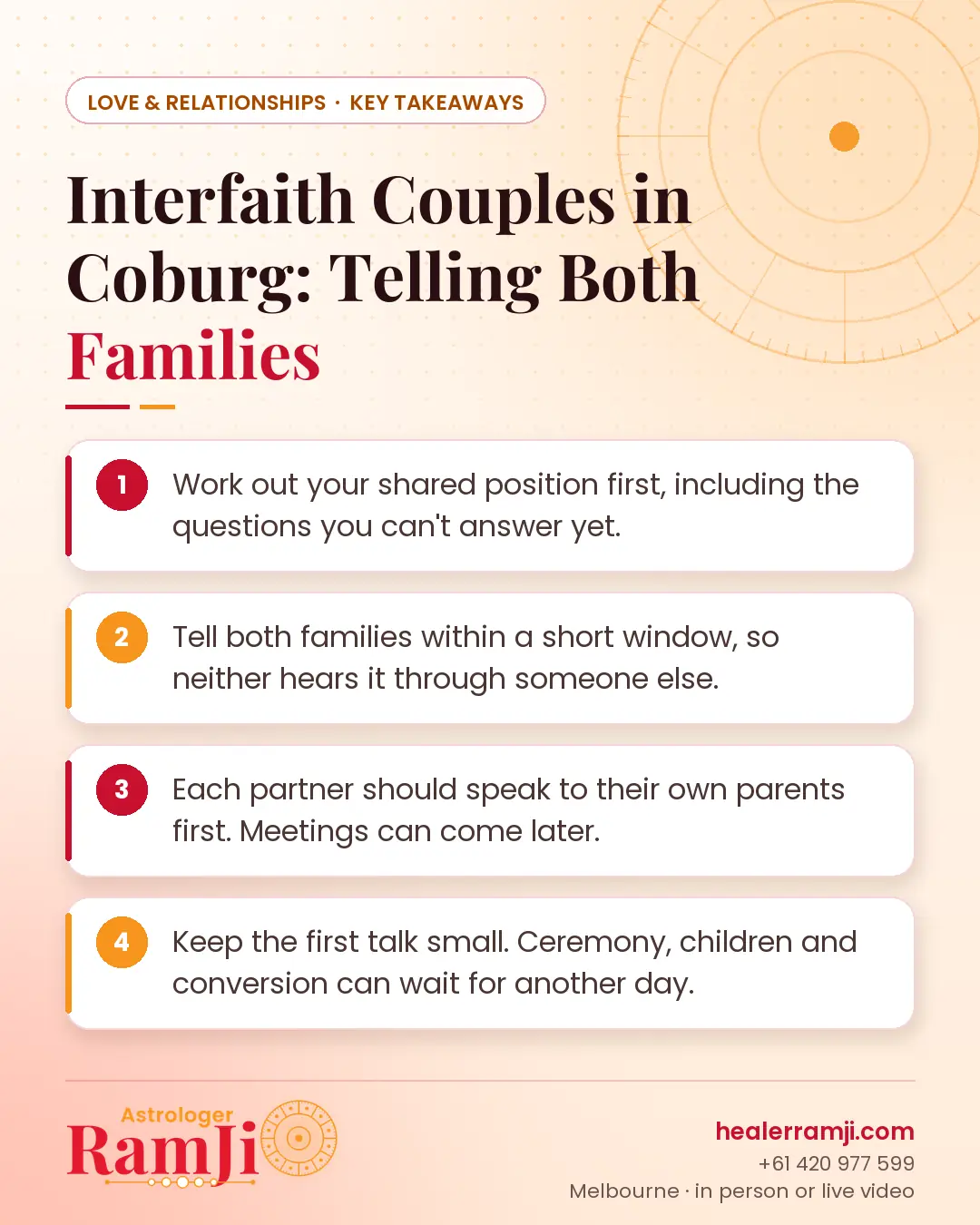
- Work out your shared position first, including the questions you can't answer yet.
- Tell both families within a short window, so neither hears it through someone else.
- Each partner should speak to their own parents first. Meetings can come later.
- Keep the first talk small. Ceremony, children and conversion can wait for another day.
What should the two of you agree first?
Parents will test any gap between you, usually without meaning to. So talk these through in private:
- How serious are we? "We're getting married" and "we're together and it matters" are very different announcements.
- Is anyone being asked to convert? If so, by whom? A change of faith should be freely chosen by the person making it, and never a condition set by someone else.
- What about children, if we have them? "We haven't decided, but we'll decide together" is an honest answer.
- What will we do if one family says no? Talk about this before it happens.
- What won't we accept? You might decide that insults about your partner's faith end the conversation.
You don't need all the answers. You do need to know which ones you have, so that neither of you is surprised by what the other says at a parent's kitchen table.

Who should tell which family first?
There's no single right order, but a few principles help.
- Each partner speaks to their own family. Parents can say harsh things to their own child and later take them back. It's harder to take them back if they were said to a guest.
- Start with an ally. A sibling, cousin or aunt can tell you how the news might land, and might stand beside you later.
- Keep the two talks close together. Aim for the same week. In a neighbourhood where relatives might run into each other along Sydney Road, or where word moves through a mosque, church, temple or gurdwara, a long gap is a risk.
- Tell parents before the wider family. Learning it from an uncle hurts more than the news itself.
- Let safety change the plan. If you fear a violent or controlling response from one side, don't follow this order. Get advice first, and don't break the news alone in a closed house.
What do you actually say?
Keep it short and use the language your parents are most at home in. You could try something like this:
"I want to tell you about someone important to me. Her name is Sara. We've been together for two years. She's Muslim, and she's a good person. I'm telling you because I love you, and I want you to hear it from me."
The name and details are only an example. Then stop talking, which is the hard part. They may be silent, angry or tearful, or they may start asking questions immediately. You don't have to answer everything. "We haven't worked that out yet" is a full answer, as is "Can we talk about that next weekend?"
Try not to argue about theology in this first talk, and don't bring your partner to it. A quick end to the conversation isn't a failure. You have said it, and they have heard it from you. That was the whole aim.

Which questions will come next?
Expect some version of these over the following weeks:
- "Will you convert?" Answer honestly, and say if it's still undecided.
- "What about the children?" Tell them what you've agreed, even if that's only a principle.
- "Which wedding will it be?" Many couples work out a way to honour both sides. Our guide to blending rituals in an interfaith wedding looks at the options.
- "What will people say?" This is often the real worry. Take it seriously. Ask who they're most worried about.
- "Who will perform our rites when we're old?" This one is rarely said aloud, but older parents often think about it.
Religious rules on interfaith marriage differ between and within traditions. We can't tell you what a particular community will accept, so ask a priest, imam, granthi or rabbi from that community directly. It can also help to give your parents something to read. Our guide for parents of an intercaste couple speaks to many of the same fears.
Does astrology have a place in this?
Only if you both want it. One family might ask for a chart comparison as a matter of course, while the other might consider astrology forbidden. Don't use a reading as a weapon in either direction, and never have your partner's chart read without their consent. A chart is a traditional lens, and it hasn't been shown to predict how a marriage will go. It can't resolve a disagreement about faith, as our page on the limits of compatibility astrology makes clear.
What if one family won't accept it?
Some parents come around slowly and some don't. You can leave the door open while still living your life. Send a message at festivals. Tell them important news. Set a limit on what you'll listen to, and leave calmly when it's crossed. A respected elder who is willing to speak on your behalf can sometimes do more than you can.
Guidance when family opposes a relationship is one place to talk this through, and intercaste and interfaith marriage guidance goes further into marriage itself. For professional help, the Merri-bek council page lists Holstep Health for counselling and family and relationship services, with locations including Coburg. Ask them what would suit your situation.
When is it no longer a family disagreement?
Some things are not about faith at all. Threats, violence, confiscating your phone or passport, being taken overseas against your wishes, or pressure to marry someone else are serious.
My Blue Sky explains that a forced marriage is one where a person marries without freely and fully consenting, and that it can happen through pressure, threats or being misled. The service also offers free legal advice by secure message. You can call 1800RESPECT on 1800 737 732 for confidential support, and if you are in immediate danger, call 000. Keep your documents and some money somewhere safe, and let a trusted friend know your plans.
When you want someone outside both families to talk to, sessions can be held by phone, WhatsApp or video, and what you share is confidential. We've gathered more guides for Melbourne's northern suburbs, or you can get in touch.

Related service
Keep reading
Separated and Still Sharing Kids in Narre Warren
Separated and sharing children in Narre Warren? Put the kids' safety first, find local mediation and legal help, and keep yourself steady while things settle.
Read article →
Love and Family Pressure From Shepparton
Facing family pressure about who you love while living in Shepparton? Why it can feel lonelier in a regional city, and where to find confidential support.
Read article →
Airport Goodbyes at Tullamarine: Long-Distance Reality
The drive home from Tullamarine after a long-distance visit can hurt. Ways to handle the farewell, the first week after, and when to look for more support.
Read article →More from Melbourne's Northern Suburbs

Cleansing a Shared House in Reservoir
Renting in a Reservoir share house? How to do a smoke free cleansing that respects your housemates, smoke alarms and lease, and what a ritual can't fix.
Read article →
When a Parent Dies Overseas: First Steps From Epping
A parent has died overseas and you are in Epping, perhaps unable to fly back. Gentle first steps, simple rites at home, and where to find real support.
Read article →
Job Offer Across Town: Thinking It Through From Craigieburn
Offered a better job across Melbourne but live in Craigieburn? How to weigh pay and career growth against hours on the road or train, and where a chart fits.
Read article →Local pages

Quick answers
Can astrology bring my ex back?
No, astrology can't make your ex come back, and nobody can honestly promise it. Here is what a reading can help with, and how to avoid costly promises.
Read answer →Is vashikaran ethical?
No. Vashikaran aims to control another person, which is unethical and is refused here. Why consent matters, and where to turn if you feel pressured or controlled.
Read answer →Talk to Vijay Ramji
Tell us what you are facing. If a reading is unlikely to help, you will be told that plainly.