
Remarriage After Divorce in Indian Families

Remarriage after divorce in an Indian family often means facing gossip and telling children carefully. Tell your children before the wider family, at a pace that suits their age, and never ask them to take sides. Your divorce must be final before you remarry, and a lawyer can explain parenting and property effects.
Deciding on remarriage after divorce is a hopeful step. In many Indian families, it also reopens conversations you thought were finished. An aunt asks pointed questions, a former mother-in-law goes quiet, and your children want to know what this means for them.
This page looks at two parts of that: handling the stigma that can still follow divorce, and telling your children in a way that keeps them feeling safe.
Key takeaways
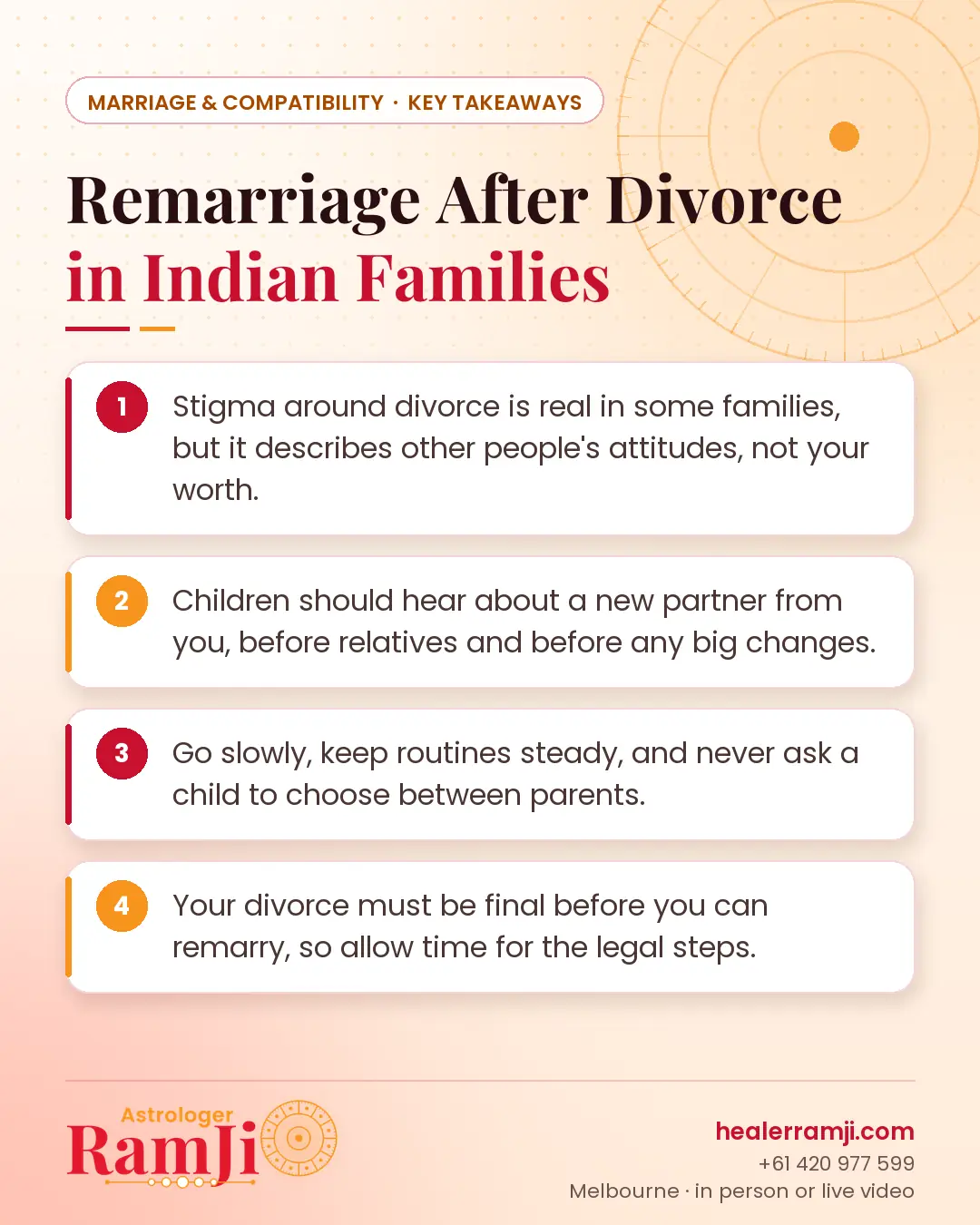
- Stigma around divorce is real in some families, but it describes other people's attitudes, not your worth.
- Children should hear about a new partner from you, before relatives and before any big changes.
- Go slowly, keep routines steady, and never ask a child to choose between parents.
- Your divorce must be final before you can remarry, so allow time for the legal steps.
Why does divorce still carry stigma in some Indian families?
Attitudes are changing, especially among people raised in Australia. Still, older relatives may have grown up with the idea that marriage is for life and that a divorce reflects on the whole family. In some families, women are judged more harshly than men for the same choice. Comments may be framed as concern ("we only want you settled") or as blame ("you should have adjusted").
Some of this comes from fear about what the community will say. Some comes from love that doesn't know how to show itself. Neither makes it easier to hear, but it can help to know the remark is usually more about them than about you.
How do you answer the comments?
You don't owe anyone a full account of your first marriage. A few short replies can carry you through most family gatherings:
- "I'm happy, and I'd love you to be happy for me."
- "That chapter is closed. I'd rather talk about what's next."
- "The children are doing well, thank you for asking."
Choose one or two relatives who are genuinely on your side, and tell them first. They can quietly correct gossip in rooms you aren't in. If someone keeps pushing, it is fine to leave the conversation.
Who should hear the news first?
Order matters, because people remember how they found out. A sensible sequence for many families is:
- You and your partner. Be sure of the relationship yourselves before you involve anyone else.
- Your former partner, if you share children. Relationships Australia advises talking with your child's other parent before introducing your child to a new partner. Even if you rarely agree, this avoids your children being caught in the middle.
- Your children. Before grandparents, cousins or social media.
- Your parents and close family.
- Former in-laws, where you are still in touch. They are your children's grandparents, and that relationship deserves protecting.
How do you tell children of different ages?
Every child is different, but age gives you a starting point.
Young children
Keep it simple and concrete. "This is my friend Priya. She'll be coming to the park with us sometimes." Young children mostly want to know that their routines, their home and both parents are staying put. Show them, through ordinary days, that nothing important is being taken away.
Primary school age
Expect questions, sometimes at odd moments. Answer honestly and briefly. Children this age may worry that liking a new adult is disloyal to their other parent. Tell them plainly that they don't have to choose, and that loving more people doesn't mean loving anyone less.
Teenagers
Teenagers often want a say. Ask their views before big changes, such as moving house or merging households, even if you make the final decision. Don't expect them to treat your new partner as a parent. A respectful, friendly adult is a good starting point.
Adult children
Grown children can feel surprisingly unsettled. They may grieve the family they knew, worry about a parent being hurt, or have unspoken concerns about the family home and inheritance. Be open about practical arrangements, and invite them to get to know your partner without forcing it.

What helps children settle?
Relationships Australia's advice on blended families stresses taking things slowly and keeping routines stable. It also notes that children may feel their loyalties are being tested or fear that a parent is being replaced. A few habits follow from that:
- Never speak badly of their other parent in front of them.
- Don't ask them to keep secrets from their other parent.
- Keep one-on-one time with each child, without your partner.
- Let affection between your children and your partner grow at the children's pace.
If a child seems withdrawn, angry or anxious for more than a short while, talk to their school or GP. A family counsellor can help too.
What legal steps come before the wedding?
Victoria Legal Aid explains that you can't remarry until your divorce order becomes final, one month after the hearing. It also warns against setting a wedding date too close to that point, in case of delays. Your celebrant will tell you what proof of the divorce they need.
A new marriage can affect your will, your property settlement and any parenting arrangements. A family lawyer can explain how. Our article on starting again after divorce in the city covers readiness and privacy, if those questions are on your mind too.
Where does astrology fit?
Some families will want charts compared before a second wedding, and some couples decide they don't need it. Either is fine. A chart can't explain why your first marriage ended, and nobody should tell you your divorce was your chart's fault. Our short answer on what a birth chart can show about a second marriage sets out the limits.
No ritual is needed before you marry again. If someone says your past must be cleansed for a fee, treat that as a warning sign.
If you would like a calm conversation about timing, family worries or how to tell people, second marriage guidance looks at your chart again from where you stand now, without stigma. Vijay Ramji is based in Ascot Vale, appointments are arranged in advance, and sessions can be held by phone, WhatsApp or video. What you share is confidential. When you're ready, get in touch.
Related service

Keep reading

Finding Partnership Again After Widowhood
Thinking about remarriage after widowhood? A gentle look at grief, guilt, family attitudes and adult children, with real support and honest limits.
Read article →
Marriage Remedies: What Is Worth Doing
Low-cost marriage remedies from astrology set against costly, pressured ones. What tradition suggests, what to avoid, and the warning signs of a remedy scam.
Read article →
Getting a Guna Milan Check Done Near Moonee Ponds
Your options for a guna milan check near Moonee Ponds, including family priests, nearby readers and video sessions, plus the details both partners should bring.
Read article →Quick answers
Does a birth chart show a second marriage?
A birth chart can't confirm a second marriage. Here is what astrologers look at, why they disagree, and what a chart can and cannot tell you about marrying again.
Read answer →What is Mangal dosha?
Mangal dosha is a traditional marriage concern linked to the placement of Mars in a birth chart. Here is what it means and why it is rarely a reason to panic.
Read answer →Talk to Vijay Ramji
Tell us what you are facing. If a reading is unlikely to help, you will be told that plainly.