
The Gayatri Mantra: Meaning and Practice

The Gayatri mantra is a Rigveda verse addressed to Savitr, the divine sun. Its meaning is roughly: we meditate on the radiant glory of the divine; may it inspire our minds. It is a prayer for clear understanding, traditionally chanted at dawn, noon and dusk, and customs differ on who receives it and how.
Many people raised in Hindu families can recite the Gayatri mantra before they can explain it. They learned it at home, at a temple class or at a sacred thread ceremony, and it stayed as a sound more than a sentence.
This guide sets out where the verse comes from, what each word means, how different translators have rendered it, and how to chant it with care.
Key takeaways
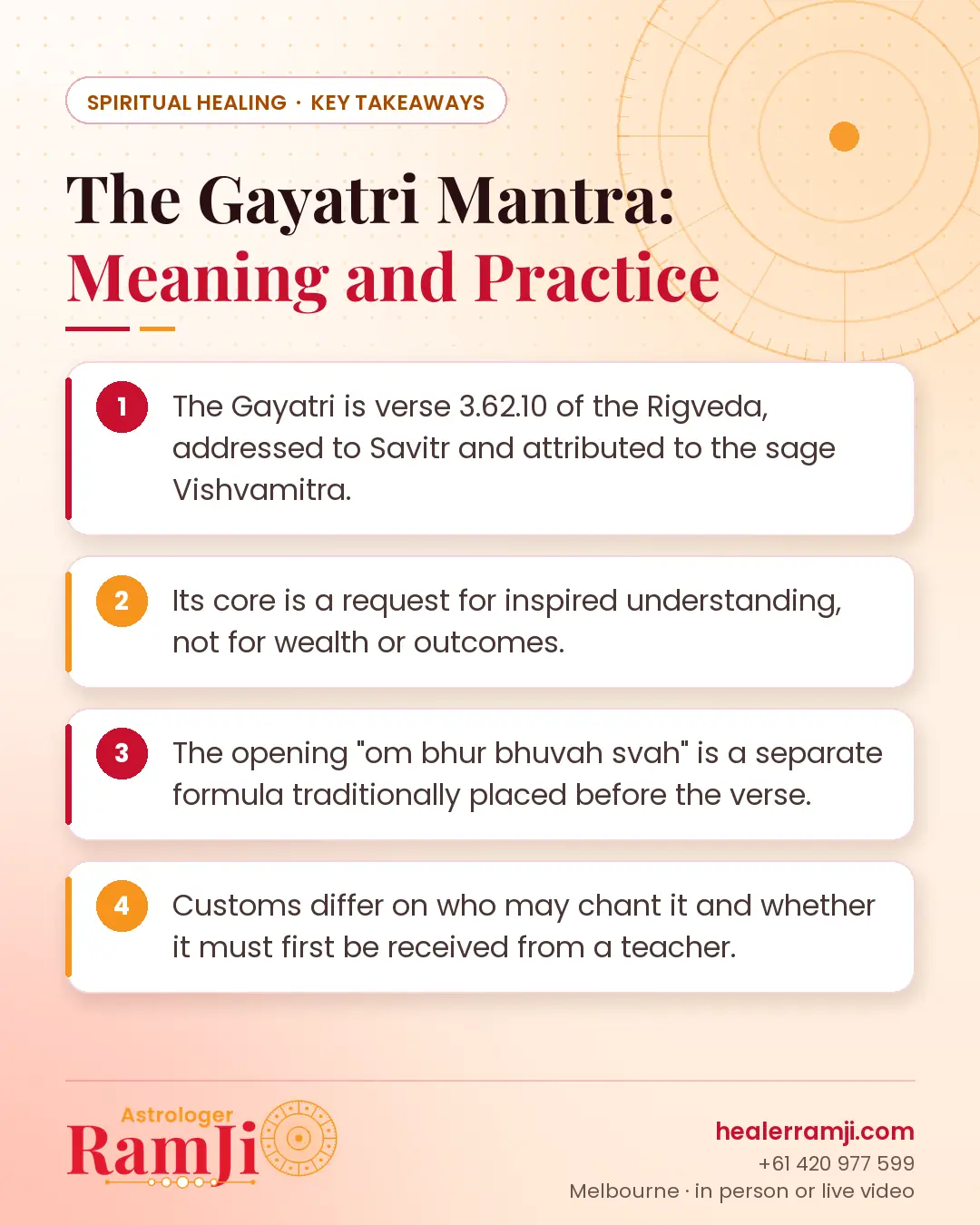
- The Gayatri is verse 3.62.10 of the Rigveda, addressed to Savitr and attributed to the sage Vishvamitra.
- Its core is a request for inspired understanding, not for wealth or outcomes.
- The opening "om bhur bhuvah svah" is a separate formula traditionally placed before the verse.
- Customs differ on who may chant it and whether it must first be received from a teacher.
Where does the Gayatri mantra come from?
The verse sits in the third book of the Rigveda, one of the oldest Hindu scriptures. It is addressed to Savitr, a solar deity often described as the power that rouses and impels, and it is attributed to the sage Vishvamitra. For that reason it is also called the Savitri mantra.
The name Gayatri refers to its metre, a form traditionally described as three lines of eight syllables. In time the mantra was personified as the goddess Gayatri, and many families today picture her when they chant. Both views sit comfortably side by side in Hindu practice.
What are the words?
In a common simplified transliteration, the full recitation reads:
- Om bhur bhuvah svah
- tat savitur varenyam
- bhargo devasya dhimahi
- dhiyo yo nah prachodayat
The first line is not part of the Rigveda verse itself. It is the mahavyahriti, or great utterance, which later texts prescribe chanting before the verse.
What does it mean, word by word?
- Om: the sacred syllable that opens most Hindu prayers.
- Bhur, bhuvah, svah: usually explained as earth, the space between, and the heavens. Together they stand for the whole of existence.
- Tat: that.
- Savitur: of Savitr, the divine sun or inspirer.
- Varenyam: most excellent, worthy to be chosen.
- Bhargo: radiance or splendour.
- Devasya: of the divine one.
- Dhimahi: we meditate on, or may we hold in mind.
- Dhiyo: thoughts or understanding.
- Yo: who.
- Nah: our.
- Prachodayat: may inspire, urge or direct.
How have translators rendered it?
Translations vary because Sanskrit allows several readings, and because translators bring their own theology. Swami Vivekananda gave it as "We meditate on the glory of that Being who has produced this universe; may He enlighten our minds." Sarvepalli Radhakrishnan offered "We meditate on the effulgent glory of the divine Light; may he inspire our understanding."
One reads the verse as a prayer to a creator, the other to divine light. Some scholars stay closer to the Vedic setting and keep Savitr as the sun god. None of these is simply wrong. If your family follows a particular teacher or tradition, its explanation is a good place to start.
What stays constant is the request. The Gayatri doesn't ask for money, a partner or a result. It asks for the mind to be lit and guided. Many people find that a useful reminder of what prayer is for.

Who may chant it?
This is where traditions differ most. The mantra has long been taught at the upanayana, or sacred thread ceremony, which marks the start of Vedic study, and in many communities it was traditionally limited to certain groups. From the nineteenth century, reform movements spread the chant widely. Swami Vivekananda, for example, reportedly taught it to people outside the priestly class.
Today many men and women chant it freely, while some families still hold that it should be received from a teacher or at a rite. Both positions deserve respect. If your family has a view, raise it with them before you begin.
How do you chant it?
- Learn the sounds slowly. Say each line separately until it feels natural. Listen to a careful recording from a teacher or temple you trust.
- Watch the metre. The preserved text has one syllable fewer than the 24 the metre expects, so some reciters use the restored form "vareniyam", while others lengthen the final sound of "varenyam". Follow whichever form your teacher uses.
- Choose your voice. Spoken, whispered or silent repetition are all traditional. Silent chanting suits shared homes and public transport.
- Pick a time. The traditional times are the three sandhyas: dawn, midday and dusk. If your day doesn't allow that, once a day at a fixed point is a sensible start.
- Pick a count. 108 on a mala is traditional, but 11 or 27 done with attention is a fine beginning. Our short answer on why mantras are chanted 108 times explains the number, and how to use a mala covers counting.
- Hold the meaning. Let one phrase, such as "may it inspire our understanding", sit in mind while you repeat the sounds.
Mistakes are part of learning. Traditions value careful pronunciation out of respect, but no beginner should be frightened into silence by claims that an error brings harm.
What can the Gayatri do, and what can't it?
For believers, the Gayatri is a prayer of great dignity, and chanting it can be a daily act of devotion. As a focus for meditation, it works like any mantra. healthdirect lists a mantra as one possible point of focus, and suggests beginners start with one to two minutes a day.
It is not a treatment, and it can't secure a job, a marriage or an exam result. Be wary of anyone selling a "special" Gayatri ritual at a high price with promises attached. For a plain definition of the wider practice, see what a mantra is.
If you'd like help with pronunciation, meaning and fitting a short practice into your day, mantra and meditation guidance works one to one. Sessions can be held by phone, WhatsApp or video, and any fee is stated before paid work begins. To start, get in touch.
Related service

Keep reading

Meditation for People With No Spare Time
Meditation for busy people, shift workers and commuters: one to ten minute practices tied to your roster or trip, plus why you should never meditate while driving.
Read article →
How to Use a Mala
How to use a mala for mantra practice: holding it, counting a round, what to do at the guru bead, how traditions differ, and how to choose one without overspending.
Read article →
Hindu Rites After a Death in Melbourne
What antim sanskar, the mourning days and shraddha mean, and how Hindu families in Melbourne adapt funeral rites to Australian crematoria and customs.
Read article →Quick answers
What is a mantra?
A mantra is a sacred sound, word or phrase repeated in prayer or meditation. Here is what the word means, how it is used, and how to begin simply.
Read answer →What is energy healing?
Energy healing rests on the belief in a life force that can be guided. Here is what a session involves, and what the evidence does and doesn't show.
Read answer →Talk to Vijay Ramji
Tell us what you are facing. If a reading is unlikely to help, you will be told that plainly.