
The Seven Chakras Explained Simply
The seven chakras are centres of subtle energy that yogic and tantric traditions picture along the spine, from Muladhara at the base to Sahasrara at the crown. Each has a Sanskrit name, a place in the body and, for the first five, an element. They are a meditation map, not organs, and no test can measure them.
Chakras are everywhere now. They appear on yoga mats, candle labels and phone apps, often with a rainbow and a promise. Underneath the marketing sits an old contemplative idea that is far simpler, and in some ways more interesting.
This guide describes the seven chakras as the tradition presents them, points out which parts were added much later, and is honest about what the idea can and can't do.
Key takeaways
- Chakras are imagined centres along the spine, used as points of focus in meditation.
- The seven-chakra map is one version among several. Older texts count different numbers.
- The rainbow colours and personality traits are mostly twentieth-century additions.
- There is no scientific evidence that chakras exist, and a "blocked chakra" is not a health finding.
What is a chakra?
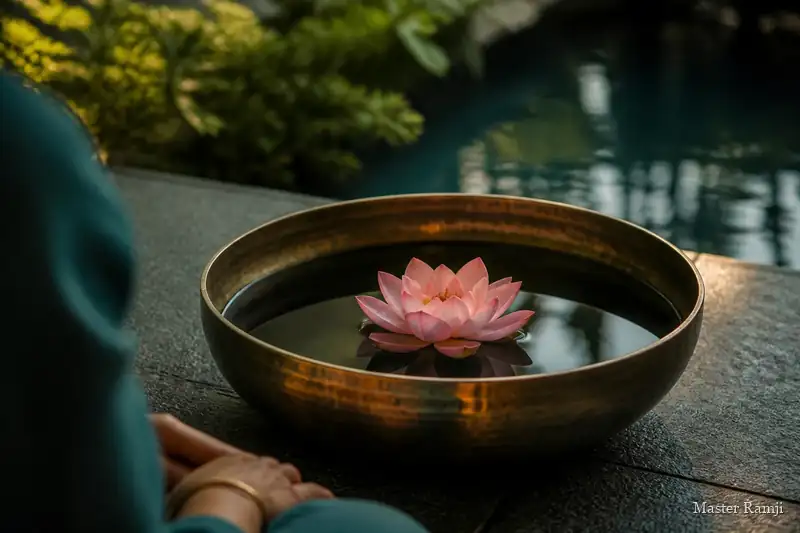
Chakra is Sanskrit for wheel or circle. In tantric and yogic traditions, chakras are described as centres in the subtle body, often pictured as lotuses with a set number of petals. Practitioners move their attention from one centre to the next, often with a seed sound, as a way of steadying the mind.
The same traditions describe channels called nadis. Three matter most here. The central channel, sushumna, runs up the spine, with ida and pingala winding on either side. The chakras sit along that central line. For a one-paragraph version, see our short answer on what chakras are.
What do the seven chakras mean?
Here is the best known map, from bottom to top. The names have meanings worth knowing, and the first five are each linked with one of the classical elements.
1. Muladhara, the root support
At the base of the spine. Its element is earth. In tantric writing, this is where the coiled energy called kundalini is said to rest.
2. Svadhisthana, one's own place
In the lower abdomen. Its element is water.
3. Manipura, the city of jewels
At the navel. Its element is fire.
4. Anahata, the unstruck
At the heart. Its element is air. The name refers to a sound that arises without anything being struck, an image of inner quiet.
5. Vishuddha, the purifier
At the throat. Its element is space, sometimes called ether.
6. Ajna, the command centre
Between the eyebrows. It is often linked with insight. Modern writers sometimes call it the third eye.
7. Sahasrara, the thousand-petalled
At or just above the crown of the head. It is described as a lotus of a thousand petals, an image of fullness rather than a body part.
Where does the seven-chakra map come from?
It is not the only map. Medieval Buddhist texts describe four or five centres, and Hindu sources give a range of numbers. The familiar seven owes much to a sixteenth-century Sanskrit text, the Sat-Chakra-Nirupana, which reached English readers in the early twentieth century through The Serpent Power, published under the name Arthur Avalon.
The rainbow colours came later still, from Western writers in the twentieth century. The neat lists of qualities, such as "the throat chakra governs communication", were joined to the colours later again. You are free to enjoy those additions. Just know they aren't ancient teaching, and a chart claiming otherwise isn't telling the whole story. Our guide to chakra myths you can safely ignore goes through the common ones.
What about the modern meanings?
Many people meet chakras through modern labels: root for safety, sacral for creativity, solar plexus for willpower, heart for love, throat for expression, third eye for intuition and crown for connection. These can be useful prompts for reflection. Asking "where do I feel unsafe right now?" while resting attention at the base of the spine is a reasonable exercise.
The danger comes when the labels harden into diagnosis. Feeling shy does not mean your throat chakra is blocked. Back pain is not a root chakra problem. Those are leaps the tradition never made, and they can delay real care.
Is there evidence that chakras exist?
No. Chakras do not show up on scans, and nobody has found a reliable way to measure them. Some people point out that the locations sit near major nerve clusters or glands, but that is a later comparison, not proof.
That doesn't make the practice pointless. Moving attention slowly through the body, with steady breathing, is a form of meditation. healthdirect's overview of meditation notes it may help some people manage stress and sleep. You can value the map as a meditation aid without believing it describes anatomy.
Can chakras be blocked or balanced?
"Blocked" and "balanced" are modern words. There is no test for either, so be cautious if someone diagnoses a blockage and then offers to fix it for a fee. In tradition, the work was done slowly by the practitioner, through breath, sound and attention.
If you use any complementary practice, the Better Health Channel suggests telling your doctor and never stopping prescribed treatment without their advice. New or worrying symptoms belong with your GP first.
How could a beginner try it?
Keep it simple. Sit upright, breathe slowly and rest your attention at the base of the spine for a minute. Then move up, one centre at a time, to the crown. If you like, silently repeat the seed syllable for each point. Stop if it brings up distress, and don't practise while doing anything that needs your full attention.
For a longer guided version, try our grounding practice for the root chakra. If you would like a regular practice built around sound, mantra and meditation guidance may suit you.
Want to explore it with a guide?
A chakra balancing session works through the seven centres as a quiet contemplative practice, not as a treatment. Sessions can be held by phone, WhatsApp or video, and any fee is stated before paid work begins. If you have questions first, get in touch.
Related service
Keep reading
Chakra Myths You Can Safely Ignore
Seven chakras, rainbow colours, blocked chakras and crystals: common chakra myths set against what the Indian tradition actually taught, in plain language.
Read article →
A Grounding Practice for the Root Chakra
A simple ten-minute root chakra grounding practice you can try today, with breath, the seed syllable Lam and a short version for busy days. Plain and free.
Read article →
How to Start a Mantra Practice That Lasts
How to start a mantra practice you will still be doing in a year: begin with a small daily count, tie it to an existing habit, and don't panic over missed days.
Read article →Quick answers
What are chakras?
Chakras are centres of subtle energy described in yogic and tantric traditions. Here are the seven usually named, and why nobody can test if one is blocked.
Read answer →What is energy healing?
Energy healing rests on the belief in a life force that can be guided. Here is what a session involves, and what the evidence does and doesn't show.
Read answer →Talk to Vijay Ramji
Tell us what you are facing. If a reading is unlikely to help, you will be told that plainly.