
Choosing Between Healers in Brunswick

When choosing a spiritual healer in Brunswick, compare practitioners on clear fees, honest limits, respect for your medical care and your freedom to stop. Ask about their training before you book. If you have a concern about a health service, Victoria's Health Complaints Commissioner handles complaints free of charge, including about non-registered providers.
Brunswick has been a meeting place of different people and traditions for a long time. Victorian Places describes how Sydney Road, about 6 km north of central Melbourne, grew as the main route to several goldfields, and how Italian settlers arrived from the 1880s, followed by large numbers of Greek migrants after the war. Today you will find massage, acupuncture, chiropractic and other kinds of healing work advertised around the area.
Having so many options is a good thing. It also means you have to compare people who may work in completely different ways, with different training and rules. This article doesn't rate or name anyone, and nothing here suggests that any practitioner in Brunswick does anything wrong. It gives you general checks that work anywhere.
Key takeaways
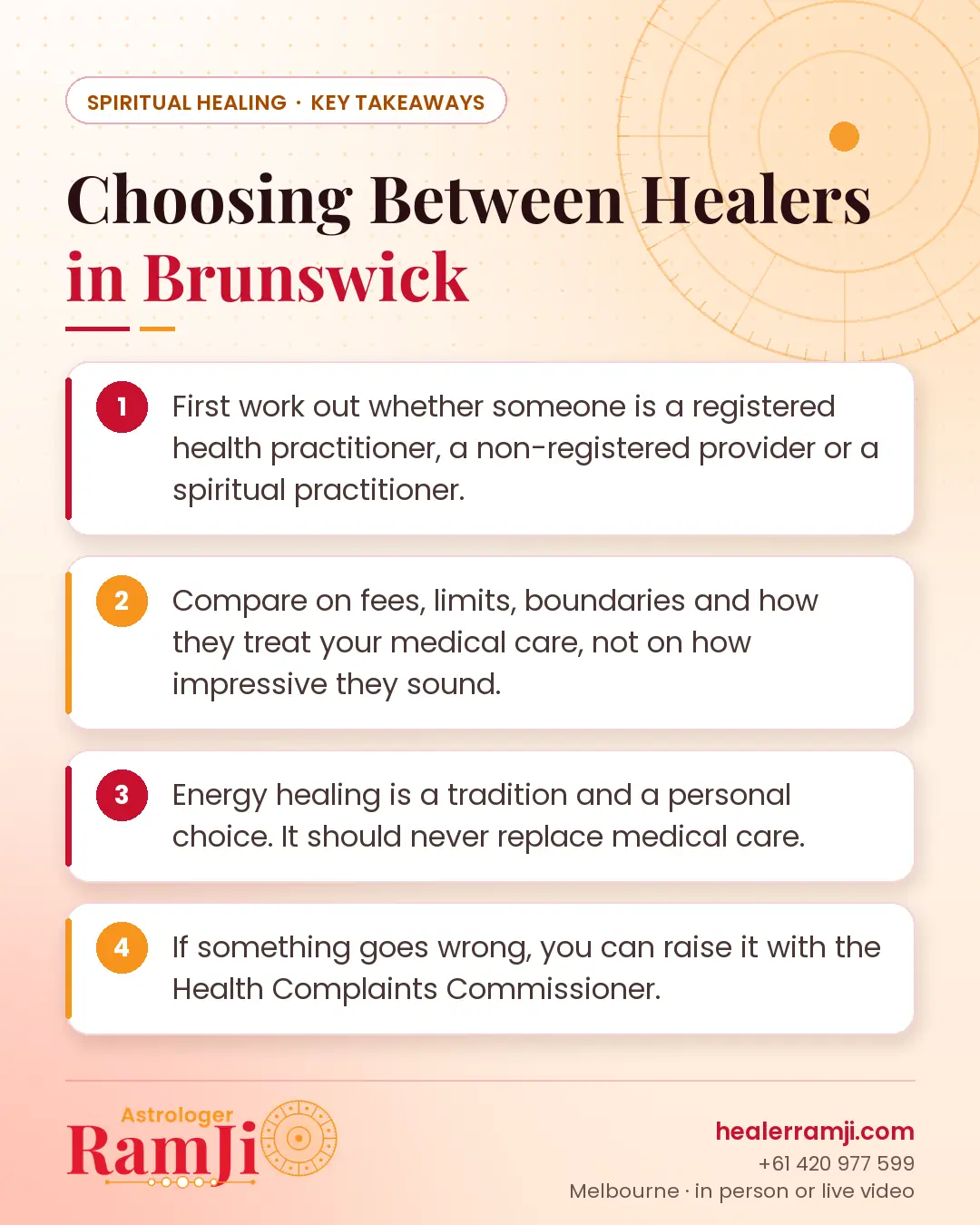
- First work out whether someone is a registered health practitioner, a non-registered provider or a spiritual practitioner.
- Compare on fees, limits, boundaries and how they treat your medical care, not on how impressive they sound.
- Energy healing is a tradition and a personal choice. It should never replace medical care.
- If something goes wrong, you can raise it with the Health Complaints Commissioner.
Who are you actually comparing?
Words such as "healer" and "therapist" can cover very different roles. A useful first step is to sort people into three broad groups:
- Registered health practitioners. Chinese medicine practitioners (including acupuncturists), chiropractors, osteopaths, physiotherapists and psychologists are registered through Ahpra, the national regulator. You can search its public register by name.
- Non-registered health providers. Victoria's Health Complaints Commissioner uses this term for people who aren't legally required to be registered, such as naturopaths, homeopaths, counsellors, massage therapists and alternative therapists. A code of conduct applies to them.
- Spiritual practitioners. This covers people offering prayer, mantra, energy work or blessing. Some of this is plainly religious practice, and some is sold as a way to feel better. The line isn't always sharp: the Commissioner gives reiki therapy as an example of general, non-registered work. Ask how they describe their own work.
Not being registered doesn't make someone unsafe, and being registered doesn't mean every service they offer is covered by that registration. It simply tells you which rules to look for. If someone holds a registration and also offers something outside it, ask which hat they are wearing during your session.

What should you compare between healers?
Try asking every person the same questions, so that you can compare the answers side by side:
- What do you actually do? Ask what a session involves and whether there is touch. A clear, plain answer is a good sign.
- What is your training? The Better Health Channel suggests asking any complementary practitioner about their training and qualifications at the first visit. For traditions with no formal register, ask who taught them and for how long.
- What does it cost? Ask for the full fee in writing, and ask what else might be recommended later.
- What can't this do? A straight answer here is one of the most useful things you can hear.
- Will you work alongside my doctor? The answer should be yes, without hesitation.
- What if I want to stop? You should be free to stop at any time, with no pressure and no warning about what may happen to you.
Then think about how you felt. Did you feel listened to, or sold to? Did they leave you time to think? It's fine to say "I'll let you know" and walk back out onto Sydney Road with no decision made.

What does the code of conduct say?
The Health Complaints Commissioner sets out what the general code requires. Among other things, it says these providers must provide safe and ethical care, obtain consent, keep appropriate records and comply with privacy laws. They must not:
- Mislead you about their products, services or qualifications
- Make false claims about curing serious illnesses such as cancer
- Discourage you from seeking other health care
- Exploit you financially
- Have an inappropriate relationship with you
This is a useful checklist even when you aren't sure the code applies. The full wording is in Schedule 2 of the Health Complaints Act 2016. Whether a particular spiritual service counts as a health service may depend on what is offered and claimed, so ask the Commissioner if you are unsure.
Which healer red flags apply anywhere?
These warning signs apply to any practitioner, in any suburb, and to any tradition:
- Telling you a problem is a curse that only they can remove
- Fees that climb after each session, or sudden requests for gold or large sums
- Promising a guaranteed result, or a set timeframe for recovery
- Telling you to stop medicine or skip a doctor's appointment
- Asking you to keep the work secret from family
- Touch you didn't agree to, or any sexual suggestion
- Using fear about your children, marriage or future to keep you coming back
One sign alone doesn't prove anything. But you don't need proof to walk away. Why to distrust get-your-ex-back promises looks at one common version of this pressure, and how to choose a spiritual healer safely goes through more checks.
Where does healing fit with medical care?
Energy healing and similar practices are traditions that some people find calming or meaningful. They haven't been proven to treat disease, and you can read an honest view of energy healing and evidence for more. The Better Health Channel says to be very cautious of any practitioner who advises you to abandon conventional treatment. It also says never to stop or change prescribed medicine without talking to your doctor, and to tell your doctor about any treatments or remedies you use.
If you are unwell, see your GP first. Why spiritual healing can't replace a doctor covers this briefly. Think of healing, if you choose it, as something that sits beside medical care and not in place of it.
What can you do if you have a concern?
You have options, and raising a concern doesn't mean you have to make a big accusation.
- Raise it with the provider first, if you feel safe doing that. The Commissioner suggests this as a first step.
- Contact the Health Complaints Commissioner. Its service is free and impartial, with an online form and a phone line on 1300 582 113. You can go straight to it if you can't approach the provider.
- Use Ahpra if your concern is about a registered practitioner.
- Try Consumer Affairs Victoria if the issue is about refunds or misleading selling. Report suspected scams to Scamwatch.
- Call Victoria Police if you have been assaulted or threatened, and Triple Zero (000) in an emergency. 1800RESPECT can help after sexual assault, on 1800 737 732.
How would these checks apply to us?
Exactly the same way. Vijay Ramji offers energy healing as a spiritual practice, and you should ask us every question on this page. The practice is based in Ascot Vale, in Melbourne's inner north-west. Sessions can be held by phone, WhatsApp or video, and fees are stated before any paid work. If you have questions, get in touch.
Related service
Keep reading

Five Quiet Minutes for Busy Parents in Mernda
A five-minute morning meditation for busy parents in Mernda, with an optional mantra, realistic places to fit it in, and where to turn when it isn't enough.
Read article →
Spiritual Practice in Retirement: Ideas From Croydon
Retired in Croydon and missing the shape of a work day? Simple ideas for a spiritual routine, mantra practice and purpose, with honest limits on what it can do.
Read article →
Keeping Your Practice Alive in Bendigo
Living far from Melbourne's big temples? Practical ideas for Hindu worship in Bendigo: a home altar, a simple mantra routine and ways to find others.
Read article →More from Inner North-West Melbourne

Second-Generation Couples in Brunswick and Family Traditions
A second-generation couple in Brunswick? How to sort family traditions into what you keep, adapt and renegotiate, and how to talk to parents without a blow-up.
Read article →
Cleansing a Kensington Townhouse Before Moving In
Moving into a Kensington townhouse? How to plan a short house blessing with neighbours through the wall, including timing, noise, smoke and what to skip.
Read article →
Remembering Someone by the Maribyrnong River
A quiet remembrance ritual for walking by the Maribyrnong River, with nothing left in the water. Where to walk, what to bring, and where to find support.
Read article →Local pages
Astrologer in Ascot Vale
Vijay Ramji is a Vedic astrologer and spiritual healer based in Ascot Vale, Melbourne. Sessions are held by phone, WhatsApp or video, booked in advance.
View area →
Astrologer for Moonee Ponds
For Moonee Ponds homes, leased offices and family matches. Vijay Ramji is based in Ascot Vale, with sessions held by phone, WhatsApp or video.
View area →
Astrologer for Essendon
For Essendon households weighing up renovations, parents and teenagers, or a mixed-faith family. Based in Ascot Vale, with sessions by phone, WhatsApp or video.
View area →Quick answers
What is energy healing?
Energy healing rests on the belief in a life force that can be guided. Here is what a session involves, and what the evidence does and doesn't show.
Read answer →Can spiritual healing replace a doctor?
Spiritual healing can't replace a doctor or prescribed treatment. Here is how to keep your faith alongside medical care, and which warning signs to watch for.
Read answer →Talk to Vijay Ramji
Tell us what you are facing. If a reading is unlikely to help, you will be told that plainly.