
Energy Healing and Evidence: An Honest View
Does energy healing work? The evidence so far is weak. A US government health agency says Reiki has not been clearly shown to work for any health purpose. Some small trials report short-term relief of pain or anxiety, but placebo effects may play a part, and there is no scientific evidence for the energy field itself.
We offer energy healing, so you might expect this page to tell you the science is on our side. It isn't, at least not in the way many websites suggest. We would rather you hear that from us than find out later.
This page sets out what research reviews have concluded, where the results look more hopeful, and why those hopeful results still come with warnings. It is a summary of published reviews, not medical advice.
Key takeaways
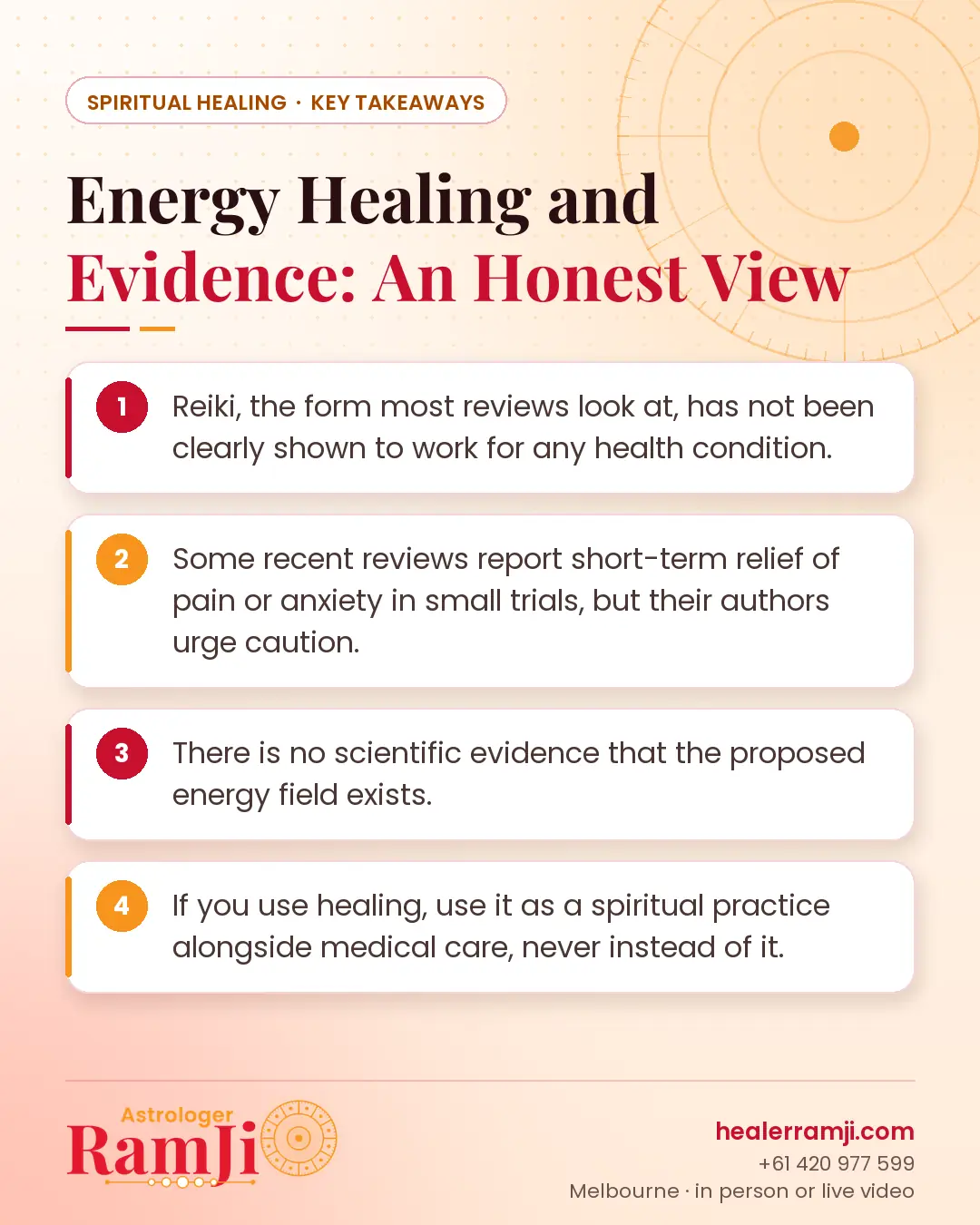
- Reiki, the form most reviews look at, has not been clearly shown to work for any health condition.
- Some recent reviews report short-term relief of pain or anxiety in small trials, but their authors urge caution.
- There is no scientific evidence that the proposed energy field exists.
- If you use healing, use it as a spiritual practice alongside medical care, never instead of it.
What does the research actually test?
"Energy healing" covers many practices. Most of the reviews we read look at Reiki, a Japanese method, or at therapeutic touch and distant healing. Far less can be said about Hindu traditions built around prana, mantra or chakra work, because results from Reiki trials don't automatically carry over to them. That cuts both ways. A Reiki study neither proves nor disproves another tradition's methods.
Keep that limit in mind as you read on. If you are curious about the traditional ideas themselves, our page on chakra myths is a good companion.
Does energy healing work? What the evidence says
Start with the plainest summary we could find. The US National Center for Complementary and Integrative Health says that Reiki "hasn't been clearly shown to be effective for any health-related purpose". It adds that most of the research "has not been of high quality, and the results have been inconsistent". It also says there is no scientific evidence supporting the existence of the energy field thought to play a role in Reiki. That page was last updated in 2018, so it doesn't cover the newer reviews below.
The same page says Reiki hasn't been shown to have any harmful effects. That is worth knowing, but the main risk lies elsewhere: delaying or dropping treatment that you need.
Cochrane, an independent group known for its careful reviews, looked at Reiki for depression and anxiety in 2015. It found only three studies, with very few people who actually had those conditions. Its conclusion was that there was "insufficient evidence" to comment on whether Reiki is useful for them. Please note what that means. It is not proof that Reiki fails. It means the question had not been properly answered.
Are there any positive findings?
Yes, and it would be dishonest to leave them out.
A 2024 meta-analysis in BMC Palliative Care, covering 824 adults, reported that Reiki reduced anxiety. It also noted that results were less consistent for people about to have surgery and for people with cancer. Its authors suggested that differences in treatment expectations might be one reason for the variation.
A 2026 review of Reiki in surgical care pooled 15 randomised trials with about 1,200 patients. It found lower pain after surgery at 24 and 48 hours, and lower anxiety and blood pressure at 48 hours, based on evidence it rated as moderate to low certainty.
The warnings matter as much as the findings. Those same authors pointed to the small number and size of the studies and the possible contribution of placebo effects. They wrote that routine use in standard care "cannot be recommended based on current evidence". If Reiki is used at all, they said, it should be a complement to established care and not a replacement.
So the fair reading is this: there are some encouraging signals about short-term comfort. There is no sound basis for saying that energy healing treats disease.

What about therapeutic touch?
Therapeutic touch offers a useful lesson in caution. Cochrane once published a review of it for healing acute wounds. It found no robust evidence that the practice helped. The review was then withdrawn in 2016, because of serious concerns over the validity of the included studies.
In other words, serious doubts hung over the underlying research. Results in this field are only as good as the trials behind them, which is why a single impressive study means little on its own.
What about distance healing and prayer?
A 2003 update of a systematic review, published by Edzard Ernst, concluded that newer and more rigorous trials shifted the weight of the evidence against the idea that distant healing is more than a placebo. Cochrane's 2009 review of prayer for the health of others said its evidence did not support a recommendation either in favour of or against it. A 2015 pair of meta-analyses by Roe and colleagues, in the journal Explore, did report a small positive effect, but also noted problems with study quality and with results that varied widely. So this remains disputed, and it is far from settled in healing's favour. We cover the practical side in how distance healing sessions are run.
None of this tells you whether prayer has value in your life. Research on health outcomes can't measure faith, meaning or comfort. It can only test narrower claims about illness.
Why is this research so hard to do?
Some of the difficulty is built in:
- Blinding is tricky. The healer always knows whether they are giving real or pretend healing, and patients often guess too.
- Many outcomes are self-reported. Pain and anxiety are real, but they are also shaped by attention, expectation and a calm setting.
- Trials tend to be small. Small studies can swing widely by chance.
- Methods vary. Sessions differ in length, number and style, which makes results hard to compare.
Why can a session feel helpful anyway?
There are ordinary explanations worth considering. You rest. Someone gives you their full attention. You are in a setting that holds meaning for you. Many symptoms also ease naturally over time, and people tend to seek help when they feel at their worst.
A good experience is still a good experience, and you don't need a study to value it. It just isn't evidence that anything physical has changed, so don't let it talk you out of seeing a doctor.
What should you do with all this?
If energy healing appeals to you as part of your spiritual life, here is a sensible way to approach it:
- Keep your GP and specialists at the centre of any health decision. Read whether healing can replace a doctor (it can't).
- Never stop or change medication because of a session. Our guide on healing alongside treatment explains how to raise it with your doctor.
- Spend only what you can comfortably afford, and be wary of anyone who cites "studies" without naming them.
- Ask a healer what they think a session can't do. The answer will tell you a lot.
Our energy healing sessions are offered on those terms, as a spiritual practice and not as treatment. For health questions, speak to your GP or call healthdirect on 1800 022 222. If you would like to ask us anything about this page, please get in touch.

Related service

Keep reading
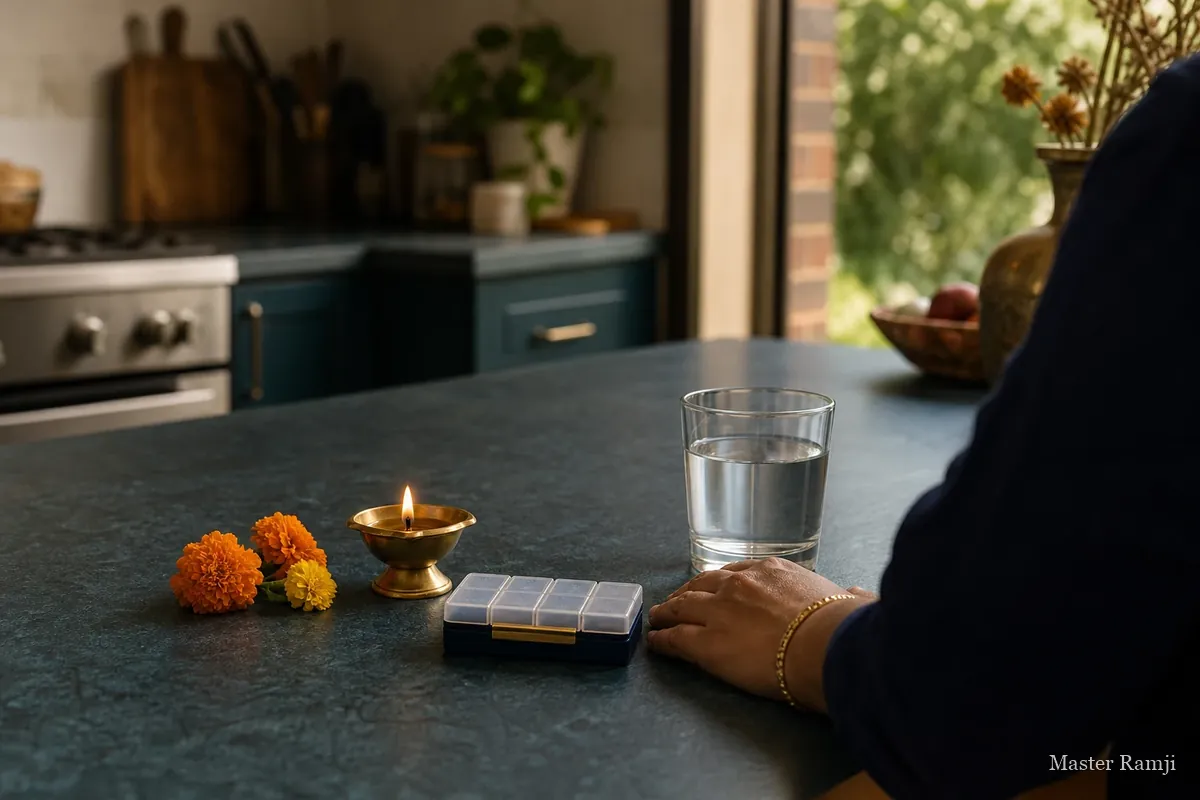
Using Spiritual Healing Alongside Medical Treatment
How to use spiritual healing alongside medical treatment safely: what to tell your doctor, why you never stop medication, and the warning signs in a healer.
Read article →
How Distance Healing Sessions Are Run
What a distance healing session involves: how it is set up by phone or video, what to ask beforehand, what privacy to expect, and the limits of remote work.
Read article →
The Seven Chakras Explained Simply
The seven chakras explained in plain language: what each name means, where tradition places it, which parts are old and which are modern, and what chakras cannot do.
Read article →Quick answers
What is energy healing?
Energy healing rests on the belief in a life force that can be guided. Here is what a session involves, and what the evidence does and doesn't show.
Read answer →Can spiritual healing replace a doctor?
Spiritual healing can't replace a doctor or prescribed treatment. Here is how to keep your faith alongside medical care, and which warning signs to watch for.
Read answer →Talk to Vijay Ramji
Tell us what you are facing. If a reading is unlikely to help, you will be told that plainly.