
Is It the Right Time to Ask for a Promotion?

Astrology can suggest periods that the tradition reads as better for visibility or growth, but it can't tell you when a promotion will come. Use any timing as a deadline for preparing your case: results, feedback and a clear request. Your employer's review cycle and budget usually matter more than any planetary period.
You've been doing the bigger job for months. Your manager seems happy. Still, you hesitate, because asking feels risky and the timing never seems right. Some people turn to their chart at this point, hoping it will tell them when to speak up.
A chart can play a part, but a smaller one than many hope. This article explains what astrology timing can and can't add, and how to use it to sharpen your case without letting it take the place of one.
Key takeaways
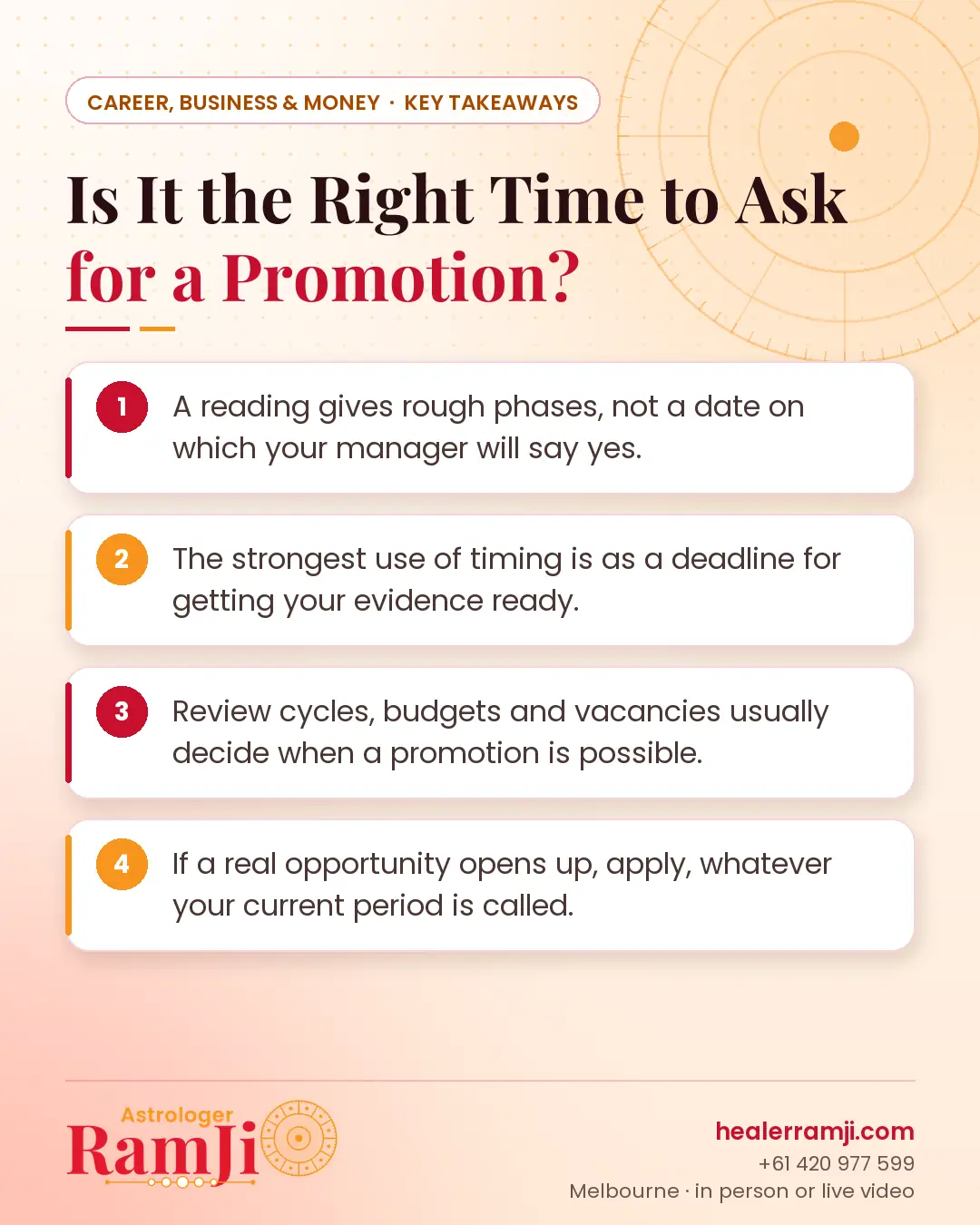
- A reading gives rough phases, not a date on which your manager will say yes.
- The strongest use of timing is as a deadline for getting your evidence ready.
- Review cycles, budgets and vacancies usually decide when a promotion is possible.
- If a real opportunity opens up, apply, whatever your current period is called.
What can a chart say about promotion timing?
In Vedic astrology, a reader usually starts with your dasha timeline, the sequence of planetary periods worked out from the Moon's position at birth. They then look at the tenth house, linked with career and public standing, and the eleventh, linked with gains. Slow transits, mainly Saturn and Jupiter, are added on top.
From this, a reader might describe the next year as one the tradition links with visibility and recognition, or as one better suited to steady work and building skills. That's the extent of it. Readers can disagree about the same chart, and an uncertain birth time can move dasha dates by months or more. Our guide to what the tenth house says about career explains the main factors.
Astrology is a traditional practice and hasn't been shown to predict careers. Nothing in a chart can see your company's budget, your manager's plans or who else has applied.
What actually decides whether you are promoted?
Before thinking about planets, it helps to be honest about the real factors. They usually include:
- Whether a higher role exists, or can be created
- When your organisation sets budgets and runs performance reviews
- How clearly your manager, and their manager, can see your results
- Whether you are already doing parts of the next role
- How the request is made, and when
Many Australian organisations plan budgets around the financial year, which runs from 1 July to 30 June, but plenty use other cycles. Find out how yours works. A request made after salaries are set can be harder to approve, however good the case.

How can timing help you prepare instead?
Here is a practical way to use a reading. Treat a growth-leaning period as the date your case should be ready, not the date you expect an automatic yes. Treat a slower period as time for gathering evidence and filling gaps.
A solid case usually has four parts:
- Results. Projects delivered, problems solved, money saved or earned. Use figures wherever you honestly can.
- Scope. Responsibilities you've taken on beyond your current position description.
- Feedback. Emails or comments from colleagues, clients or other teams.
- A clear request. The role, title or level you are asking for, and what you'd do in it.
Keep it to one page. A manager who has to argue for you with their own boss will find a short, factual summary far easier to pass on than a long email.
Ask your manager early what the next level requires. That conversation is useful in any period, and the answer gives you a checklist to work through before the formal request.
What if the reading says wait, but the job is advertised now?
Apply. Opportunities follow their own timetable, and a vacancy may not come back for years. A period described as slow in a reading is not a reason to stay silent when a real role opens up. It may be a reminder to prepare thoroughly, ask for feedback and keep your expectations calm.
The reverse is also true. A period called favourable doesn't make a weak case strong. If you haven't yet done the work, the best use of a good period may be to start building it.

Does Saturn mean you should hold back?
Not necessarily. Saturn periods are often described with words like discipline, duty and patience, and some people read that as "no progress". In practice, many people take on more responsibility in exactly these years, and that responsibility often becomes the evidence for a later promotion. Our piece on what Saturn periods can teach about work looks at this more closely.
What if you are turned down?
Ask what would need to change, and by when. Write the answer down and agree to revisit it. A no with a clear path is useful information. A no with no reasons, repeated over years, may be telling you it's time to look elsewhere.
If you are thinking about moving on, our short answer on whether a chart can show a good time to change jobs covers what to check before you resign. If the problem is a difficult relationship with a manager, understanding your own patterns in workplace conflict may help, while serious bullying needs action now, not a better period.
Avoid anyone who says a promotion depends on buying a gemstone or paying for a ritual. Nothing supports that, and money spent this way is better kept.
Where else can you get help?
For questions about pay rates, classifications and entitlements, the Fair Work Ombudsman is the place to check. A union or an employment lawyer can advise on your situation. For free career planning, Victoria's Skills and Jobs Centres offer career, employment and training support.
Can a career reading help?
If you'd like to see how the next few years are read in your chart, a career timing reading sorts them into periods that may suit growth and periods that may suit consolidation, and then tests that against your real commitments. It's reflection, not employment advice. Sessions can be held by phone, WhatsApp or video, and fees are stated before any paid work. To ask about one, get in touch.
Related service
Keep reading

Starting a Side Business While Employed
Thinking of starting a side business while you keep your job? Check your employment contract and registrations first, then choose an astrology timing for launch.
Read article →
Starting a Business in Dandenong: Timing and Practical Steps
Planning a shop on or near Foster Street? How to start a business in Dandenong with council and lease checks first, and a muhurat that fits the real dates.
Read article →
Burnout in a City Job: What a Chart Can and Can't Tell You
Worn out by a Melbourne CBD job? See a GP first, then look at support at work. What career astrology can and can't add once your health is being looked after.
Read article →Quick answers
Can astrology help me choose a career?
Astrology can prompt useful questions about work, but it can't pick your career. Here is what a chart may suggest, its limits, and who to ask for real advice.
Read answer →Which house shows career in Vedic astrology?
In Vedic astrology, the tenth house is the main house of career. Here is what else a reader looks at, where views differ, and what a chart can't tell you.
Read answer →Talk to Vijay Ramji
Tell us what you are facing. If a reading is unlikely to help, you will be told that plainly.