
Burnout in a City Job: What a Chart Can and Can't Tell You

If a Melbourne CBD job has left you exhausted, see a GP first, and ask about support at work. Burnout is a workplace problem with real help available. A chart cannot diagnose it or say when you will feel better. Career astrology may offer a way to reflect on timing, later, as a tradition only.
You get off at Flinders Street or Southern Cross, walk to your building on Collins or Bourke, and sit down already tired. The weekend no longer fixes it. You catch yourself dreading emails, or feeling nothing about work you used to care about.
If that has gone on for a while, this page has one main message: start with your health. Astrology comes second, if it comes at all. People do ask whether burnout and career astrology have anything to say to each other, and we'll get to that. But a chart is not where this should begin.
Key takeaways
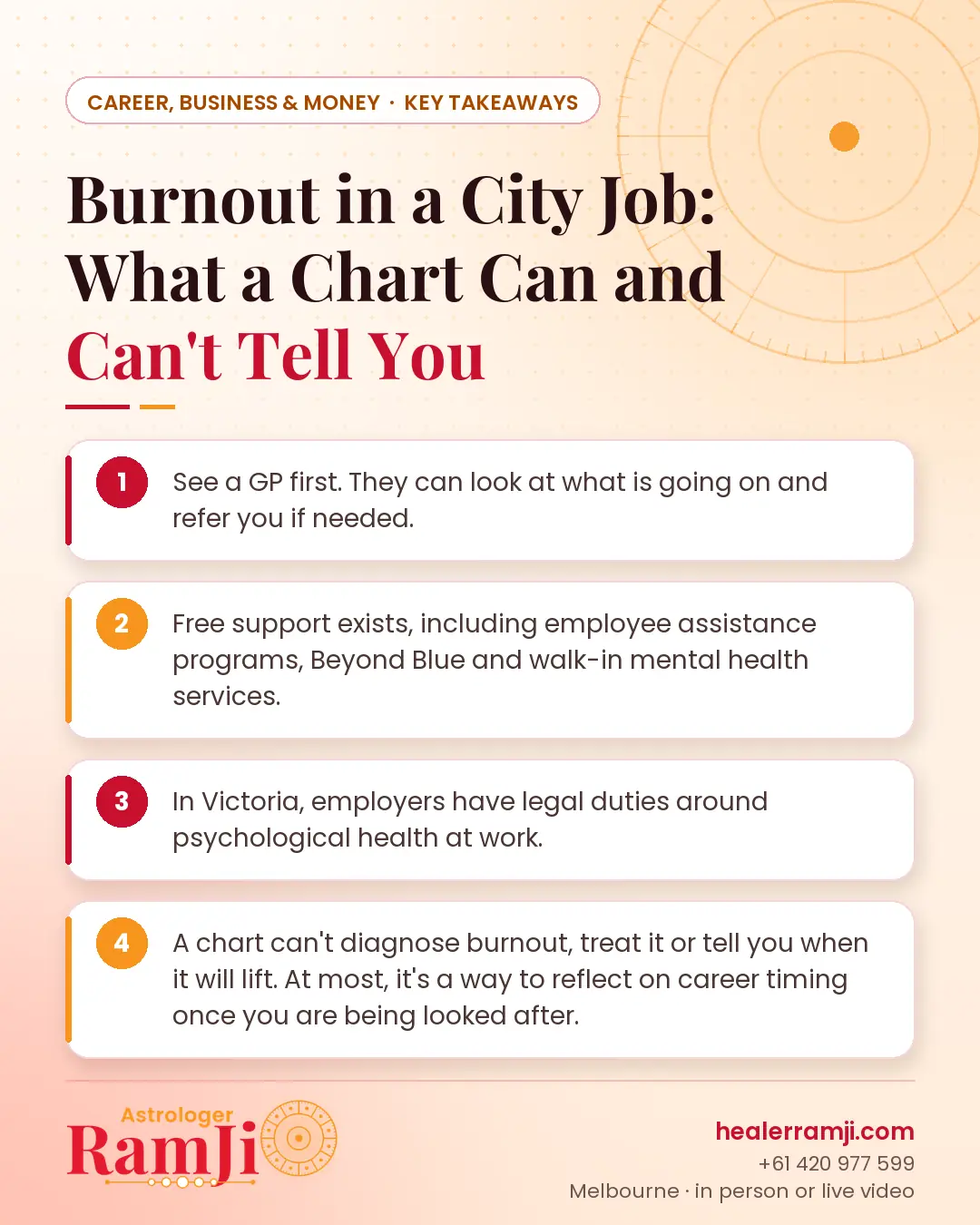
- See a GP first. They can look at what is going on and refer you if needed.
- Free support exists, including employee assistance programs, Beyond Blue and walk-in mental health services.
- In Victoria, employers have legal duties around psychological health at work.
- A chart can't diagnose burnout, treat it or tell you when it will lift. At most, it's a way to reflect on career timing once you are being looked after.
What is burnout?
The World Health Organization describes burn-out as resulting from "chronic workplace stress that has not been successfully managed". It lists three features: exhaustion, growing mental distance or cynicism about your job, and reduced professional efficacy. The WHO says it is an occupational phenomenon and "not classified as a medical condition".
That doesn't make it minor. It also doesn't mean tiredness and low mood are always burnout. They can have many causes, and working that out is a job for a health professional, not for you alone at 2 am, and certainly not for an astrologer.
Who should you see first?
Your GP. The Better Health Channel lists a GP first among the places to go for help with stress, alongside a psychologist or counsellor and community mental health services. Healthdirect's advice is similar: if workplace stress is getting too much, see your doctor, who may refer you on.
A few things can make that visit easier:
- Book a longer appointment. Ask for one when you ring, and say it's about stress and exhaustion.
- Choose what you can actually reach. A GP near home often beats one near work, as you won't be rushing back to your desk. Some clinics offer telehealth.
- Write down the basics. Note how long it's been going on, how you are sleeping, how many hours you work, and anything you've stopped doing.
Not sure where to go? Healthdirect can advise you on 1800 022 222. If you are thinking about harming yourself or you feel unsafe, please don't wait for an appointment. Call Lifeline on 13 11 14 at any hour, or 000 in an emergency.

What other support is there?
- Your employee assistance program. Many larger employers have one. Healthdirect notes these provide counselling and are usually free to use. Ask HR, or look on your intranet, if you'd rather not ask anyone.
- Beyond Blue. It has information on burnout at work, and support on 1300 22 4636.
- Medicare Mental Health Centres. These are free, with no referral or appointment needed, and hours vary by centre. The official website has a map.
- Mental Health and Wellbeing Locals. This is a free Victorian service for people aged 26 and over, with no GP referral needed. The Better Health Channel points out that they aren't crisis services.
Check the official finders for your nearest centre of either kind. The closest may be nearer your home than your office, which could suit you better anyway.
What can you ask of your workplace?
You aren't only asking a favour. Victoria's Occupational Health and Safety (Psychological Health) Regulations started on 1 December 2025. WorkSafe Victoria asks employers to take practical steps to manage psychosocial risks, and its list of hazards includes bullying and work-related fatigue.
The Better Health Channel suggests that talking to a manager or HR can help. You might raise your workload, your hours, or a deadline pattern that keeps repeating. A health and safety representative, if your workplace has one, or your union can also help. Keep your own notes of what was said and when.
For questions about leave, hours or being contacted after work, try the Fair Work Ombudsman, or a lawyer if things have become serious. We can't give legal advice, and neither can a chart.
Small things in your day have their place too. Taking your lunch away from your desk, perhaps as far as the Flagstaff Gardens, is a reasonable thing to do. It isn't a treatment, and it won't fix an unsafe workload.

Should you resign right now?
Maybe, eventually. But exhaustion is a hard state to make a large decision in, and resigning has financial consequences you should look at clearly. Talk with your GP about how you're going, and with a registered financial adviser if money is tight. If you leave, you want it to be a decision and not an escape from a bad week. That holds whatever a chart seems to say.
So what can a chart actually tell you?
Here is the second part, and it should stay second. In Vedic astrology, a reader might look at the tenth house, which is traditionally linked with career, and at your current dasha period. Many people also ask about Saturn and slow years at work, because the tradition describes Saturn as heavy and demanding.
Some people find this gives them a way of thinking. For example, a reader might frame a period as one traditionally read as consolidation, and ask what you want to build once you are well. It is a tradition and a belief. It hasn't been shown to predict work outcomes, and you are free to set it aside.
What can't a chart tell you?
- Whether you have burnout, depression or anything else
- Why you are tired, or what you should take for it
- When you will feel better
- Whether your workplace is meeting its legal duties
- Whether a specific job, promotion or pay rise is coming
When should you walk away from a reader?
An ethical reader will ask whether you have seen a GP, and will take your exhaustion seriously before looking at any chart. Be wary of anyone who:
- Tells you to skip a doctor, or stop any treatment
- Says Saturn is punishing you and you simply have to push through
- Claims a gemstone or ritual will fix your health or your job
- Names a date when everything will turn around
- Uses your tiredness to sell you something costly
When might a career timing reading make sense?
Later, and only if it interests you. A good moment is when you have health support in place, you can think clearly, and you're weighing a real decision: staying, changing teams, studying or moving on. A career timing reading can offer one more angle on that, without promising dates or outcomes. If you'd like company through a hard stretch rather than a forecast, spiritual support in hard times is a conversation, and it isn't counselling or medical care.
Sessions can be held by phone, WhatsApp or video, and what you share stays confidential. A short session around your work day is possible, though a rushed break in the middle of a bad week isn't the best time. For other city guides, see our CBD and inner south page. When you feel ready, you can get in touch.
Related service
Keep reading

Launching a Trade Business in Epping: Date and Paperwork
Starting a trade business in Epping? How to pick a launch date without delaying your ABN, licences or insurance, and what a business muhurat can and can't do.
Read article →
Staying or Leaving After Study in Geelong
Finishing at Deakin Waurn Ponds? How to weigh a career after study in Geelong against moving to Melbourne, using real job ads, commute tests and honest questions.
Read article →
Vastu and Timing for a Small Office in Moonee Ponds
Leasing a small office in Moonee Ponds? Check the lease and heritage rules first, then use vastu and muhurta for desk placement and a simple, quiet opening.
Read article →More from Melbourne CBD and Inner South
Vastu When Your Southbank Apartment Faces the Wrong Way
Is a south-facing Southbank apartment bad in vastu? Why fixed facing is no catastrophe, what the tradition says, and what you can sensibly change in a tower.
Read article →
Smoke-Free Rituals in Docklands Apartments
Living in a Docklands apartment? How owners corporation rules and fire alarms affect incense and lamps, plus smoke free home cleansing that still feels real.
Read article →
Visiting the Hare Krishna Temple in Albert Park
Visiting the Hare Krishna temple on Danks Street in Albert Park? What to wear, how to get there, what happens inside, and how it differs from other temples.
Read article →Local pages

Quick answers
Can astrology help me choose a career?
Astrology can prompt useful questions about work, but it can't pick your career. Here is what a chart may suggest, its limits, and who to ask for real advice.
Read answer →Which house shows career in Vedic astrology?
In Vedic astrology, the tenth house is the main house of career. Here is what else a reader looks at, where views differ, and what a chart can't tell you.
Read answer →Talk to Vijay Ramji
Tell us what you are facing. If a reading is unlikely to help, you will be told that plainly.