
Rahu and Ketu Explained Without the Fear
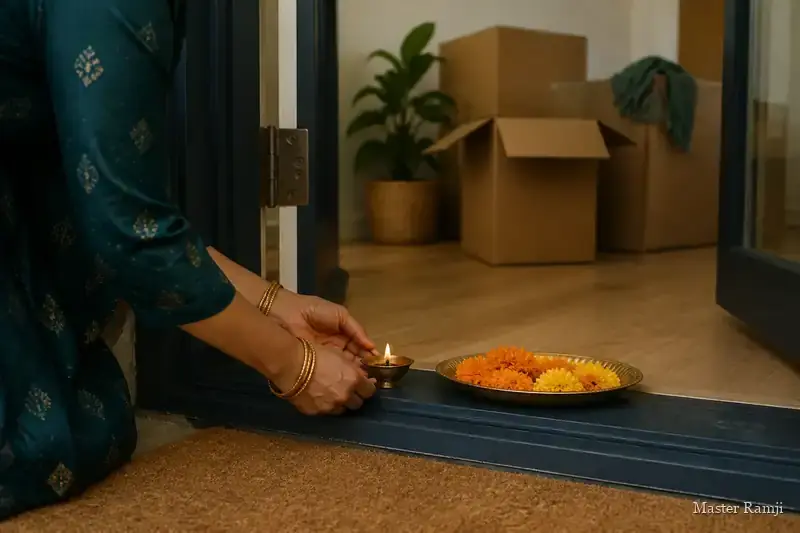
Rahu and Ketu are the two lunar nodes, the points where the Moon's path crosses the Sun's. Vedic astrology counts them as shadow grahas. Rahu is usually read as desire, hunger and the unfamiliar, and Ketu as detachment and letting go. Together they describe a pull between wanting more and having had enough.
Few parts of a Vedic chart cause as much worry as Rahu and Ketu. People hear that Rahu is "sitting on" their seventh house, or that a Ketu period will take everything away, and they leave a reading more anxious than they arrived.
This guide looks at what the two nodes actually are, how the tradition describes them, and a calmer way to read them. Think of them as a pair that shows where you reach for more and where you are learning to let go.
Key takeaways
- Rahu and Ketu are not physical bodies. They are two points on the Moon's orbit, always exactly opposite each other.
- Rahu is linked with appetite, ambition and the new. Ketu is linked with detachment, insight and loss of interest.
- They are best read as one axis across two houses, not as two separate threats.
- No placement of the nodes condemns you, and no ritual is needed to survive one.
What are Rahu and Ketu, astronomically?
The Moon's orbit is tilted slightly against the path the Sun appears to take through the sky. The two lines cross at two points, called the lunar nodes. In astronomy, the point where the Moon crosses heading north is the ascending node, which Jyotish calls Rahu. The point where it crosses heading south is the descending node, or Ketu.
These points are not fixed. According to NASA's explanation of the Moon's orbit, the nodes slowly move westward, completing one full circuit in about 18.6 years. That is why Vedic astrology describes Rahu and Ketu as moving backwards through the zodiac, and why each stays in a sign for roughly a year and a half.
The nodes also explain eclipses. A solar or lunar eclipse can only happen when the Sun and Moon line up close to one of these crossing points. Ancient observers noticed the link long before anyone could explain it.
Where does the story of the severed head come from?
The best-known myth comes from the churning of the ocean, the Samudra Manthan. As the account of Rahu retells it, an asura named Svarbhanu slipped in among the gods and drank the nectar of immortality. The Sun and Moon exposed him, and Vishnu, in the form of Mohini, cut off his head with his discus. Because he had already tasted the nectar, he did not die. The head became Rahu and the body became Ketu.
The story says Rahu chases the Sun and Moon and swallows them, which is how the tradition explained eclipses. Having no body, he cannot hold them, and they slip free again.
It is a vivid image, and it has shaped the frightening reputation of the nodes. Read another way, it is a story about hunger that can never be satisfied, and about a body that carries on without a head. That is close to how many astrologers describe the pair today.

What does Rahu mean in a chart?
Rahu is the head without a body. It is often described as appetite: the wish for more, for status, for experience, for whatever is foreign or unconventional. Classical writing links Rahu with deception, confusion and excess, and it is counted as a natural malefic.
That does not make it simply bad. Rahu is also linked with ambition, technology, travel and stepping outside the expected path. Plenty of migrants, career changers and people who built something from nothing could describe their lives in Rahu terms. The difficulty comes when wanting turns into restlessness, or when chasing one thing crowds out everything else.
What does Ketu mean in a chart?
Ketu is the body without a head. It is usually read as detachment, withdrawal, sudden loss of interest and spiritual seeking. Many astrologers describe the house Ketu occupies as an area where you already feel experienced, or oddly indifferent. Some describe it as skill carried over from past lives, a belief that not everyone shares.
Ketu's difficult side is a sense of emptiness or of pulling away too early. Its gentler side is clarity. It can show where you are able to let go of what no longer matters.

Why read them as an axis?
Because they are always exactly opposite, Rahu and Ketu always fall in opposite houses. Reading them together turns two scary labels into one question: where am I reaching, and what am I releasing in order to reach it?
A few generic examples show the idea:
- First and seventh houses. A pull between building your own identity and investing in partnership.
- Fourth and tenth houses. A pull between home and family on one side, and career and public standing on the other.
- Second and eighth houses. A pull between steady security and sudden change or shared resources.
Which side is Rahu and which is Ketu changes the emphasis, but the point is balance. Our guide to the nine grahas shows how the nodes fit alongside the other seven.
What happens in a Rahu or Ketu period?
In the Vimshottari system, Rahu's major period lasts 18 years and Ketu's lasts 7. Our short answer on what a dasha is explains how these periods are set from your birth star. Many people never live through a full Rahu period at all, depending on where they started.
A Rahu period is often described as busy, hungry and expansive. A Ketu period is often described as quieter, with a shift away from old goals. Neither is a sentence. A dasha analysis looks at where the node sits, which sign it is in and which grahas it is with, because a node is said to take on the qualities of its company. If a period already feels heavy, getting through a difficult dasha offers practical steps.
What about Rahu and Ketu transits?
As the nodes move into new signs about every eighteen months, the axis shifts through your houses. A Saturn and Jupiter transit reading often touches on the nodes as well, since they add context to the slower planets. Eclipses near your Moon or rising sign are watched closely by some astrologers. Others give them little weight. Traditions differ, even on basics such as the sign where Rahu is strongest.
Should you worry about kaal sarp dosh?
Kaal sarp dosh is a label given when all seven other grahas fall on one side of the Rahu and Ketu axis. It is often sold with dramatic warnings. Astrologers disagree about it, and some say it has no firm basis in the older texts. Even those who use it weigh it against the whole chart.
If you have been told you have it and must pay for an urgent remedy, slow down. Ask how the conclusion was reached and get a second opinion. Nothing in the tradition requires you to decide that day.
What can the nodes not tell you?
Astrology is a traditional way of reflecting, not a science. NASA can tell you where the nodes are. It cannot tell you that they shape your life, and no evidence shows that they do. The nodes cannot predict illness, accidents, a visa result or a court case. They cannot tell you what another person intends.
What they can offer is a useful question. Where in your life are you hungry for more, and where are you ready to let go? If you would like to look at your own axis in the context of your chart, get in touch.
Related service
Keep reading
Saturn's Return in Vedic Astrology
How Vedic astrology reads Saturn's return around the late twenties and late fifties, why the dates differ from Western charts, and what to do with those years.
Read article →
What a Jupiter Transit Actually Changes
Jupiter transit effects in Vedic astrology, explained plainly: why a good transit is read as an opening, not a reward, and how to use one without overreaching.
Read article →
Sade Sati Myths That Cause Needless Fear
Common sade sati myths set against what Vedic tradition actually says, from the idea that it ruins every life to the third-round scare. Calm and practical.
Read article →Quick answers
What is a kundli?
A kundli is a Vedic birth chart that maps the planets at your exact time and place of birth. Here is what it shows, in plain words.
Read answer →What details do I need for a kundli reading?
A kundli reading needs your date, time and place of birth, plus a clear question. Here is how exact each detail should be, and what to do if one is missing.
Read answer →Talk to Vijay Ramji
Tell us what you are facing. If a reading is unlikely to help, you will be told that plainly.