
Ten Questions to Bring to Your First Reading
Good questions to ask an astrologer are specific and testable. Name the decision you face, ask which part of the chart an answer comes from, how confident the reader is, how your birth time affects it, and what would show it is wrong. Ask about any remedy's cost and whether a free option exists.
Most people come to a first reading with a feeling rather than a question. Something is unsettled, and they hope the chart will name it. A good reader can work with that, but you will get far more from the session if you arrive with a few clear questions written down.
This page gives you ten questions to ask an astrologer, so you can choose the ones that fit. Some are about your own life. Others are about how the reader reaches their answers, which is just as useful to know.
Key takeaways
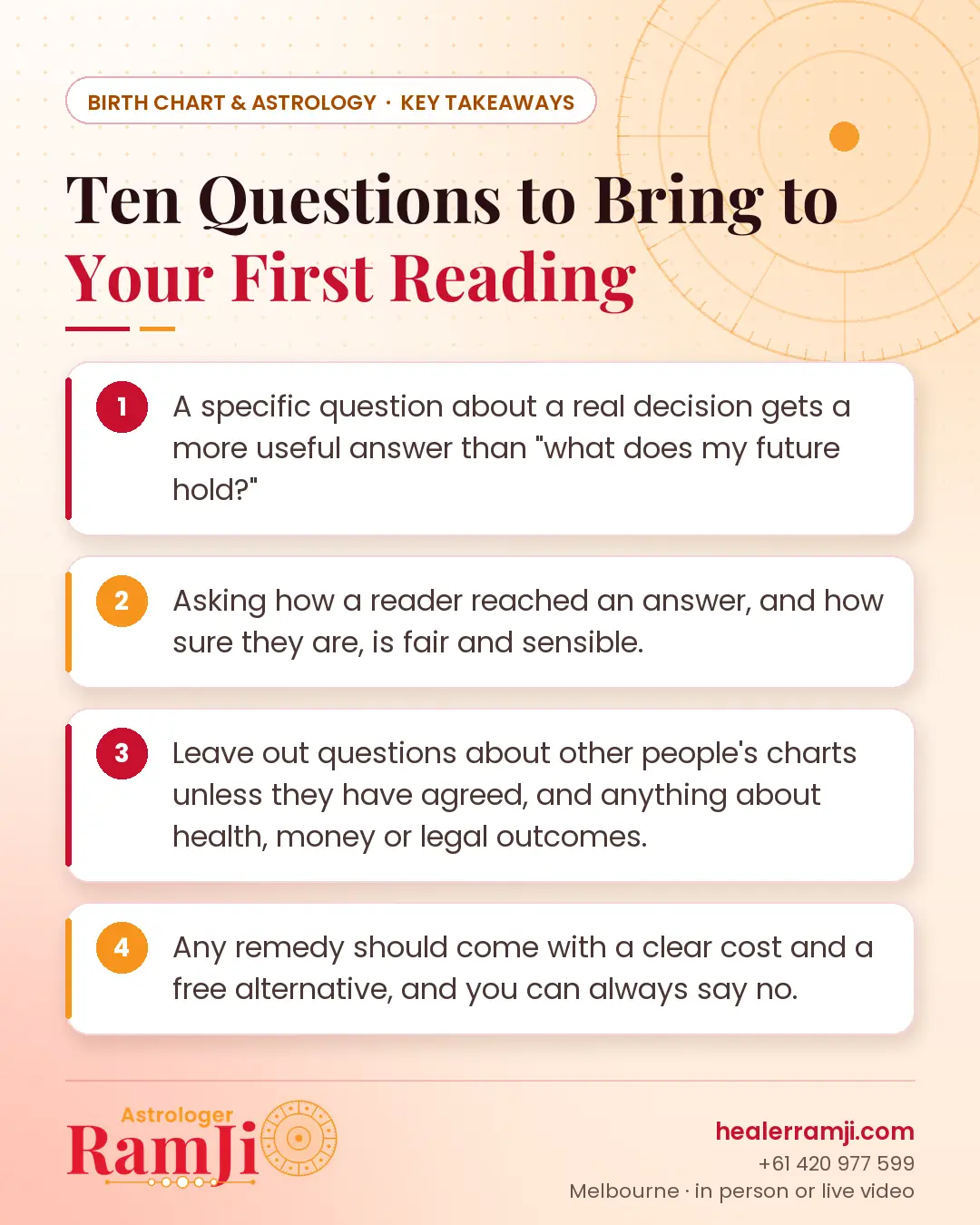
- A specific question about a real decision gets a more useful answer than "what does my future hold?"
- Asking how a reader reached an answer, and how sure they are, is fair and sensible.
- Leave out questions about other people's charts unless they have agreed, and anything about health, money or legal outcomes.
- Any remedy should come with a clear cost and a free alternative, and you can always say no.
How do you turn a worry into a question?
Start with the thing that keeps you up at night, then ask what decision sits underneath it. A few generic examples:
- "Will I ever be happy at work?" becomes "I have an offer to move teams. Does this period suit a change, or a wait?"
- "When will I get married?" becomes "What does my chart suggest about the kind of partnership I tend to build?"
- "Why does everything go wrong?" becomes "Which period am I in now, and what themes does the tradition link with it?"
The second version of each gives the reader something to work with. It also keeps the decision with you, which is where it belongs.
What are the ten questions?
You won't need all of them. Pick three or four that fit your situation.
- "Here is the decision I'm weighing. What in my chart speaks to it?" Lead with your real situation. A reader who knows the context can focus on the parts of the chart that matter.
- "How sure can we be of my birth time, and what does that change?" Some parts of a chart shift with a few minutes of error. If your time came from a relative's memory, the reader should say which conclusions are shaky. Our guide to why accurate birth details matter explains how much can move.
- "Which part of the chart is that coming from?" A planet, a house, a dasha or a transit. You don't need to follow every term, but a reader should be able to point to something.
- "How confident are you about that, and would other astrologers agree?" Schools of Jyotish differ on many points. An honest reader will tell you when a view is mainstream and when it is their own.
- "What would show this reading is wrong?" Statements that fit everyone feel personal but tell you little. Psychologists call this the Barnum effect: people rate vague, general descriptions as accurate when told they were written for them. A good question pushes past it.
- "Which period am I in, and what does the tradition link with it?" Vedic astrology divides life into planetary periods. Ask for themes rather than events, and ask how the dates depend on your birth time.
- "What is in my hands here?" A reading that leaves you feeling powerless hasn't helped. Ask what you can actually do this month, however small.
- "Is there anything I shouldn't decide on the strength of this reading?" A careful reader will name the limits themselves, such as medical, financial or legal choices.
- "If you suggest a remedy, what is it, what will it cost, and is there a free version?" Many traditional practices cost nothing. Our short answer on whether remedies have to cost money is worth reading beforehand.
- "Do I need to come back, and if so, why?" One session is often enough. If a follow-up is suggested, you should hear what it would add.
Which questions are best left out?
Some questions sound natural but lead nowhere good:
- Someone else's chart without their consent. An ex, a partner who hasn't agreed, a boss or a sibling. Their birth details are theirs, and a reading done behind their back isn't fair to them.
- Dates of death or illness. No chart can tell you these, and a frightening answer can stay with you for years.
- Diagnoses, investments, court cases and visas. These belong with a GP, a licensed adviser, a lawyer or a registered migration agent.
- "Will they come back to me?" A chart can't read another person's mind, and it can't make anyone return. A better question is what you want to do next for yourself.
How should you listen during the reading?
Take notes, or ask whether you may record the call for your own use. Memory tends to keep the dramatic lines and drop the qualifications, such as "possibly" or "traditions differ here".
When something doesn't fit, say so. A reading is a conversation, and correcting the reader often leads to a more useful answer. If a statement makes you anxious, ask straight away what it is based on and how certain it is. You are allowed to stop and think.
Notice how the reader responds to questions. Someone who gets annoyed when you ask "how do you know?" is telling you something about the reading.

What should you do after the reading?
Give yourself a day or two before acting on anything. Read your notes and sort them into three groups: things that matched your experience, things that didn't, and things you can't yet judge. Only the first group deserves much weight.
Talk any big decision through with someone you trust who wasn't on the call. Our article on using a reading as a prompt rather than an instruction goes into this in more depth.
Be wary if you leave with a deadline, a fear and a price attached. Scammers often create urgency so you pay before you think, and Scamwatch is the place to report it if that happens.
What can a first reading realistically offer?
Astrology is a tradition and a belief system. It isn't a science and hasn't been shown to predict events, as our answer on whether astrology can predict the future explains. What it can offer is a structured way to reflect on a decision, a period or a pattern, using a framework many families have trusted for generations.
A kundli reading is the usual starting point. Bring your birth details, the source of your birth time, and the three or four questions above that matter most to you. Vijay Ramji is based in Ascot Vale, appointments are arranged in advance, and sessions can be held by phone, WhatsApp or video. Fees are stated before any paid work. When your questions are ready, get in touch.
Related service
Keep reading

Why a Muhurat from India May Not Work in Melbourne
Why a muhurat worked out for India can't simply be converted to Australian time: local sunrise, day length, the rising sign and daylight saving all change it.
Read article →
What to Expect at a First Reading in Ascot Vale
Booking a first reading with an astrologer based in Ascot Vale? How it works by phone, WhatsApp or video, what to prepare, and what a reading cannot do.
Read article →
A Reading on Your Lunch Break: How It Works in the CBD
How to fit an astrology reading into a lunch break in the Melbourne CBD: one question, a phone or video session, a private spot, and what to leave for later.
Read article →Quick answers
What is a kundli?
A kundli is a Vedic birth chart that maps the planets at your exact time and place of birth. Here is what it shows, in plain words.
Read answer →What details do I need for a kundli reading?
A kundli reading needs your date, time and place of birth, plus a clear question. Here is how exact each detail should be, and what to do if one is missing.
Read answer →Talk to Vijay Ramji
Tell us what you are facing. If a reading is unlikely to help, you will be told that plainly.